ZETA Releases EV Battery Recycling Whitepaper
The rise of electric vehicles (EVs) marks one of the biggest transformations in transportation history. By replacing gasoline with clean electricity, EVs help reduce greenhouse gas emissions, improve air quality, and pave the way for a more sustainable future. But powering millions of EVs also brings a new challenge: what happens to their batteries once they reach the end of their life?
Most modern EV batteries are designed to last 10–15 years, but as adoption grows, more used batteries will eventually need to be repurposed or recycled. That’s where EV battery recycling comes in, a critical part of creating a truly circular clean energy economy.
EV batteries contain valuable materials like lithium, nickel, cobalt, manganese, and copper. Mining and refining these materials is energy-intensive and has environmental impacts. Recycling not only prevents old batteries from ending up in landfills but also allows manufacturers to recover and reuse these materials, reducing the need for new mining. In fact, experts say recycling could supply a significant share of the raw materials needed for future EVs, lowering costs and emissions across the supply chain.
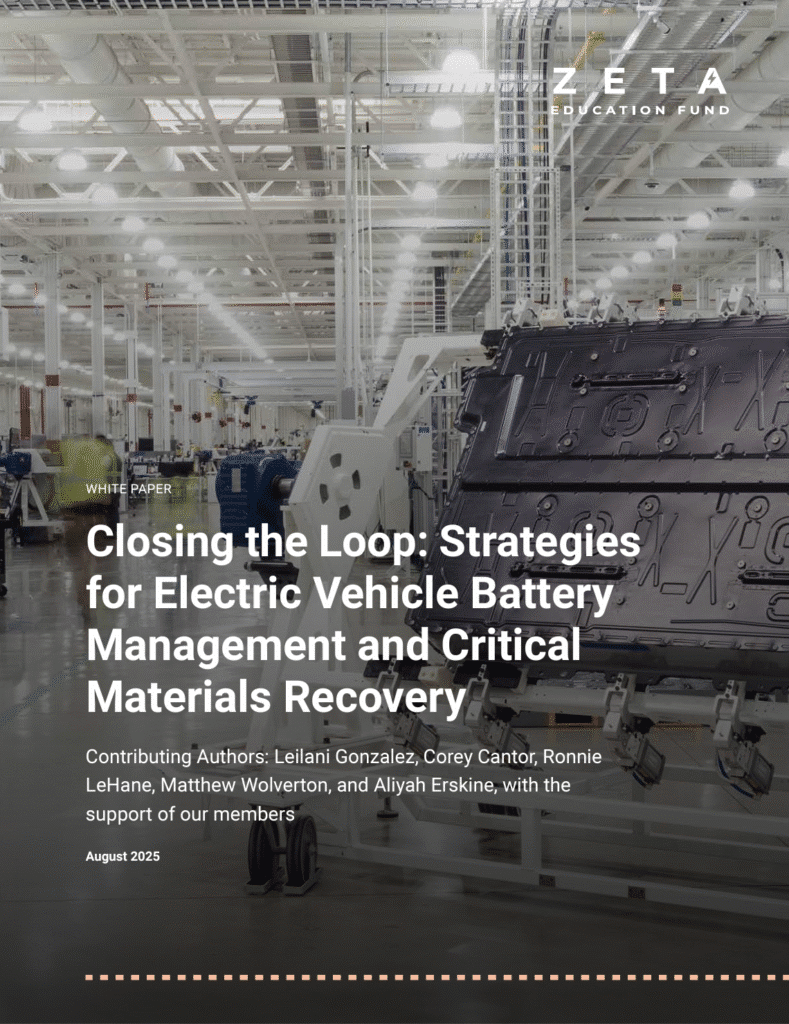
Closing the Loop: Strategies for Electric Vehicle Battery Management and Critical Materials Recovery
ZETA released a new whitepaper in August 2025, titled Closing the Loop: Strategies for Electric Vehicle Battery Management and Critical Materials Recovery. Contributing Authors Leilani Gonzalez, Corey Cantor, Ronnie LeHane, Matthew Wolverton, and Aliyah Erskine collaborated, with the support of ZETA members.
Battery recycling is rapidly becoming a cornerstone of the energy economy and a critical enabler of U.S. energy security, industrial resilience, and supply chain independence. As electric vehicle (EV) adoption accelerates, the ability to recover and reuse high-value minerals from used batteries is essential to maintaining global competitiveness and building a secure, circular economy.
Recycling not only reduces dependence on foreign-controlled supply chains but also helps stabilize manufacturing costs and generate new economic opportunities across the nation. However, several challenges stand in the way of large-scale adoption.
Transportation bottlenecks, unclear liability frameworks, fragmented regulations, and the absence of consistent standards for collection and processing all pose risks to progress. Overcoming these barriers will require a coordinated national strategy that strengthens domestic recycling infrastructure, promotes uniform rules, and ensures that batteries remain within U.S. industrial ecosystems where their value can be maximized.
Second Life Before Recycling
Before being dismantled for recycling, many EV batteries still retain up to 80% of their original capacity. This makes them perfect candidates for “second-life” applications, such as stationary energy storage for homes, businesses, or renewable energy projects. By extending their use, we get more value out of each battery while easing the demand for new storage technologies.
EV battery recycling and repurposing are brand-new industries, as only in the last few years have EV batteries reached the end of their useful lives in powering EVs.
In July, EVinfo.net reported that In a move poised to accelerate the growth of U.S. energy storage capacity, General Motors has signed a non-binding memorandum of understanding with Redwood Materials to collaborate on the deployment of advanced storage systems using both new and second-life EV batteries.
The Road Ahead for Repurposing and Recycling EV Batteries
With supportive policies and growing consumer awareness, EV battery repurposing and recycling will soon become a mainstream part of the EV ecosystem.
EVs are helping drive us toward a zero-emission future, and battery repurposing and recycling ensures that progress is truly sustainable. The more we recycle and repurpose, the closer we get to a world where the clean energy transition doesn’t just replace fossil fuels, it reuses and regenerates the very materials that power it.
The Zero Emission Transportation Association (ZETA) is a federal coalition dedicated to accelerating the transition to electric mobility by strengthening every link of the EV supply chain. Through strategic advocacy, ZETA works to advance policies that expand electric vehicle adoption, foster the creation of hundreds of thousands of jobs, and ensure that American manufacturing remains a global leader in the rapidly growing EV market.