Australia Debuts World’s Largest Land-Mobile Batteries Equipped Electric Locomotive
Australia has taken a major step toward decarbonizing heavy rail, as Fortescue introduced electric locomotives equipped with the world’s largest land-mobile batteries. The mining company says deploying the first two units will cut diesel consumption by roughly one million liters per year.
Built by Progress Rail, a Caterpillar company, the battery-electric locomotives will soon enter service hauling iron ore from Fortescue’s Pilbara mining operations to ports in Western Australia. While passenger rail is often electrified on high-traffic routes, freight operations in remote regions have long relied on diesel. Fortescue’s move highlights how battery-electric technology can significantly reduce emissions in heavy-haul and industrial transport where full network electrification is impractical.
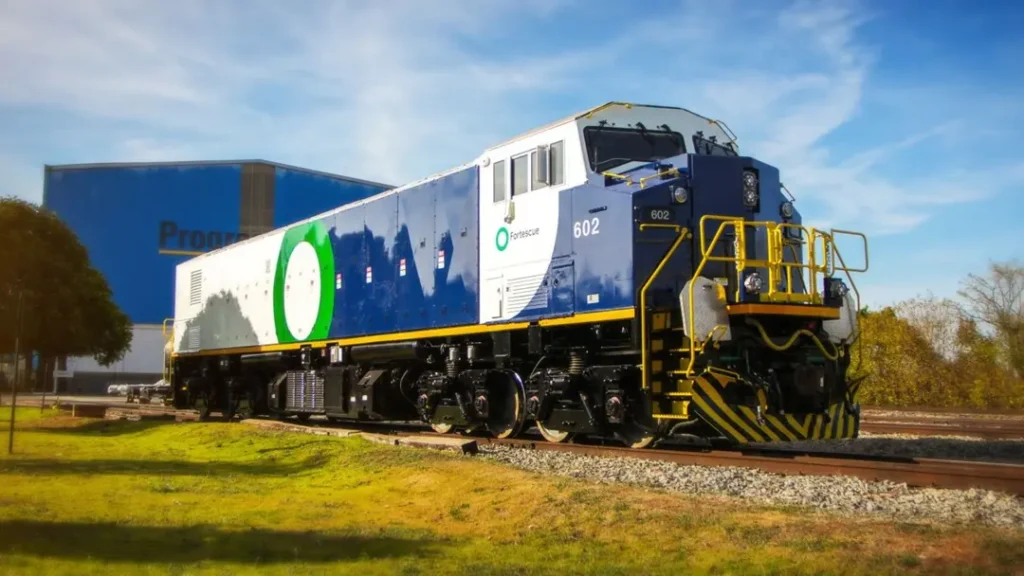
The locomotives were manufactured in Sete Lagoas, Brazil, and form a key part of Fortescue’s plan to achieve zero emissions across its Pilbara mining operations by the end of the decade. Each eight-axle locomotive carries a 14.5 MWh battery, making it the largest land-mobile battery system in operation. Regenerative braking allows the units to recover up to 60% of energy on downhill runs, improving overall efficiency. They can be charged at up to 2.8 MW, enabling fast operational turnarounds, with Fortescue planning to supply electricity from its own renewable energy assets.
Although originally scheduled for delivery in 2023, the first locomotive arrived in June, followed by the second earlier this month, both landing at Port Hedland before deployment to the Pilbara. Fortescue CEO Dino Otranto described the locomotives as “operational assets” that demonstrate what is now possible for heavy-haul rail.
Other miners are following suit. BHP recently received battery-electric haulage locomotives from Wabtec, featuring 7 MWh batteries and regenerative braking. Together, these projects signal a broader shift toward battery-electric rail, helping reduce emissions in mining and long-haul freight while advancing a cleaner future for the rail industry.
Electric Locomotives Are Gaining Momentum Worldwide
Electric locomotives are rapidly emerging as a critical solution in the global push to decarbonize heavy transportation. Long dominated by diesel power, particularly in freight and mining operations, rail is now undergoing a meaningful transformation as battery electric and hybrid electric locomotives move from pilot projects to real world deployment across multiple continents.
One of the primary drivers is emissions reduction. Rail accounts for a significant share of freight related carbon emissions, especially on long haul routes and in remote regions. Battery electric locomotives offer a way to eliminate diesel use on these routes while delivering immediate reductions in greenhouse gases, particulate matter, and noise pollution. When paired with renewable electricity, they can operate with near zero lifecycle emissions.
These locomotives use regenerative braking to recover energy on downhill grades, significantly improving efficiency and reducing overall energy demand.
Advances in battery technology are accelerating adoption. Higher energy density, improved thermal management, and falling costs are making large format rail batteries more viable. At the same time, modular designs allow locomotives to be tailored to specific routes and duty cycles, improving return on investment for operators.
Policy and regulation are also playing a role. Governments are tightening emissions standards for non road mobile machinery, including locomotives, while offering incentives for low and zero emission equipment. Combined with rising diesel costs and corporate net zero commitments, the economic case for electric locomotives is strengthening.