Ford Reveals New UEV Platform Secrets
Ford announced the next chapter in the company’s EV journey on February 17, 2026, on its official website.
Ford’s upcoming Universal Electric Vehicle platform is scheduled to launch in 2027, beginning with a midsize electric pickup expected to start around $30,000. Despite the aggressive pricing target, Ford says the truck will still deliver the features modern EV buyers expect, including a front trunk, ample passenger space, competitive range and performance, and advanced software.
If warnings from Ford leadership about rising competition from Chinese automakers are accurate, the success of this platform is critical. Ford has recently scaled back several other EV initiatives, placing even more pressure on the UEV program to deliver both affordability and profitability. During the media briefing, Ford executives outlined new details about the truck, the platform underpinning it, and how the company plans to pass cost savings directly to customers while finally producing a profitable EV.

Starting With a Truck and Making It Slippery
Ford executives say the strategy begins with a straightforward idea. Americans love trucks, so leading electrification efforts with an electric pickup made sense. However, that only works if the electric option offers a clear advantage over internal combustion alternatives.
The Ford F-150 Lightning struggled in this regard. It closely resembled its gasoline counterpart but came with a higher price and reduced endurance. Ford says it is determined not to repeat that mistake.
Instead, the UEV platform debuts with a vehicle positioned closer to a battery electric version of the Ford Maverick. While some traditional truck buyers question whether the Maverick qualifies as a true truck due to its car-based platform and softer proportions, its sales success has validated the approach.
Ford expects the UEV truck to blur that line even further. Aerodynamics were treated as a foundational requirement rather than a secondary consideration. Engineers prioritized reducing drag and frontal area to minimize battery size while still meeting range targets. Because batteries remain the most expensive component in an EV, improving efficiency became the primary path to cost reduction.
Design iterations relied heavily on rapid prototyping, with small aerodynamic gains accumulating into meaningful efficiency improvements. Ford also introduced an internal system that assigned direct battery cost impacts to individual engineering decisions, reinforcing the financial consequences of design tradeoffs.
The resulting truck is expected to be approximately 15 percent more aerodynamically efficient than the Maverick, currently one of the most efficient pickups on the market. That level of efficiency suggests softened edges and airflow-focused bodywork that may challenge traditional expectations of truck design. Ford maintains that the vehicle will still deliver the utility expected of a compact pickup, even if its final form looks unconventional.

“The Best Part Is No Part”
Veterans from other EV companies now working inside Ford brought with them a familiar philosophy. The best part is no part. The second-best part is one that performs multiple functions.
One example is the side mirrors. Instead of separate motors for adjustment and folding, the UEV mirrors use a single shared motor. This allowed Ford to shrink the mirror assembly by more than 20 percent. According to the company, that change alone contributes roughly 1.5 miles of additional driving range.
Ford claims the combined effect of these decisions makes the UEV truck more aerodynamically efficient than any comparable pickup currently on sale.
Using Software to Cut Cost
Ford leadership argues that true affordability depends on becoming a software-defined vehicle company. While consumers may not care about architectural distinctions, they benefit directly from lower cost, faster updates, and better features.
Traditional vehicles rely on dozens of electronic control units, many developed by suppliers that do not communicate seamlessly. By contrast, companies like Rivian use centralized computing systems and control the full software stack.
For Ford, legacy practices initially carried over into early EVs. Eliminating redundant ECUs and excessive wiring significantly reduces cost and complexity. In the UEV platform, software interactions are handled by centralized controllers and domain-specific systems such as the E-Box, which consolidates power management and charging hardware.
Ford owns the entire software stack on the UEV platform, enabling consistent over-the-air updates and long-term feature expansion. Executives say customers will see a vehicle that is affordable without feeling stripped down and one that improves over time.

Over-the-Air Updates That Actually Matter
Many legacy automakers advertise over-the-air update capability, but real-world execution has been inconsistent. Updates are often delayed, limited in scope, or fragmented across model lines.
Ford attributes this to two issues. First, inconsistent hardware and software architectures force updates to be rolled out piecemeal. Second, supplier-controlled software requires extensive human coordination before updates can be deployed.
Executives contrast this with the UEV platform, which will support up to eight vehicles on a common software foundation. By eliminating what Ford calls “people putty,” engineers can focus purely on functional execution rather than supplier coordination.
LFP Batteries and a 400-Volt System
The UEV platform uses lithium iron phosphate batteries, a chemistry dominant in China due to its lower cost, longer life, and improved thermal stability. While less energy dense than nickel-based alternatives, Ford says its domestically produced LFP cells will be the cheapest available in the U.S.
Ford also chose a 400-volt electrical architecture rather than moving to 800 volts. While higher voltage systems enable faster charging, they also significantly increase cost. Ford determined that affordability mattered more than peak charging speed for this vehicle.
Upgraded Electronics and Driver Assistance
Although battery costs were tightly constrained, Ford modernized the vehicle’s electronics. The UEV platform introduces Ford’s first 48-volt low-voltage system, reducing wiring mass while supplying more power to critical systems like advanced driver assistance.
Ford says the platform will eventually support hands-free or eyes-off driving, though details on sensors and timelines remain limited. Given broader industry pullbacks on autonomy promises, the company acknowledges that this capability should be viewed cautiously for now.
The Battery as the Floor
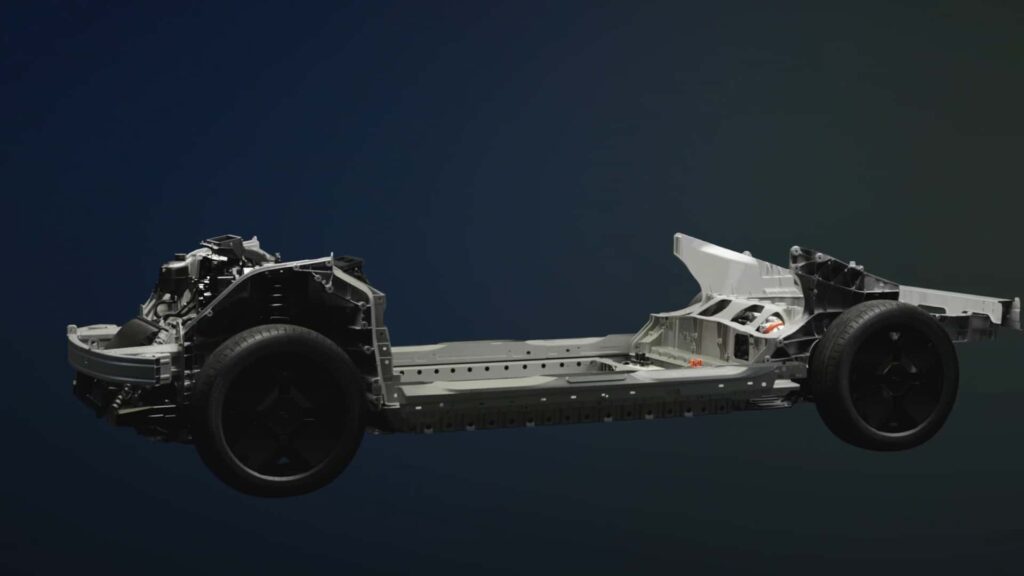
The UEV platform also features Ford’s first structural battery pack. While not a full cell-to-body design, the pack serves as the vehicle floor, with seats and interior components bolted directly to it. This eliminates redundant structures, lowers the roofline, and improves aerodynamics without requiring a larger battery.
A Fully Integrated Approach
Ford engineers emphasize that modern EV design requires holistic optimization. Legacy vehicle programs were siloed, with competing priorities negotiated late in development. The UEV platform instead treats efficiency, cost, software, and hardware as interconnected from the outset.
Ultimately, Ford’s claims will be judged by execution. Delivering a highly efficient, software-driven electric truck at a $30,000 starting price would represent a major shift for the company. Whether the UEV platform can meet those expectations will become clear once production vehicles arrive.
EVinfo.net’s Take: This is Encouraging News From Ford
Ford’s newly released details about its Universal Electric Vehicle platform are genuinely encouraging. For the first time in years, the company appears to be aligning its EV strategy with the fundamentals that have driven success for EV leaders. We were glad to see our great friend and well-known EV expert Loren McDonald, CEO and Chief Analyst at Chargeonomics participate in the event.
Most notably, the UEV platform is designed from the ground up as an electric vehicle. This marks a clear break from Ford’s earlier approach of adapting gasoline vehicle architectures for EV use. Ford is also adopting a structural battery pack, integrating the battery into the vehicle’s floor instead of treating it as a separate component.
The platform introduces a 48-volt low-voltage electrical system, reducing wiring complexity. The UEV platform is a true software-defined vehicle, enabling meaningful over-the-air updates that apply across multiple models. Aerodynamics also play a larger role than in past Ford trucks.
The targeted starting price of around $30,000 matters. High-priced EVs may attract early adopters, but they do little to materially expand adoption in North America. If Ford can deliver a genuinely capable, efficient, and software-rich electric truck at this price point, the UEV platform could represent a meaningful step toward making EVs a mass-market reality rather than a premium niche.
This news, and a whole host of other factors, mean mass EV adoption is finally coming to the stubborn USA soon. It’s absolutely inEVitable.

Electric Vehicle Marketing Consultant, Writer and Editor. Publisher EVinfo.net.
Services