GM Leads in Fast-Growing V2H, VGIC Gives 2025 Year in Review
General Motors is expanding the role of electric vehicles (EVs) beyond transportation. In 2025, GM ranked as a top two EV seller in the United States and delivered more than 246,000 vehicles equipped with hardware capable of powering a properly outfitted home during an outage.
Through GM Energy, GM offers vehicle-to-home capability that integrates compatible EVs with home energy management systems. When paired with approved equipment, these systems allow the vehicle to supply backup power if the grid fails, effectively turning the EV into a mobile energy resource.
To broaden adoption, GM Energy is evaluating a leasing model for its home energy management systems and PowerBank stationary batteries. Rather than requiring a large upfront payment, homeowners would have the option to pay a monthly fee, similar to a vehicle lease. The structure is intended to lower initial cost barriers and align with common household budgeting practices. Additional program details are expected closer to launch.
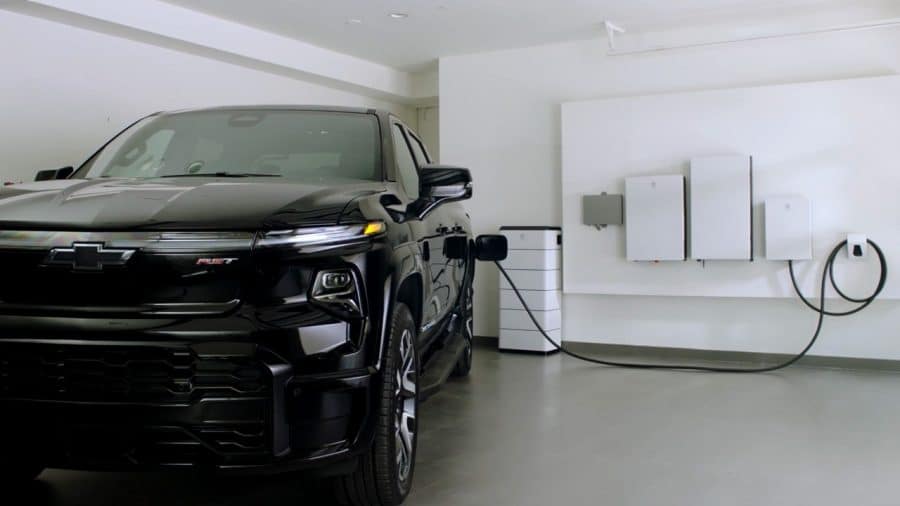
Energy resilience and cost control are key drivers for adoption. For example, GM reported on customers who combined rooftop solar, battery storage, and GM EVs to secure backup power while managing energy expenses and qualifying for utility incentives. Other GM EV owners have maintained power during hurricanes along the Gulf Coast and wildfire-related outages in the West. Some reduce electricity costs by charging overnight at lower rates and drawing on stored energy during peak pricing periods.
In Texas, GM’s Free Charge Nights program with Reliant Energy supports overnight charging strategies. Meanwhile, Pacific Gas and Electric Company is piloting vehicle-to-everything programs that allow EVs to export power to homes, the grid, or other devices, with incentives of up to $4,500 available for eligible customers using qualifying GM Energy products.
Compared with traditional gasoline generators, these systems operate quietly and require no annual engine maintenance. GM Energy has also completed positive internal testing for vehicle-to-grid functionality and is working with utilities on certification processes. The long-term objective is an integrated energy ecosystem in which vehicles, homes, and the electric grid operate as coordinated assets rather than isolated systems.
V2H and V2G Are Scaling Rapidly, Redefining Transportation and Energy
Vehicle-to-home (V2H) and vehicle-to-grid (V2G) technologies fall under the vehicle-to-everything (V2X) umbrella, and are moving from pilot programs to commercial deployment across the United States and international markets. As electric vehicle adoption accelerates, automakers, utilities, and regulators increasingly view EVs not just as transportation assets, but as distributed energy resources capable of stabilizing grids, reducing peak demand, and enhancing household resilience.
From Mobility Asset to Energy Asset
Modern battery electric vehicles typically carry 60 to 200 kWh of energy storage. For context, the average U.S. home consumes roughly 25 to 30 kWh per day. That means a single EV, when paired with a compatible bidirectional charger and home integration system, can power essential household loads during outages or shift energy usage away from peak pricing periods.
In the U.S., companies such as General Motors are developing V2H or bidirectional capabilities across portions of their EV portfolios. Utilities including Pacific Gas and Electric Company and Duke Energy are running pilots that compensate customers for exporting power back to the grid during peak demand events.
Globally, momentum is even more pronounced. Japan has long supported V2H as part of its disaster resilience strategy, while countries in United Kingdom and Netherlands are advancing V2G aggregation models that allow fleets of EVs to participate in grid balancing markets.
Economic and Grid Implications
The rapid growth of renewables has increased variability in power generation. Solar output peaks midday, while residential demand often peaks in the evening. V2G-enabled EVs can absorb excess renewable generation and discharge during high-demand windows, effectively acting as mobile storage nodes.
For consumers, the value proposition includes:
- Backup power during outages
- Peak shaving and time-of-use arbitrage
- Participation in demand response programs
- Potential utility incentives and compensation
For grid operators, aggregated EV fleets represent a scalable, distributed flexibility resource that can reduce reliance on peaker plants and improve frequency regulation.
Infrastructure and Policy Acceleration
Congresswoman Julia Brownley (CA-26) reintroduced the Bidirectional Electric Vehicle Charging Act, legislation that would accelerate the deployment of bidirectional charging technology for electric vehicles (EVs) and electric buses in November 2025. In April 2024, Maryland was the first US state to pass vehicle-to-grid legislation. The act also enables the creation of distributed energy resource (DER) virtual power plants that pool the capabilities of home solar PV, batteries, smart thermostats, and other equipment.
State-level pilot programs are accelerating deployment. Standardization of bidirectional charging protocols and the expansion of smart metering infrastructure are reducing technical barriers. Meanwhile, fleet operators are beginning to evaluate V2G participation as a revenue stream rather than simply a resilience feature.
VGIC’s 2025 in Review: More Products, Clearer Rules, Better Deployment Models
Zach Woogen of the Vehicle-grid integration council reviewed the progress in 2025 of vehicle-grid integration (VGI) solutions on December 17, 2025.
In 2025, vehicle-grid integration shifted decisively from niche pilot programs to mainstream deployment. Public awareness expanded significantly, with coverage in major national media outlets and increased engagement from governors, regulators, and utility commissions. The conversation moved beyond feasibility toward scaling access and customer participation.
Product Expansion and Grid-Parallel Charging
A major milestone was the growth of residential bidirectional charging systems designed for grid-parallel operation, not just backup during outages. Automakers including Ford Motor Company, Volvo Cars, Polestar, Kia, and Hyundai Motor Company launched or expanded bidirectional offerings that enable time-of-use optimization, demand response participation, and real-world testing of utility interconnection processes.
Interconnection Progress
States advanced clearer rules for V2G participation:
- Maryland implemented comprehensive V2G interconnection standards.
- Michigan clarified that islanded-only systems do not require interconnection review.
- California advanced alternative certification pathways and continued refinement of Rule 21 for bidirectional systems.
Additional policy activity emerged in Nevada, Texas, New York, and Massachusetts.
New Deployment Models
2025 also marked a transition from small demonstrations to larger deployment initiatives that reduce upfront costs. In Massachusetts, a state-backed V2X program covers equipment and installation for select participants. In Connecticut and California, incentive-backed programs lowered barriers to entry, including targeted efforts within Pacific Gas and Electric Company’s service territory.
Meanwhile, utilities collaborated on best practices for managed charging program design to ensure scalability, customer simplicity, and long-term durability.
What to Watch in 2026
Two themes are expected to define the next phase:
1. Financeable Business Models
States including New York, Colorado, Virginia, and Illinois are advancing reforms to enable durable compensation for managed charging and V2G participation. Rate design evolution, virtual power plant expansion, and integration into existing DER programs are positioning VGI for scalable revenue pathways.
2. Standards and Interconnection Alignment
Key technical standards supporting V2G AC interconnection are nearing completion. Once finalized, utilities are expected to incorporate these standards into formal interconnection processes, enabling a repeatable, safety-aligned pathway for bidirectional deployment.
Overall, 2025 marked a structural inflection point. VGI moved beyond theory into tangible products, clearer rules, and scalable programs. With stronger policy frameworks, improving standards, and expanding financial incentives, 2026 is poised to accelerate the transition from early adoption to mainstream grid integration.
A Converging Future
The convergence of transportation electrification and distributed energy management marks a structural shift in how energy systems are designed. Vehicles are becoming dynamic grid participants rather than passive loads. Homes are evolving into micro energy hubs. Utilities are transitioning from centralized generation models to network orchestration.
As V2H and V2G scale, the implications extend beyond backup power or utility bill savings. The integration of millions of mobile batteries into the grid could fundamentally reshape load management, renewable integration, and energy security.
The result is a more resilient, decentralized, and interactive energy ecosystem where transportation and power infrastructure operate as a unified system rather than separate domains.

Electric Vehicle Marketing Consultant, Writer and Editor. Publisher EVinfo.net.
Services