Waymo’s Aim to Raise About $16 Billion in Financing Will Supercharge US EV Adoption
Waymo is aiming to raise about $16 billion in a financing round that would value it at nearly $110 billion, Bloomberg News reported. Reuters reported the news on January 31, 2026.
Alphabet unit Waymo is aiming to raise about $16 billion in a financing round that would value it at nearly $110 billion, Bloomberg News reported, citing people familiar with the matter. Alphabet is the parent company of Google.
Alphabet would provide about $13 billion to the autonomous driving firm, while the remainder would come from investors including Sequoia Capital, DST Global, and Dragoneer Investment Group, the report added. In December last year, The Information reported that Waymo was in talks to raise money at a valuation of at least $100 billion.
Waymo, which Alphabet carved out of Google’s self-driving car project in 2016, is the only operator in the United States offering paid robotaxi services with no safety drivers or in-vehicle attendants. It operates a fleet of more than 2,500 vehicles. This move underscores the accelerating race to commercialize fully autonomous vehicles, as leading players invest heavily and focus on safety, technology refinement, and regulatory cooperation to gain market share.
The United States auto safety agency said on Thursday that it has opened an investigation after a Waymo self-driving vehicle struck a child near an elementary school in Santa Monica, California, last week. The incident caused minor injuries and renewed concerns about the safety of robotaxis.
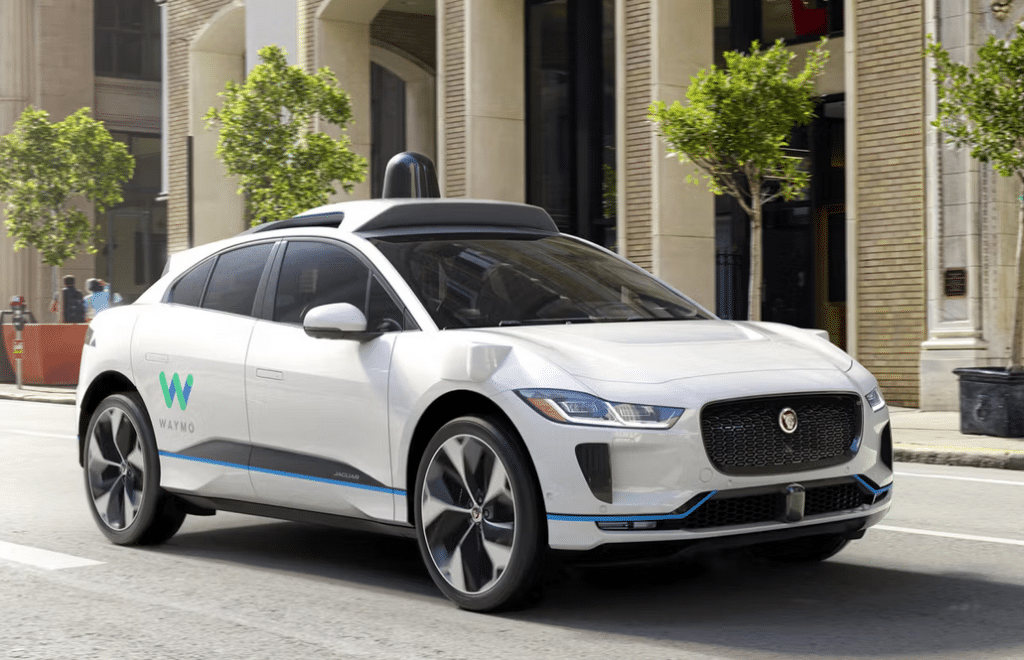
EVinfo.net’s Take: Waymo and Other Robotaxis Will Supercharge EV Adoption in the US
As robotaxis grow fast globally, this will add more speed and strength to fast-growing, cleaner, cheaper to own EVs as they take more and more market share from polluting, inefficient gas vehicles.
Electric vehicle adoption in the United States is often discussed through the lens of consumer demand, incentives, and charging infrastructure. However, one of the most powerful accelerators of EV adoption may not be individual drivers at all. It may be autonomous ride-hailing fleets, led by companies like Waymo.
Waymo has moved beyond pilots and promises into real commercial operations. It is currently the only company in the United States offering paid robotaxi services with no safety drivers or in-vehicle attendants. Its growing fleet of fully electric vehicles is operating daily in complex urban environments, proving that EVs are not just viable but optimal platforms for autonomous mobility.
Robotaxis naturally align with electric drivetrains. EVs offer lower operating and maintenance costs, fewer moving parts, and predictable energy usage. For high-utilization fleets that operate nearly around the clock, these advantages compound quickly. Electricity is cheaper and more stable than gasoline, and centralized charging allows fleet operators to optimize charging schedules, manage peak demand, and reduce downtime. For autonomous fleets, these efficiencies are not optional. They are essential to achieving profitability at scale.
The impact of robotaxis on EV adoption extends beyond fleet numbers. High-visibility deployments in cities like Phoenix, San Francisco, and Los Angeles expose millions of riders to EVs in a way that test drives and marketing campaigns cannot. For many passengers, a robotaxi ride is their first experience in an electric vehicle. Quiet cabins, smooth acceleration, and the absence of tailpipe emissions reshape perceptions of what modern transportation can feel like.
Autonomous EV fleets also drive infrastructure investment. To support large robotaxi operations, companies must build reliable charging depots, upgrade grid connections, and deploy energy management software. These investments strengthen local charging ecosystems and grid readiness, benefits that spill over to commercial fleets, multi-family housing, and eventually private EV owners. In effect, robotaxi operators become anchor customers for charging infrastructure in urban cores.
Safety and regulation remain critical hurdles, and recent incidents underscore the need for rigorous oversight and transparency. However, these challenges do not negate the broader trajectory. Instead, they push companies to improve hardware redundancy, software validation, and operational discipline. As regulators gain real-world data from commercial deployments, clearer frameworks for both autonomy and electrification are likely to emerge.
Other autonomous vehicle players, such as Amazon’s Zoox and future entrants, are following a similar path by pairing autonomy with electrification. This convergence is not accidental. Autonomous systems perform best when paired with EV platforms that offer precise torque control, simpler mechanical architectures, and easier integration with sensors and compute systems.
In the long term, robotaxis could become one of the largest buyers of electric vehicles in the country. A single autonomous fleet can deploy thousands of vehicles in a single metro area, each displacing multiple privately owned gas-powered cars. That shift reduces emissions, cuts urban noise, and changes how cities think about parking, congestion, and mobility access.
Waymo and its peers are not just building autonomous vehicles. They are quietly laying the groundwork for faster, broader EV adoption in the United States. As robotaxis scale, their influence on vehicle electrification, infrastructure development, and public perception may prove to be one of the most consequential forces shaping the future of transportation.
Why Tesla’s Camera-Only Robotaxi Approach Is Less Safe Than Waymo’s Lidar-Based System
As robotaxis move from pilot programs to real commercial deployments, the debate over sensor strategy has become one of the most consequential issues in autonomous driving. Tesla and Waymo represent two fundamentally different philosophies. Tesla relies almost entirely on cameras and neural networks, while Waymo uses a sensor fusion approach anchored by lidar, radar, and cameras. From a safety and deployment standpoint, these choices are not equivalent.
Perception limits of cameras
Cameras are powerful but fragile sensors. They depend on visible light and struggle in low-light conditions, glare, shadows, fog, heavy rain, and direct sun angles. Snow, dust, or a dirty lens can further degrade performance. While humans also rely on vision, people bring contextual reasoning and experience that current AI systems do not fully replicate. A camera-only system must infer depth, speed, and object boundaries indirectly, increasing uncertainty in complex or degraded environments.
Lidar provides direct 3D ground truth
Lidar measures distance directly by emitting laser pulses and timing their return. This produces a precise three-dimensional point cloud of the environment, independent of lighting conditions. Pedestrians, cyclists, vehicles, road edges, and unexpected obstacles are detected based on physical geometry, not visual appearance. This is especially critical in edge cases such as night driving, construction zones, or partially occluded objects, where cameras alone are more prone to misclassification.
Waymo’s lidar allows its system to know where objects are, not just guess what they might be. That distinction matters when safety margins are tight and reaction times are measured in milliseconds.
Redundancy is foundational to safety
Modern safety-critical systems are built around redundancy, not single points of failure. Waymo’s architecture uses overlapping sensing modalities so that if one sensor degrades, others can compensate. Radar can detect motion through rain or fog, lidar confirms spatial structure, and cameras provide semantic context like signage and traffic signals.
Tesla’s camera-only approach removes this redundancy by design. If cameras are impaired, there is no independent sensing modality to cross-check perception. In aviation, rail, and industrial automation, this would be considered an unacceptable risk profile for fully autonomous operation.
Validation versus aspiration
Waymo’s lidar-based system has been validated through millions of fully driverless miles in constrained but real urban environments. It operates paid robotaxi services today with no safety drivers or in-vehicle attendants. Its deployment model reflects a conservative, safety-first approach that prioritizes operational design domains, extensive simulation, and real-world testing before expansion.
Tesla’s approach is more aspirational. It aims to solve full autonomy as a generalized vision problem, with safety promised through future software improvements. While this strategy may reduce hardware costs, it shifts risk into software inference and long-tail edge cases that are difficult to predict and validate without sensor redundancy.
Cost savings versus risk tradeoffs
Tesla argues that eliminating lidar reduces vehicle cost and accelerates scaling. However, in robotaxi operations, safety failures are far more expensive than sensors. A single high-profile incident can trigger regulatory intervention, fleet grounding, or loss of public trust. For commercial autonomy, the relevant metric is not bill of materials cost but risk-adjusted cost per mile.
Lidar prices have fallen dramatically over the past decade, while compute and software validation costs have risen. The economic argument against lidar is far weaker today than it once was.
Regulatory and public trust implications
Regulators tend to favor systems that demonstrate layered safety and measurable risk reduction. Waymo’s sensor fusion approach aligns with established safety engineering principles and provides clearer auditability when incidents occur. For cities and transportation agencies deciding who to permit on public roads without human drivers, demonstrable redundancy matters.
Public acceptance follows a similar pattern. Passengers are more likely to trust a system that is visibly engineered for safety rather than optimized for minimal hardware.
Safety Must Prevail Over Cost Savings
Tesla’s camera-only robotaxi strategy is bold, but bold does not equal safer. Cameras alone can work well in many conditions, yet they lack the robustness and redundancy required for consistent, driverless operation at scale. Waymo’s lidar-centric, multi-sensor approach reflects decades of safety engineering lessons and has already proven viable in commercial service.
As robotaxis become a visible part of daily transportation, the systems that prioritize redundancy, direct measurement, and conservative validation will define the safety baseline. In that context, lidar is not a luxury. It is a foundational safety technology.

Electric Vehicle Marketing Consultant, Writer and Editor. Publisher EVinfo.net.
Services