Which Countries Won the EV Race in 2025?
Visual Capitalist published an analysis on February 13, 2026, authored by Bruno Venditti, ranking countries by electric vehicle share of new car sales in 2025. The data highlights how EVs have moved from niche adoption to a dominant position in several markets in just six years. In 2019, EVs accounted for only single-digit shares of new vehicle sales in most countries. By 2025, multiple markets have surpassed the 50% threshold, with some approaching full electrification.
Norway continues to set the global benchmark, with EVs representing an estimated 97% of new car sales in 2025, up from 56% in 2019. This rapid transition has been driven by consistent policy support, tax incentives, and extensive charging infrastructure. Nepal ranks second, with EVs making up approximately 73% of new car sales, a dramatic increase from just 8% in 2019. Denmark, Sweden, Finland, and the Netherlands have also crossed the 50% mark, reinforcing the Nordic region’s leadership in electrification.
While Norway leads by percentage, China dominates by scale. In 2025, China is projected to sell more than 13 million electric vehicles, accounting for roughly 53% of new car sales. Data compiled from the International Energy Agency and Ember includes both battery electric vehicles and plug-in hybrid electric vehicles, with 2025 figures estimated. China’s position reflects both the size of its automotive market and sustained government support for EV manufacturing and adoption.
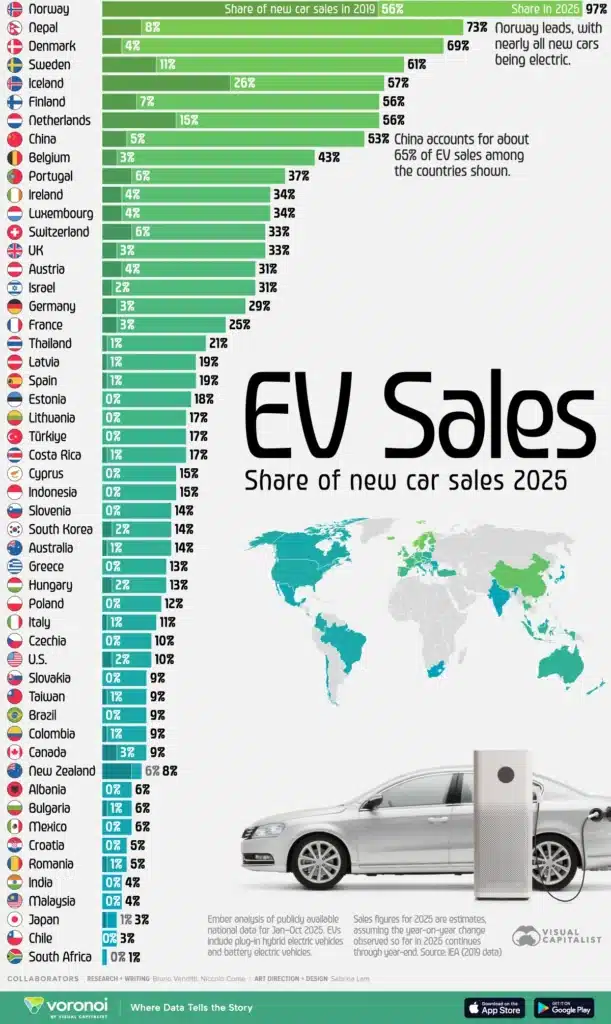
The United States lags behind leading markets, with EVs representing around 10% of new car sales, or roughly 1.6 million units. Canada follows closely at approximately 9%. Across Europe, adoption continues to accelerate, with countries such as Belgium, Portugal, Ireland, Luxembourg, Switzerland, and the United Kingdom recording significant growth. Germany alone is expected to sell more than 840,000 EVs in 2025.
Emerging markets are also gaining momentum. Thailand leads Southeast Asia with an estimated 21% EV share, followed by Indonesia at 15%. In Latin America, Brazil and Mexico show steady progress, with EV shares of approximately 9% and 6%, respectively. Collectively, the data underscores how quickly electric vehicles have transitioned from early adoption to a structural shift in global automotive markets.
EVinfo.net’s Take: USA Must Try Harder to Catch Up
Mass electric vehicle adoption in the United States is still coming. Short-term market fluctuations, uneven quarterly sales, or temporary pullbacks by automakers do not change the underlying structural shift underway. The long-term drivers remain firmly in place: expanding EV model availability across all price segments, continuous improvements in battery energy density and durability, and a steadily declining total cost of ownership compared to internal combustion vehicles. As these forces compound, EVs become not just a cleaner choice, but the economically rational one for a growing share of American drivers.
The real question is no longer whether EVs will scale, but whether the nation’s charging infrastructure will be ready when demand accelerates again. In many regions today, EV adoption is already outpacing charging deployment. Utilization across both public and private charging networks continues to rise, a clear signal that existing infrastructure is being used more frequently and more efficiently. Higher utilization is a positive indicator for charging economics, but it also exposes capacity gaps that will become more acute as adoption resumes its upward trajectory.
Policy uncertainty is a major headwind. Federal decisions around incentives and emissions standards matter enormously at this stage of the transition. Rollbacks of the federal EV tax credit and proposed changes to vehicle emissions rules have already imposed real costs on the industry. Automakers invested billions of dollars in electrification strategies, only to be forced to pivot back toward hybrids and gasoline vehicles to manage regulatory and market risk. That kind of policy whiplash slows progress, increases costs, and undermines long-term planning across the entire EV ecosystem.
This is especially problematic given that EVs remain the most cost-effective and environmentally efficient vehicle option over their lifecycle. Lower fuel and maintenance costs, combined with zero tailpipe emissions, make EVs a foundational technology for both economic and climate goals. Supporting mass adoption is not just about consumer choice, but about industrial competitiveness, energy security, and public health.
If the United States wants to lead rather than follow, federal policy must align with market reality. Stable incentives, consistent emissions standards, and sustained investment in charging infrastructure are essential. Mass EV adoption is still coming. The only question is whether the country chooses to be ready for it.

Electric Vehicle Marketing Consultant, Writer and Editor. Publisher EVinfo.net.
Services