World’s First Mass-Produced Sodium-Ion Battery EV Offers Little to No Range Loss in Extreme Cold
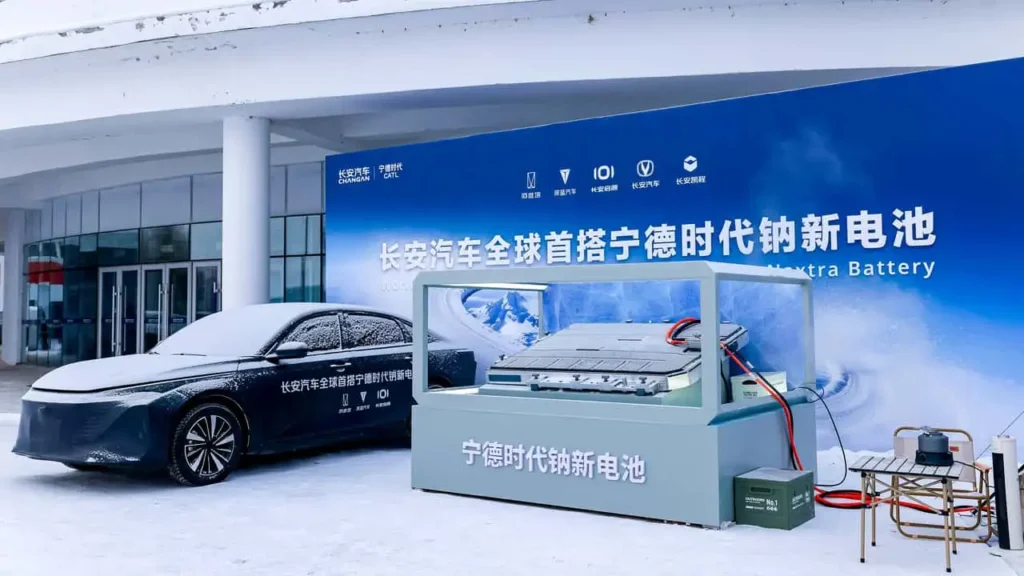
Chinese battery manufacturer CATL and automaker Changan Automobile are preparing to introduce the world’s first passenger vehicle powered by a sodium-ion battery, with plans to place it on public roads by mid-2026. If the rollout succeeds, the technology could mark a turning point for electric vehicles by reducing fire risk and improving performance in extreme temperatures.
CATL’s Naxtra sodium-ion battery will make its production debut in the Changan Nevo A06 sedan, which is expected to deliver roughly 400 kilometers, or 249 miles, of driving range on the China Light-Duty Test Cycle. CATL has indicated that the battery will later be deployed across Changan’s wider lineup, including models sold under the Avatr, Deepal, Qiyuan, and Uni brands.
According to CATL, the launch signals a broader industry shift toward a dual-chemistry battery ecosystem in which sodium-ion and lithium-ion technologies coexist and complement one another to address different use cases and customer priorities. The move reflects growing interest in sodium-ion batteries as an alternative to lithium-iron phosphate packs, which currently dominate China’s EV market. Research suggests sodium-ion batteries eliminate the risk of thermal runaway and are significantly less affected by extreme heat or cold, while also relying on sodium, a material that is cheaper and far more abundant than lithium.
In terms of energy density, the Naxtra battery is competitive rather than groundbreaking. At 175 watt-hours per kilogram, it falls short of high-nickel chemistries but is broadly comparable to LFP, making it well suited for affordable, shorter-range electric vehicles and stationary energy storage applications. CATL achieved the Nevo A06’s projected range by using a cell-to-pack architecture that integrates individual cells directly into the battery pack, reducing weight and improving efficiency.
CATL believes there is substantial room for improvement as the sodium-ion supply chain matures. The company expects future versions to enable pure electric vehicles to reach up to 600 kilometers, or 373 miles, of range, while extended-range EVs and hybrids could deliver as much as 400 kilometers on electric power alone. That level of performance would cover a significant portion of typical driving needs in China, according to the company.
Cold-weather performance is where the Naxtra battery stands out most. CATL says discharge power at minus 30 degrees Celsius is three times higher than that of LFP batteries, while range retention remains above 90 percent at minus 40 degrees Celsius. Power output is also reported to remain stable at temperatures as low as minus 50 degrees Celsius, addressing one of the most persistent challenges facing EV adoption in colder climates.
Real-world performance will ultimately depend on independent testing, but on paper the technology appears promising. While the Naxtra battery is not expected to launch in the United States, its characteristics could be particularly valuable in regions such as the Midwest and Northeast, where winter conditions often lead to sharp drops in EV range.
More broadly, the project underscores a growing consensus that the future of electric vehicles will not rely on a single battery chemistry. Instead, multiple technologies are likely to coexist, giving drivers options tailored to cost, range, performance needs, and climate, much as internal combustion engines evolved to serve different use cases over time.
EVinfo.net’s Take: The USA Must Try Harder to Catch Up With EV Innovations Like Sodium-ion
China’s push into sodium-ion batteries is the latest reminder that electric vehicle innovation is accelerating elsewhere while the United States continues to lose ground, largely due to inconsistent and counterproductive federal policy.
Sodium-ion technology, now moving from lab development to real-world deployment in China, offers clear strategic advantages. Sodium is abundant, inexpensive, and widely distributed, reducing reliance on fragile lithium supply chains. The chemistry is inherently more stable, lowering fire risk, and it performs far better in extreme cold than many lithium-ion alternatives. While sodium-ion batteries do not yet match the energy density of high-nickel lithium packs, they are well suited for affordable EVs, urban transportation, and stationary energy storage. In other words, they solve real problems at scale, not just premium use cases.
China understands this distinction. Rather than betting on a single “winning” battery chemistry, it is deliberately building a multi-technology ecosystem that includes lithium-iron phosphate, high-nickel lithium-ion, and now sodium-ion batteries. That flexibility allows Chinese automakers and suppliers to optimize cost, safety, and performance across different vehicle segments and climates. It also gives China a structural advantage as raw material markets fluctuate and geopolitical pressures intensify.
By contrast, U.S. EV progress remains constrained by federal policies that are slow, fragmented, and often self-defeating. Domestic sourcing rules, protectionist trade barriers, and shifting incentive structures have created uncertainty for manufacturers and discouraged experimentation with alternative chemistries. Instead of enabling innovation, policy has increasingly tried to pick winners, locking the market into a narrow set of technologies while the rest of the world moves on.
The result is that American consumers see fewer affordable EV options, slower technology adoption, and weaker resilience to supply chain shocks. Cold-weather performance, battery safety, and cost reduction remain persistent pain points in the U.S. market, precisely the areas where sodium-ion batteries show the most promise. Yet there is little meaningful federal support for accelerating these alternatives from pilot projects to production.
This gap is not about engineering talent or private capital. The U.S. has both in abundance. It is about policy alignment. China’s government sets long-term industrial goals and then clears the regulatory and financial path to reach them. The U.S. approach, by comparison, often layers new rules on top of old ones, producing delays, higher costs, and missed opportunities.
Sodium-ion batteries will not replace lithium-ion entirely, and they do not need to. Their significance lies in what they represent: pragmatic innovation focused on scale, affordability, and resilience. As China continues to commercialize technologies like this, the U.S. risks falling further behind, not because it cannot compete, but because federal policy makes it harder to do so.
If the United States wants to remain competitive in the EV transition, it will need to shift from reactive, restrictive policymaking to an innovation-first framework that encourages multiple technological paths. Otherwise, breakthroughs like sodium-ion batteries will keep arriving from abroad, and America will keep watching from the sidelines.

Electric Vehicle Marketing Consultant, Writer and Editor. Publisher EVinfo.net.
Services