Instavolt Calls on UK Government to Act on EV Charging Signage Promises
InstaVolt, the UK’s largest ultra-rapid EV charging network, is urging the government to follow through on its pledge to improve signage for public EV charging sites after a planning application intended to highlight the issue was rejected by local authorities.
The company submitted an application in November 2025 for a non-operational advertising wind turbine at its flagship Winchester Superhub. The installation was designed to draw attention to what InstaVolt says is a major obstacle to EV adoption: the lack of clear roadside signs directing motorists to public charging locations.
According to InstaVolt, inadequate signage continues to make it difficult for drivers to locate charging stations, even when large-scale facilities are located near major highways.
Delvin Lane, Chief Executive Officer of InstaVolt, said: “We’re delivering on our commitments to build critical EV infrastructure using private investment, and we need government to deliver on its promises as well. We’ve faced an ongoing battle with signage, and we know more can be done.
“We’re doing everything we can to make charging simple and convenient for drivers, but too often people still struggle to find charging locations easily. That creates unnecessary friction for drivers and risks slowing wider EV adoption.
“The government has been clear that improving signage for EV charging is a priority. A year on, we are still waiting for that to translate into action. Drivers deserve better, and the wider EV transition depends on it. We will keep making that case until something changes.”
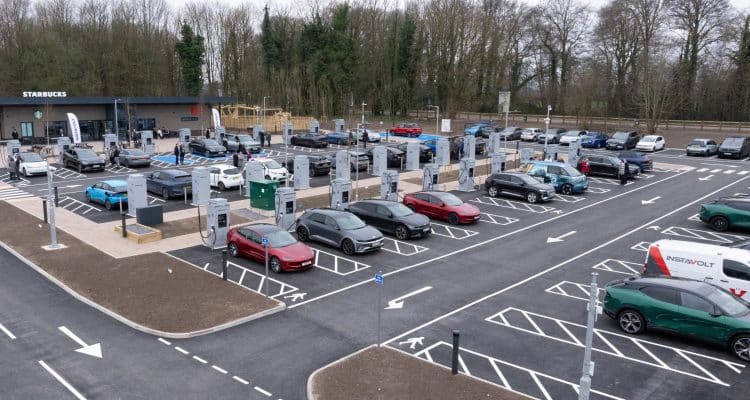
The Winchester Superhub, located just off the A34 near the M3 motorway, is the UK’s largest ultra-rapid charging hub operated by a single provider. The site includes 44 ultra-rapid chargers, an 870-panel solar array, and on-site battery storage. Despite its size and importance, InstaVolt says drivers still struggle to find the facility because of insufficient roadside guidance.
The company argues that the issue extends far beyond Winchester and reflects a broader disconnect between the government’s ambitions for EV infrastructure and the practical experience of drivers.
The UK government has previously committed to improving EV charging signage as part of its strategy to support electric vehicle adoption and achieve its goal of ending the sale of new petrol and diesel vehicles by 2030. However, InstaVolt believes progress has stalled, creating uncertainty for consumers who may remain unaware that extensive charging infrastructure already exists nearby.
InstaVolt says this uncertainty can discourage potential EV buyers who continue to worry about charging accessibility, even as new charging hubs are being built across the country.
According to the company, the problem is not a lack of national ambition but a breakdown in implementation. While central government establishes transportation policies, decisions regarding signage are typically handled by local highway authorities and councils, each operating with different priorities and timelines.
The company currently operates more than 3,000 chargers across 900 sites nationwide. All chargers are powered by 100% renewable energy and are available on a pay-as-you-go basis without requiring subscriptions.
InstaVolt says it has repeatedly encountered difficulties obtaining adequate signage across its network, particularly at larger charging hubs located outside urban areas where drivers traveling on major roads often receive little or no advance notice that a charging facility is nearby.
The company is now calling on the government to establish a clear timetable for implementing improved EV charging signage standards and to work directly with local highway authorities to ensure major charging locations are properly signposted throughout the strategic road network.
InstaVolt argues that coordinated action is essential to maintaining public confidence in the UK’s growing charging infrastructure. Without clearer signage, drivers may continue to experience unnecessary uncertainty when searching for charging stations, potentially slowing the country’s transition away from petrol and diesel vehicles at a critical moment for EV adoption.
EVinfo.net’s Take: EV Charging Signage Is Needed in the USA and Around the World
One of the most overlooked barriers to electric vehicle adoption is not the availability of chargers themselves, but the lack of clear and consistent signage directing drivers to them.
Around the world, governments, charging companies, and automakers have invested billions of dollars into building public charging infrastructure. Yet many EV drivers still struggle to find charging stations, especially those located near highways, shopping centers, parking garages, hotels, and large commercial properties.
As the number of electric vehicles on the road continues to rise, EV charging signage must become a much higher priority in the United States and other countries.
Imagine driving a gasoline vehicle on an unfamiliar road without signs indicating where the next gas station is located. It would be considered unacceptable. Yet EV drivers frequently encounter this exact situation.
Many charging stations remain hidden from view, tucked behind retail stores, inside parking structures, or in the back corners of large parking lots. In some cases, drivers may pass within a few hundred feet of an EV charging hub without ever realizing it exists.
This creates unnecessary anxiety, particularly for new EV owners and travelers driving in unfamiliar areas.
The issue becomes even more important along major interstate corridors. Drivers planning long-distance trips need advance notice of charging stations so they can make informed decisions about where and when to stop.
While navigation apps have become an essential tool for EV drivers, they should not replace physical signage. Technology can fail, cellular signals can be weak, apps may not always be updated, and not every driver wants to rely exclusively on a smartphone or an in-vehicle navigation system.
Roadside signs remain one of the most effective ways to communicate critical information to motorists.
The United States has made significant progress in expanding its charging infrastructure. There are now hundreds of thousands of public charging ports nationwide, with additional deployments funded through federal, state, and private investments. However, charging visibility has not kept pace with infrastructure growth.
A standardized national approach would benefit everyone involved.
Drivers should see universally recognizable EV charging symbols on highways, major roads, and city streets. Signs should indicate the distance to upcoming charging stations, similar to how gas stations, restaurants, and lodging are currently displayed.
Additional signs could identify charging speeds, such as Level 2 or DC fast charging, and indicate whether stations are open 24 hours a day.
Clear signage would also provide economic benefits.
Businesses that host charging stations invest significant resources to attract customers and support transportation electrification. Better visibility could increase charger utilization rates and drive additional traffic to retail stores, restaurants, hotels, and shopping centers.
Charging network operators would benefit from increased awareness of existing infrastructure rather than having to build additional stations simply because current ones are difficult to locate.
This issue is not limited to the United States.
Countries throughout Europe, Asia, Latin America, and Australia are rapidly expanding their charging networks. As adoption grows, governments must establish consistent standards that allow drivers to easily identify charging locations regardless of which region they are visiting.
Tourism destinations could especially benefit from improved EV charging signs, helping visitors feel more confident traveling longer distances in electric vehicles.
The charging stations are being built. Now drivers need to be able to find them.

Electric Vehicle Marketing Consultant, Writer and Editor. Publisher EVinfo.net.
Services