$95 Million Plan Announced to Expand EV Charging and Hydrogen Fueling Across CA
California is investing $95.2 million to accelerate the expansion of zero-emission vehicle (ZEV) infrastructure across the state. The funding will support EV charging and hydrogen refueling infrastructure for light-, medium-, and heavy-duty ZEVs, reinforcing California’s position as a national leader in clean transportation infrastructure.
The California Energy Commission (CEC) approved the investment as part of the state’s Clean Transportation Program Investment Plan. The plan provides $95.2 million during the current fiscal year, with additional funding projected through 2028-2029. Since 2008, the program has invested more than $2.7 billion in grants supporting ZEV infrastructure and clean transportation.

The latest investment follows Governor Gavin Newsom’s announcement earlier this month of instant rebates of up to $3,500 for Californians purchasing their first zero-emission vehicle through the MyFirstEV program. Together, the initiatives address two major barriers to EV adoption: the upfront cost of purchasing a vehicle and access to charging and fueling infrastructure.
Of the $95.2 million, $48 million will support light-duty EV charging, with an emphasis on DC fast charging and charging at or near homes. Another $30.2 million will support medium- and heavy-duty ZEV infrastructure for freight operations, ports, public fleets, and school buses. Hydrogen refueling will receive $15 million, while $2 million will support ZEV workforce training and development.
At least 50% of program funding must support projects benefiting low-income Californians and residents of low-income or disadvantaged communities. As of March 2026, more than 62% of Clean Transportation Program and supplemental funding had gone to projects serving disadvantaged or low-income communities.
California Energy Commissioner Nancy Skinner said transportation tailpipe emissions account for roughly half of the pollution affecting the state’s air and climate. Expanding ZEV infrastructure can give drivers greater confidence to move away from gasoline-powered vehicles while improving air quality and public health.
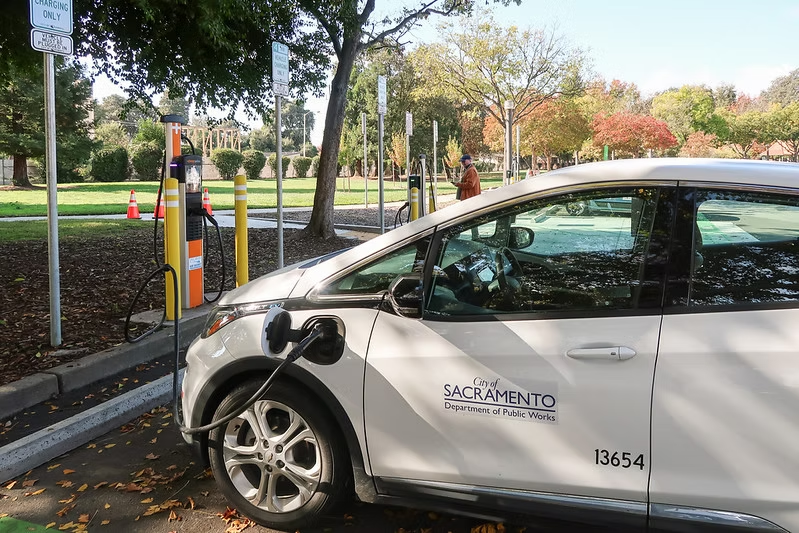
Since the program’s first investment plan was released in 2009, California’s Clean Transportation Program has installed or planned more than 52,000 EV chargers, including approximately 41,000 lower-power chargers and more than 11,000 DC fast chargers. The program has also funded more than 40 manufacturing projects supporting ZEV production, components, infrastructure, and in-state economic growth, along with more than 30 workforce training projects.
California has also used the program to help develop the nation’s largest hydrogen refueling network, with more than 100 stations serving light-, medium-, and heavy-duty fuel cell electric vehicles.
California now has 216,445 publicly available and shared EV charging ports. Earlier this year, the state surpassed 20,000 DC fast chargers, expanding charging options for both local travel and longer trips along major transportation corridors. Public chargers are available at locations such as grocery stores, park-and-ride facilities, and gas stations, while shared chargers can be found at workplaces, medical offices, sports facilities, and other locations where access may be restricted. This network is supplemented by an estimated 800,000 residential EV chargers.
The ZEV infrastructure expansion is occurring alongside broader investments in clean electricity. Since Newsom took office in 2019, California has added more than 38,000 megawatts of utility-scale clean and renewable energy capacity to the grid. At the end of 2024, clean energy accounted for 67% of California’s retail electricity sales. In 2025, clean energy supplied 100% of the state’s electricity demand for at least part of the day on 279 days. During the first half of 2026, that milestone occurred on more than nine out of every 10 days.
California is also investing in battery storage safety as energy storage becomes increasingly important to the electricity system. A state Battery Storage Safety Collaborative launched in 2024 has contributed to updated fire codes, additional state oversight, and stronger safety standards.
The clean energy sector is also generating employment. California had 552,300 clean energy workers in 2024, nearly twice the number in the second-ranked state, Texas, according to a 2025 report from E2. The state added nearly 7,300 clean energy jobs in 2024, with employment growth in the sector more than three times higher than growth across the rest of California’s economy.
The $95.2 million investment continues California’s long-running effort to expand charging and hydrogen fueling while supporting EV adoption, clean energy development, workforce growth, and the transition away from fossil fuels.
Electric Vehicle Marketing Consultant, Writer and Editor. Publisher EVinfo.net.
Services