TU/e Unveiled a Prototype of the World’s First Solar-Powered Ambulance
Researchers at the Eindhoven University of Technology (TU/e) in the Netherlands have unveiled what they describe as the world’s first solar-powered ambulance, a prototype designed to bring medical care to remote communities with limited access to healthcare services and electricity.
Called Stella Juva, the vehicle was developed by the university’s Solar Team and is equipped with high-efficiency solar panels using all back contact (ABC) solar cell technology from Chinese manufacturer Aiko. The solar array generates electricity to power both the vehicle and the medical equipment carried onboard.
Unlike a traditional ambulance focused on transporting patients to hospitals, Stella Juva is intended to serve as a mobile medical unit capable of delivering care directly in areas where infrastructure is limited or unavailable. Under favorable conditions, the vehicle can travel up to 715 kilometers (444 miles) and reach speeds of 120 km/h (75 mph). A built-in battery system provides power when sunlight is unavailable, allowing operation at night or during cloudy weather.
The prototype will now undergo field demonstrations and operational testing to assess its performance in real-world healthcare applications. The project highlights a growing effort to integrate solar generation directly into vehicles rather than relying solely on solar-powered charging infrastructure.
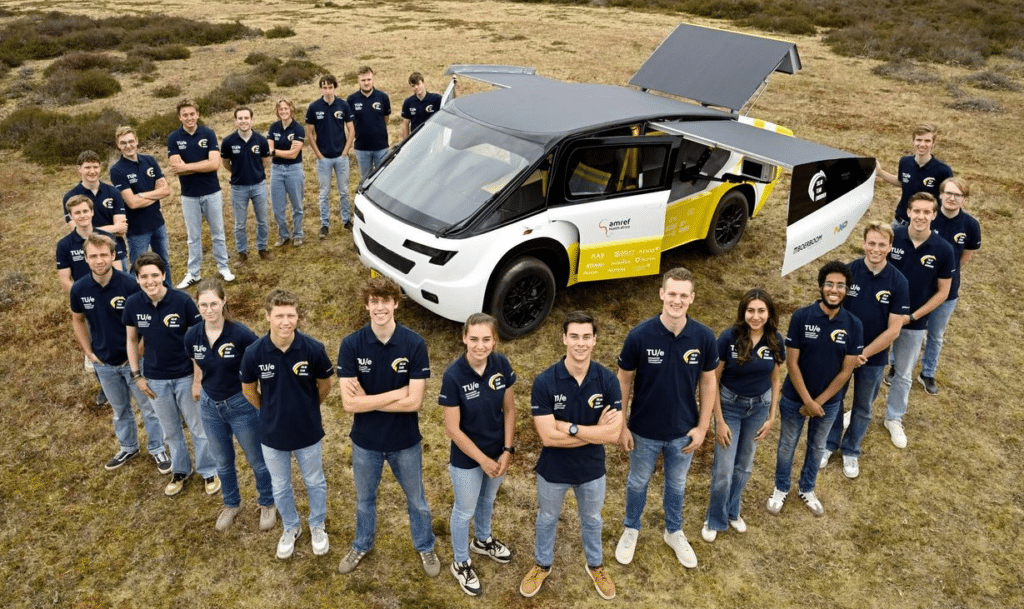
Stella Juva is the latest addition to Eindhoven’s “Stella” family of solar-powered vehicle prototypes, which includes concepts ranging from passenger cars to off-road vehicles. While none are currently available for commercial sale, the projects continue to showcase the potential of vehicle-integrated solar technology.
In 2023, EVinfo.net reported on TU/e’s Stella Terra, which was hailed as “the world’s first off-road solar-powered vehicle.” It is an invention that promises to transform the automotive industry and connectivity in remote areas. After the prototype SUV was unveiled, the team embarked on a journey to Morocco to test Stella Terra on diverse off-road terrains.
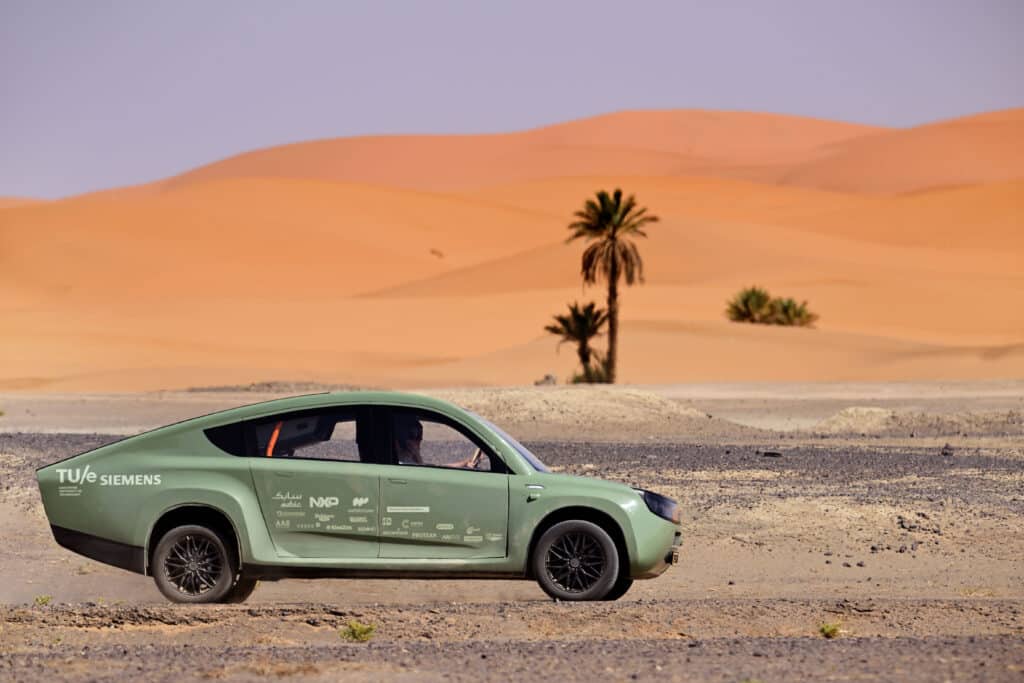
One of the biggest challenges facing solar-powered vehicles is the limited surface area available for solar panels, along with the added weight of integrating energy-generating equipment. The team selected Aiko’s ABC cells because of their high efficiency, long-term performance, and durability. The cells also feature copper interconnection technology designed to withstand the vibrations associated with rough terrain.
Interest in vehicle-integrated solar is growing globally. In the United Kingdom, the Smart Use of Integrated Technology for EV (SUITE) project is exploring how solar energy can supplement electric vehicle power systems. The initiative includes support from Oxford PV, which is supplying lightweight perovskite-on-silicon tandem solar cells. The project aims to combine solar generation, advanced charging systems, and vehicle-to-grid (V2G) technology into a production-ready architecture for future electric vehicles.

Electric Vehicle Marketing Consultant, Writer and Editor. Publisher EVinfo.net.
Services