Solar Transport Systems Building INTI, a Lightweight Solar-Powered Neighborhood EV
What if an electric vehicle did not need a public charging station for most of its daily driving? Solar Transport Systems is putting that idea into practice with the INTI, a lightweight solar-powered neighborhood electric vehicle designed to generate energy from the sun while it sits outside or drives.
Developing countries could face a major obstacle in the transition to electric vehicles: charging infrastructure. Solar Transport Systems (STS) believes solar-powered vehicles could provide a way to bypass much of that challenge.
Julian Field, founder and CEO of STS, said on October 2, 2026, that the company has secured more than $2 million in orders, with confirmed customer cash deposits already reaching its bank account. The company has not yet turned on its assembly line.
Field said the results demonstrate growing demand for clean-energy transportation that can charge while driving. STS is preparing to open its Series A funding round at Venture Atlanta on October 14-15, with the goal of accelerating its manufacturing footprint to meet demand.
STS has spent the past 12 years developing the INTI, a lightweight, rugged and affordable two-seat solar-powered vehicle. Weighing just 550 kilograms, the INTI is less than one-third the weight of the average EV.
The company sees particular potential for the vehicle in developing countries, where roughly 70% of the world’s population lives and where abundant sunshine could make solar transportation especially practical.
STS also says the vehicle’s near-zero running costs could make it an affordable transportation option in markets where fuel and charging infrastructure are expensive or difficult to access. Its rugged suspension is designed for challenging terrain, expanding its potential beyond paved urban roads.
Although the INTI is primarily designed to run on solar energy, it can also be charged from a standard domestic electrical outlet.
The concept challenges the conventional assumption that EV adoption everywhere must follow the same path as wealthy countries. In regions with abundant sunshine but limited charging infrastructure, solar-powered vehicles could offer a different route to electrification.
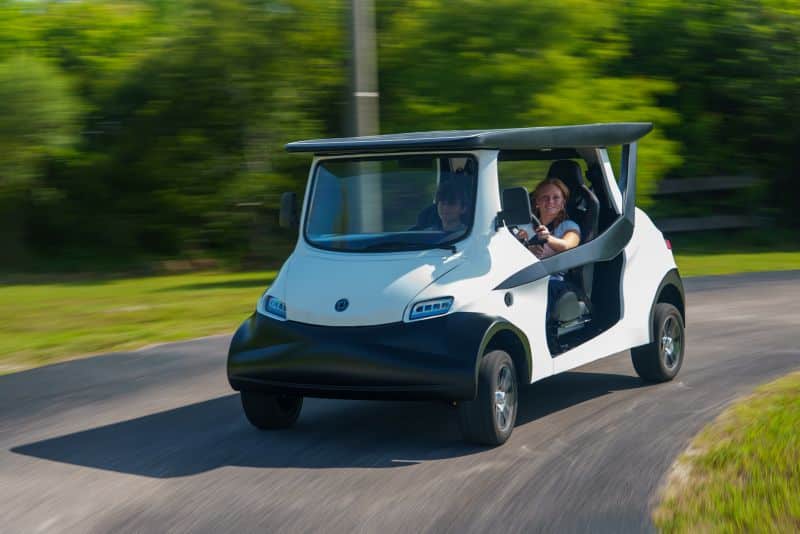
INTI Solar Car Turns Sunshine Into Everyday Transportation
The two-seat INTI starts at $19,950 and weighs about 1,250 pounds. Its solar roof can provide up to 35 miles of daily solar range, while its battery provides up to 100 miles of total range. When additional charging is needed, the INTI can plug into a standard 110-volt outlet and fully recharge in about five hours.
The vehicle is classified as a Low Speed Vehicle, with a top speed of 25 mph. Unlike a conventional golf cart, the INTI was engineered for road use and includes a full roll cage, side-impact bars, three-point seat belts, head restraints, and front and rear bumpers.
Its lightweight design is central to the concept. Rather than carrying the mass of a conventional automobile, the INTI is designed around local transportation, where daily trips are typically short. That makes the relatively modest solar energy generated by its roof far more useful.
The INTI also challenges the idea that every EV needs to look and operate like today’s conventional cars. It is open-sided for airflow in warm climates, has integrated rain covers, regenerative braking, a touchscreen dashboard and Bluetooth connectivity.
The most interesting aspect of the INTI is its potential to expand electrification without waiting for a massive charging network to be built first. Solar-powered transportation will not replace conventional EVs for every trip, but for short-distance mobility in sunny regions, putting the charging source directly on the vehicle could be a compelling alternative.

Electric Vehicle Marketing Consultant, Writer and Editor. Publisher EVinfo.net.
Services