Electric Trucks Capture 50% of China’s Heavy-Truck Sales as Diesel Demand Falls
Electric trucks accounted for 50.3% of all heavy-duty truck sales in China in September 2026, marking a major milestone in the country’s transition away from diesel-powered freight transportation. China sold 33,100 electric heavy trucks during the month, up 37% from a year earlier, even as the overall heavy-truck market contracted 21%.
The shift is already affecting petroleum consumption. China’s diesel demand is expected to decline by approximately 230,000 barrels per day in 2026, with electric and natural gas trucks replacing diesel-powered vehicles.
Electric Heavy-Truck Sales Surge in China
In 2024, new-energy vehicles accounted for 13.6% of China’s heavy-truck sales, including trucks weighing 12 tonnes or more. In 2025, sales nearly tripled to 231,100 vehicles, an increase of 182%, giving new-energy trucks a 28.9% market share.
Electric heavy trucks exceeded 50% of monthly sales in September 2026. December 2025 had previously reached 53.9%, as buyers rushed to take advantage of trade-in subsidies before they expired and new purchase taxes took effect. Market share subsequently fell to approximately 23% in March 2026 before recovering.
During the first nine months of 2026, China sold 226,400 electric heavy trucks, up 64% year over year. That nearly matched the entire 2025 sales total with three months remaining. Among tractor trucks used to pull long-haul trailers, electric models captured 64.5% of September sales.
China’s progress also exceeds its government targets. Eleven government agencies established a 2030 goal of 40% new-energy heavy-truck sales, 1.6 million new-energy trucks on the road, 30,000 kilometers of zero-carbon freight corridors, and approximately 3,000 charging and battery-swapping stations. Electric trucks have already exceeded the 2030 sales target on a monthly basis. CATL expects new-energy trucks to account for half of China’s annual heavy-truck sales by 2028.
Lower Operating Costs Drive Fleet Adoption
Economics are a major reason Chinese trucking companies are switching to electric vehicles. Electric heavy trucks are increasingly less expensive to own and operate than diesel models.
CATL estimates that electric trucks can save approximately 0.6 yuan per kilometer. A study by the International Council on Clean Transportation (ICCT) and China Automotive Technology and Research Center found battery-electric trucks were approximately 19% cheaper per tonne-kilometer than diesel trucks under favorable operating conditions. However, the advantage can disappear when annual mileage is low or battery weight reduces available payload capacity.
Battery swapping is helping address charging downtime. CATL’s Qiji brand operated approximately 300 heavy-truck battery-swapping stations at the end of 2025 and plans to increase that number to 900 by the end of 2026 and 2,000 in 2027.
In August 2026, CATL agreed to invest 2.56 billion yuan, approximately $370 million, for nearly 25% of Qiyuan Green Power, China’s largest heavy-truck battery-swapping operator, which has more than 1,600 charging and swapping stations.
The company’s standardized battery packs offer capacities of 432 kilowatt-hours and 513 kilowatt-hours and can be exchanged in approximately five minutes. CATL is also expanding its battery-swapping strategy into Europe through a partnership with Octopus Energy.
Chinese manufacturers dominate the domestic electric heavy-truck market. XCMG led sales in 2025 with a 15.4% market share, followed by SANY and FAW Jiefang. The three manufacturers collectively controlled 42.9% of the market. CATL supplied approximately 60% of the batteries.
Electric Trucks Are Also Replacing LNG Models
Liquefied natural gas (LNG) trucks previously offered Chinese fleets an alternative to diesel, capturing nearly 30% of the heavy-truck market in 2024 when natural gas prices were relatively low.
However, electric trucks are now taking market share from LNG models. According to Kpler, LNG trucks accounted for 37% of heavy-duty registrations in March 2026, compared with 23% for electric trucks. By July, electric trucks had reached 47%, while LNG models had fallen to 11%.
Monthly LNG truck registrations dropped from more than 30,000 to approximately 6,200.
The transition shows how quickly battery-electric technology is replacing both conventional diesel and natural gas in China’s commercial transportation sector.
China’s Diesel Consumption Continues to Decline
China’s diesel consumption has been falling for several years. Research from Rhodium Group found that diesel refinery runs peaked in April 2023. Apparent diesel consumption subsequently declined from approximately 4.7 million barrels per day to 4 million barrels per day in April 2025.
The decline accelerated in 2026. Kpler estimates diesel demand fell approximately 420,000 barrels per day year over year in May, a decline of roughly 10%, followed by a 460,000-barrel-per-day reduction in June. Kpler forecasts a full-year decline of approximately 230,000 barrels per day in 2026, followed by a modest 64,000-barrel-per-day recovery in 2027.
Kpler estimates alternative-fuel trucks displaced approximately 680,000 barrels per day of diesel demand in China during 2026. LNG trucks accounted for approximately 450,000 barrels per day of that displacement, while electric trucks accounted for 230,000 barrels per day.
Importantly, China’s road freight activity still increased approximately 3% through July. The country is transporting more goods while consuming less diesel.
Higher fuel prices also contributed to the transition. The spring 2026 oil-price spike associated with the Iran war encouraged additional fleet operators to consider electric trucks. However, fuel prices account for only part of the decline.
Electric trucks are still relatively early in China’s overall fleet transition. Kpler estimates they will represent approximately 8% of all heavy trucks operating in China by the end of 2026. Continued annual sales shares of 40% to 50% will progressively increase their impact on diesel consumption.
Europe and the United States Lag Behind China
Electric heavy-truck adoption is increasing in Europe, although sales remain considerably lower than in China. European Automobile Manufacturers’ Association (ACEA) data shows 5,120 electric heavy trucks weighing 16 tonnes or more were registered in the European Union through September 2026, an increase of 59.9% from a year earlier. Electric trucks accounted for 2.5% of registrations, compared with 1.7% during the same period in 2025.
Diesel still accounted for 91.7% of new EU truck registrations.
Several European countries have achieved significantly higher electric-truck adoption. Switzerland reached a 24% market share, followed by Norway at 14.4%, the Netherlands at 11.1%, and Sweden at 10.3%. Germany registered the most electric trucks, with 1,722, representing a 4.2% market share.
The U.S. does not publish an official electric Class 8 truck sales figure, but available market indicators suggest adoption remains below 1%. A recent order for 2,500 Tesla Semi trucks through ZET SCALE could approximately double the number of electric Class 8 trucks operating on American roads.
However, the United States sells approximately 230,000 Class 8 trucks annually, making the electric share extremely small.
The cost difference is a major obstacle. ICCT estimates the median price of an electric Class 8 tractor in the United States at $411,200, compared with $172,500 for a diesel truck. Federal commercial EV tax credits expired in 2025, while California abandoned its proposed requirement for fleets to purchase zero-emission trucks.
China’s electric heavy-truck market share is now more than 15 times the European Union’s, highlighting the substantial difference in adoption between the markets.
EVinfo.net’s Take
China’s commercial transportation transition demonstrates what happens when electric trucks become economically competitive with diesel. For years, critics questioned whether battery-electric semis could overcome concerns about range, battery weight, charging time, and purchase prices. China is addressing those challenges through lower vehicle costs, battery-swapping infrastructure, and investments in domestic manufacturing.
The results are becoming increasingly visible in petroleum consumption. Displacing approximately 230,000 barrels of daily diesel demand with electric trucks in a single year is significant, particularly when electric vehicles still represent only approximately 8% of China’s operating heavy-truck fleet.
The contrast with the United States is substantial. America has Tesla, a Semi factory in Nevada designed for annual production of 50,000 trucks, and major freight corridors that could support commercial vehicle electrification. Yet electric Class 8 trucks cost approximately 2.4 times as much as diesel models, federal incentives have expired, and market adoption remains below 1%. Additionally, the Tesla CEO’s concerning personal behavior, growing number of missed deadlines, and distracting various other business endeavors raises doubts about Tesla’s abilities to deliver.
The 2,500-truck ZET SCALE order represents progress, demonstrating how large shippers can combine demand to support electric truck deployment. However, those trucks still need to be delivered and put into commercial operation.
Europe is further along than the United States, and its leading markets, with electric truck shares between 10% and 24%, are approaching the adoption levels China achieved in 2024 and 2025.
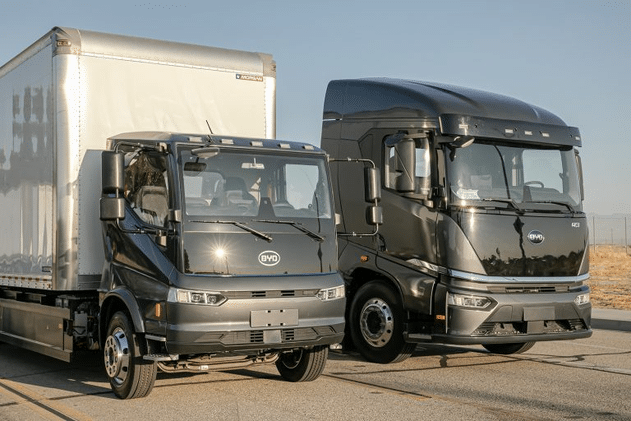
Another important development is the international expansion of Chinese manufacturers. SANY and BYD already sell electric trucks in Europe, while CATL is developing battery-swapping infrastructure that could support their expansion.
If Chinese manufacturers can bring their lower vehicle costs and battery-swapping advantages to international markets, Western truck manufacturers will face increasing pressure to compete with electric models that offer lower operating costs than diesel.

Electric Vehicle Marketing Consultant, Writer and Editor. Publisher EVinfo.net.
Services