Mercedes-Benz Rolls Out Liquid AI On-Device Technology to 2027 Models Through OTA Updates
Mercedes-Benz began distributing over-the-air (OTA) software updates in October 2026 to introduce Liquid AI’s foundation models into North American vehicles, starting with the 2027 E-Class and CLE. The 2027 S-Class, GLC Electric, and GLE are scheduled to receive the technology in the second quarter of 2027, according to the Wall Street Journal, reported by AI Weekly on November 5, 2026.
The deployment marks the production rollout of a multi-year partnership announced in April 2026 between Mercedes-Benz and Liquid AI, an MIT spinout led by CEO Ramin Hasani. The collaboration focuses on scaling embedded, on-device artificial intelligence across Mercedes-Benz models equipped with third- and fourth-generation MBUX hardware in North America.
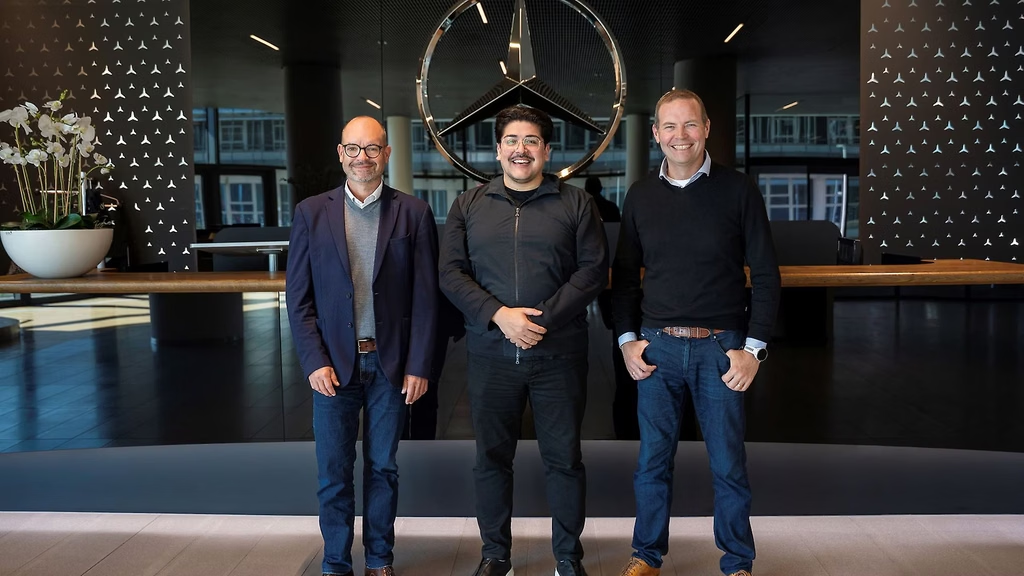
Unlike conventional AI systems that depend on remote servers, Liquid AI’s foundation models operate directly on the vehicle’s hardware through the Mercedes-Benz Operating System (MB.OS). The technology handles speech recognition, language understanding, and reasoning locally, reducing latency and eliminating the need for continuous data exchange with the cloud. The approach is designed to deliver faster responses, greater privacy, and more consistent performance in everyday driving situations.
The integration advances the MBUX Virtual Assistant by combining voice control, vehicle functionality, and contextual understanding into a more capable in-car experience. Drivers will be able to interact more naturally with vehicle systems through conversational voice commands.
Mercedes-Benz Chief Technology Officer Jörg Burzer said the collaboration will expand embedded intelligence and improve AI speech capabilities for North American customers. He described on-device speech, language understanding, and reasoning as foundational technologies for more intuitive and multimodal in-car experiences.
Liquid AI CEO Ramin Hasani said software-defined vehicles represent one of the most consequential real-world applications of artificial intelligence. He emphasized that the company’s foundation models are designed to run efficiently on hardware already installed in vehicles, delivering fast, private intelligence without depending on cloud computing.
Mercedes-Benz views embedded AI as complementary to existing cloud-based large language models and computing ecosystems. The companies also plan to explore additional product development opportunities as the partnership expands.
The October rollout meets the original production deployment target announced in April 2026, bringing Liquid AI’s technology from development into Mercedes-Benz’s production vehicle lineup.
EVinfo.net’s Take: In-Car AI Could Revolutionize the Electric Vehicle Driving Experience
Artificial intelligence is poised to transform the driving experience, making vehicles more intuitive, convenient, and capable. For electric vehicle drivers, in-car AI could become much more than a voice assistant. It could serve as a personal driving companion that manages vehicle functions, charging, and trip planning through natural conversation.
Drivers could simply ask their vehicle to turn on the windshield wipers, adjust cabin temperature, activate heated seats, or change other settings without touching physical controls or navigating menus.
For EV drivers, the possibilities extend well beyond vehicle controls. An AI assistant could check real-time charging station availability, identify working chargers, compare charging speeds, and recommend the best locations along a planned route. It could also help plan charging stops based on battery level, driving distance, and travel time.
Planning stops could become much easier, too. Drivers could ask for restaurants, coffee shops, restrooms, or shopping near available charging stations, allowing them to make productive use of charging time. AI could even coordinate charging stops with meal breaks and other travel needs.
As automakers integrate more advanced AI into their vehicles, the traditional dashboard and infotainment system could evolve into an intelligent interface that understands drivers’ needs and anticipates what they might need next.
For electric vehicles, combining AI with connected charging networks, navigation, and vehicle controls could make driving and road trips easier than ever. The future of in-car AI isn’t just answering questions. It’s helping drivers get where they want to go with less effort.
EV Drivers Can Earn Rewards With Nerava
Integrating the AI with Nerava could save drivers money and attract EV drivers to restaurants and other businesses near charging stations. Drivers could earn rewards while charging at locations using Nerava‘s innovative charging validation. The charger, the store and the loyalty program each see one part of the visit. Connecting those records turns a charge into a customer benefit, and a result you can measure. Former VISA engineer James Kirk, Nerava CEO can explain the benefits if you have questions.
Visit https://neravanetwork.com.
Cepero Collective Helps Bridge the Gap Between What the EV Market Needs and Who Can Deliver It
Kerry Cepero, Founder Cepero Collective LLC, is well versed in AI and highlights experience helping grow an EV charging company’s revenue from $2 million to $29 million, along with $16 million in binding purchase orders generated during a previous commercial EV role.
Cepero Collective provides business consulting and advisory services designed to help small and midsize businesses strengthen sales, streamline operations and generate sustainable growth.


Electric Vehicle Marketing Consultant, Writer and Editor. Publisher EVinfo.net.
Services