Why EV Charging Sites Need Battery Storage
The growing deployment of electric vehicle charging stations is increasing electricity demand, particularly as charging networks add more ports and adopt higher-power equipment. Many chargers being installed in Europe and the United States offer 350 kW DC fast charging, with some planned systems reaching 750 kW. In China, megawatt-level chargers are becoming increasingly common.
These faster chargers draw significantly more power from the grid over shorter periods. When multiple vehicles charge simultaneously, the resulting large, localized and intermittent electricity loads can create grid constraints and affect local grid stability. Battery energy storage systems (BESS) are becoming an important solution, particularly at sites with numerous high-powered charging points.
There are several reasons charging site operators are integrating battery storage. BESS can improve charging reliability, reduce demand charges, lower a site’s carbon footprint, store excess renewable electricity, and improve the stability of charging infrastructure. Battery storage also provides a buffer against grid constraints and lengthy utility connection timelines.
By supplying stored electricity during periods of high charging demand, BESS reduces the amount of power that must be drawn from the grid at once. This can allow charging operators to deliver more power through a smaller grid connection, potentially avoiding expensive electrical upgrades. Grid connection costs can increase substantially with higher-voltage infrastructure.
However, battery storage must be properly sized for each charging site. An undersized system may deplete its stored energy too quickly, reducing its ability to support charging demand and deliver expected demand-charge savings. According to U.S. guidance, appropriately sized battery storage can reduce the grid capacity required by 50% to 80% compared with a grid-only charging station.
How BESS for EV Charging Works: System Design Options
There are two primary approaches to integrating battery storage into EV charging infrastructure: battery-integrated chargers and centralized, site-level BESS.
Battery-integrated chargers, also called battery-buffered chargers, contain storage directly inside individual charging units rather than relying on a centralized battery installation. These systems are generally simpler, less expensive and faster to install. However, each charger has a fixed storage capacity, making future expansion less flexible. If charging demand increases substantially, additional site-level storage may eventually be necessary.
Site-level BESS offers greater flexibility because storage capacity can be expanded as charging demand grows. However, these installations are generally more expensive and complex.
Battery-integrated chargers are generally better suited to smaller sites and quick deployments, while centralized BESS installations are more appropriate for large charging hubs, fleet depots and locations expecting significant growth. Centralized systems also offer greater opportunities to integrate solar generation and participate in grid services.
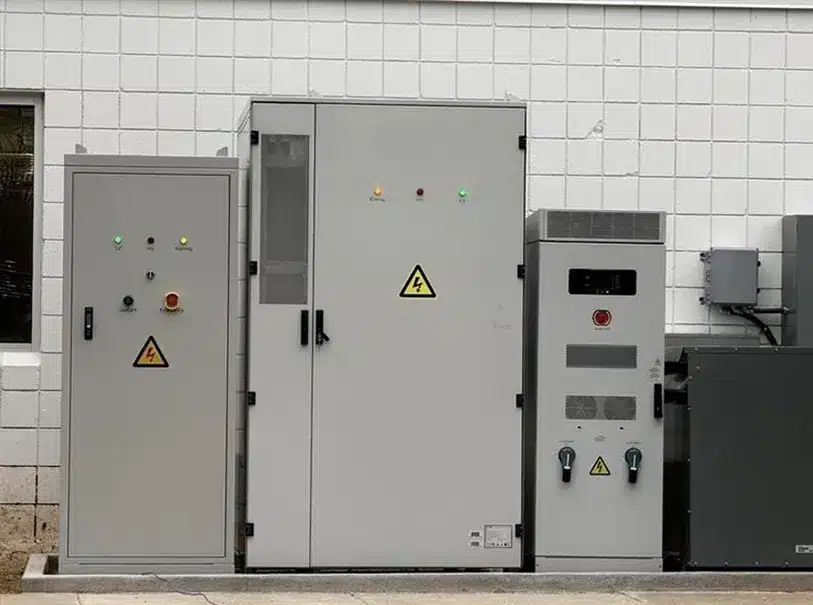
A site-level BESS installation includes battery modules, a power conversion system (PCS), battery management system (BMS), energy management system (EMS), thermal management equipment, monitoring systems and site-level safety systems.
Battery storage can be AC-coupled or DC-coupled with charging infrastructure and on-site renewable energy systems. Some installations also use second-life EV batteries.
The PCS manages electricity flowing between the battery, grid and charging infrastructure. The BMS monitors battery voltage, current, temperature, state of charge (SOC) and state of health (SOH). The EMS determines when batteries charge and discharge and coordinates energy use based on electricity prices, charging demand and grid limitations.
Modern smart energy management systems increasingly incorporate artificial intelligence to optimize charging schedules, forecast electricity demand and balance energy flows between the grid and on-site assets.
When solar panels are installed alongside battery storage, the EMS determines whether electricity should go directly to charging vehicles or be stored for later use. This allows charging sites to capture excess solar generation during periods of low demand and use that electricity when charging demand increases.
Regardless of the equipment and software involved, correctly sizing the battery system remains one of the most important factors in determining performance and financial returns.
BESS sizing involves two primary measurements: the power the battery can deliver, measured in kilowatts (kW), and the energy it can store, measured in kilowatt-hours (kWh).
U.S. guidance calculates the required energy storage using approximately 150 kWh of peak-hour charging per port, multiplied by the number of ports, minus the electricity supplied by the grid during one hour.
For example, consider a charging site with four 350 kW DC fast chargers and a 100 kW grid connection. If all four chargers operate at maximum power, their combined demand reaches 1.4 MW. After accounting for the 100 kW grid connection, the battery system would need approximately 1.3 MW of power capacity to supply the remaining demand.
Using the 150 kWh-per-port calculation, the site would need at least 500 kWh of usable battery energy to support the busiest hour. This is a representative example, and actual requirements depend on charging patterns, grid capacity and the site’s operating conditions.
What Battery Storage Does for an EV Charging Site
Battery storage can reduce demand charges, stabilize local electricity grids and help maintain consistent charging performance. Stored electricity can be used for load shifting, allowing operators to purchase or generate electricity when it is less expensive and use it during more expensive periods.
BESS can also provide backup power during grid outages, reduce peak electricity demand through peak shaving, and participate in grid services such as frequency response.
Load balancing is another important application. Rather than allowing multiple chargers to draw maximum power from the grid simultaneously, stored energy can be distributed across chargers to manage overall electricity demand. This helps reduce peak loads and demand charges.
The economic benefits extend beyond charging operations. Battery owners can store inexpensive off-peak electricity or excess solar generation for later use. Depending on local electricity markets and regulations, stored energy can also support energy trading when electricity prices are higher.
Battery storage operators may participate in virtual power plants (VPPs), combining multiple energy storage assets to provide electricity and grid services. These additional revenue opportunities can improve the economics of BESS installations when market conditions and utilization rates are favorable.
Another important benefit is the potential to defer expensive grid upgrades. Large clusters of Level 3 DC fast chargers can require substantial electrical capacity, sometimes triggering utility infrastructure upgrades before a charging site can operate.
Battery storage can reduce the size of the required grid connection and potentially shorten connection timelines. Some InstaVolt locations in the United Kingdom have used BESS to avoid certain grid upgrades.
Research from Delft University of Technology has indicated that adding battery storage to an EV fast-charging station can reduce the required grid connection size by up to 80%.
For high-throughput charging locations, particularly fleet depots, BESS can also increase the number of vehicles a charging station can serve beyond what the grid connection alone would support. By supplying additional power during periods of peak demand, storage can help maintain charging availability and increase potential revenue from higher vehicle throughput.
Challenges of Adding BESS to EV Charging
Despite the benefits, battery storage installations involve significant capital expenditures. The financial case depends on electricity prices, demand charges, battery utilization, available grid services and local regulations.
Battery systems that are undersized may fail to provide sufficient support during peak charging periods, resulting in unexpected demand charges and lower-than-anticipated savings.
Space is another consideration. Charging stations are frequently located in urban and developed areas where available property is limited. Operators must have sufficient room for battery installations while meeting local permitting and fire-safety requirements.
Battery safety is particularly important because charging station storage systems are often located near customers, employees and surrounding businesses.
Most current BESS installations use lithium-ion batteries, commonly lithium iron phosphate (LFP). Although LFP is generally more stable than other lithium-ion chemistries, it can still experience thermal runaway, potentially resulting in fires, explosions or toxic gas emissions.
Charging sites incorporating BESS must comply with applicable fire codes and safety requirements, including UL 9540 and UL 9540A standards. Proper fire detection, suppression and monitoring systems are necessary at the battery-cell, system and site levels.
Battery degradation is another consideration. Charging station batteries may experience frequent cycling, potentially accelerating degradation compared with storage systems used in applications with less frequent energy movement. This can increase replacement costs and affect long-term returns on investment.
EVinfo.net’s Take: When Does BESS Make Sense for an EV Charging Site?
Battery storage is not necessary for every EV charging station. However, it can be particularly beneficial where charging demand is high, grid capacity is limited, utility upgrades are expensive, or favorable opportunities exist to participate in grid services.
Public fast-charging hubs are among the most common applications. Multiple high-powered DC fast chargers can create substantial and unpredictable electricity demand, making battery storage useful for managing peak loads.
Fleet depots are another strong application because they often have predictable vehicle schedules and regular charging requirements. Battery storage can support vehicle throughput, reduce electricity costs and help prevent operational downtime caused by grid limitations.
Charging stations with on-site solar can store electricity generated during periods of high production and use it when charging demand increases. Remote charging locations and sites with weak electrical connections can also benefit from on-site storage.
Sites awaiting grid upgrades can use battery storage as an interim solution, providing additional charging capacity while waiting for a larger utility connection.
Battery storage is already being deployed alongside EV charging infrastructure in several major markets. A May 2026 EV Infrastructure News report estimated that approximately 1 GWh of BESS capacity had been paired with charging stations across China, France, the United States and the United Kingdom.
China is preparing an additional 10 GWh of battery storage capacity for EV charging stations. Planned deployments elsewhere include 1.5 GWh in Europe, 365 MWh in the United Kingdom and 45 MWh in the United States.
As EV charging networks add more high-powered chargers, battery storage offers another way to expand charging capacity without depending entirely on larger grid connections.
Autel Energy Completed Its First U.S. Integrated EV Charging and Battery Energy Storage System (BESS) Project in 2025
In October 2025, Autel Energy – North America, a global leader in electric vehicle (EV) charging and smart energy solutions, completed its first U.S. integrated electric vehicle (EV) charging and battery energy storage system (BESS) project at its manufacturing facility in Greensboro, North Carolina.
Approved and permitted by Duke Energy, the installation includes a 250 kWh battery cabinet and a 125 kW power conversion system supporting one MaxiCharger DC Fast charger and two DC Compact chargers.

The system is designed to reduce peak electricity demand and associated utility costs while improving charging reliability and site resilience. Autel also announced plans to expand its turnkey EV charging and battery storage design services nationwide.
Its scalable solutions range from 250 kWh systems to multi-megawatt-hour installations for commercial properties, fleet depots, municipalities, utilities, and federally funded charging projects. Services include site modeling, engineering, equipment installation, commissioning, and monitoring.
Autel’s integrated systems support peak shaving, load shifting, demand-charge management, and future integration of additional chargers and renewable energy. The company says its designs use UL 9540A-certified battery storage systems and are engineered to meet utility interconnection requirements.

Electric Vehicle Marketing Consultant, Writer and Editor. Publisher EVinfo.net.
Services