2026 Will Be the ‘Year of the Used EV,’ Says Recurrent CEO
In August, the price gap between used electric vehicles (EVs) and their gasoline-powered counterparts narrowed significantly, dropping to just $897, the smallest difference ever recorded. This shift signals a major trend in the market where the price of used EVs is becoming more competitive with gasoline cars. The average price for a used EV was $34,704, a slight decline of 1.1% from July and a more substantial 2.6% decrease from the previous year. This reduction in price is especially significant considering the expiration of the federal tax credit for used EVs, which ended on September 30. Previously, this credit had reduced the cost of used EVs by up to $4,000, making them even more affordable. Despite the removal of the tax credit, the overall affordability of used EVs remains strong, largely due to these consistent price declines.
Increasing Popularity
The growing affordability of used EVs is evident in the rapid rise of their sales. In August, nearly 41,000 used EVs were purchased, marking an impressive 59% year-over-year increase in sales. This growing demand is not expected to slow down, as analysts predict that 2026 will see great used EV sales growth. The affordability of these vehicles, combined with increased awareness and access, is expected to continue driving their popularity. Scott Case, the CEO of Recurrent, an EV market research firm, has strongly emphasized this positive trajectory, noting that the narrowing price gap is likely to continue attracting more buyers to the used EV market. 2026 will be “the year of the used EV,” Case told CNBC on October 3, 2025.
Impact of Leased EVs
A major factor contributing to the growing availability of used EVs is the increase in leased electric vehicles that are now reaching the end of their leasing terms. Automakers have relied heavily on leasing as a strategy to move electric vehicles in recent years, and since 2023, over 1.1 million EVs have been leased, said Stephanie Valdez Streaty, director of industry insights at Cox Automotive, in her September 23, 2025 article.
As these leases expire, many of these vehicles are being returned to the market, either through trade-ins or lease returns, contributing to the surge in used EV inventory. This influx of returned leased EVs is further helping to drive down prices, as higher supply typically leads to more competitive pricing. This trend has been highlighted by Streaty at Cox Automotive, who noted that the increase in used EV supply has played a significant role in the affordability of these vehicles.
Affordable Used EV Models
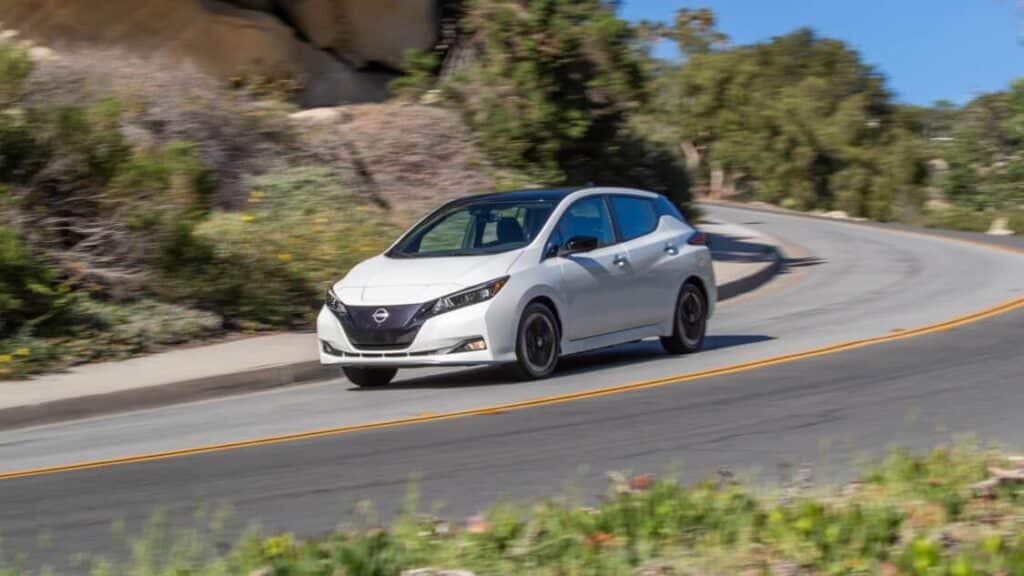
In terms of pricing, used EVs are increasingly accessible, with several models now priced below their gasoline-powered equivalents. In August, 14 used EV models were found to have a lower average price than comparable gasoline cars, demonstrating the growing affordability of EVs in the used car market. Among the most affordable and popular models were the Nissan Leaf and Chevrolet Bolt EV, with these vehicles all falling under the market average price. For instance, the Nissan Leaf, one of the most widely recognized electric vehicles, was priced at an average of just $12,890, while the Chevrolet Bolt EV was priced at $14,705. These prices reflect the increasing attractiveness of used EVs, particularly for budget-conscious buyers seeking affordable and environmentally-friendly alternatives to traditional gasoline cars.
Challenges for New EV Market
While the used EV market is experiencing strong growth, the new EV market faces its own set of challenges. The average price of a new electric vehicle in August stood at $57,245, which is nearly $9,100 higher than the average price of a gasoline car. This price premium has made new EVs less accessible to many buyers, especially with the expiration of the federal tax credit for new EVs. Prior to its expiration, this tax credit had helped to bring down the price of new EVs by up to $7,500, making them more affordable for consumers. However, with this incentive no longer available, new EV prices are expected to remain high for the foreseeable future, potentially slowing the rate at which new EVs are adopted by consumers.
Affordable New EVs
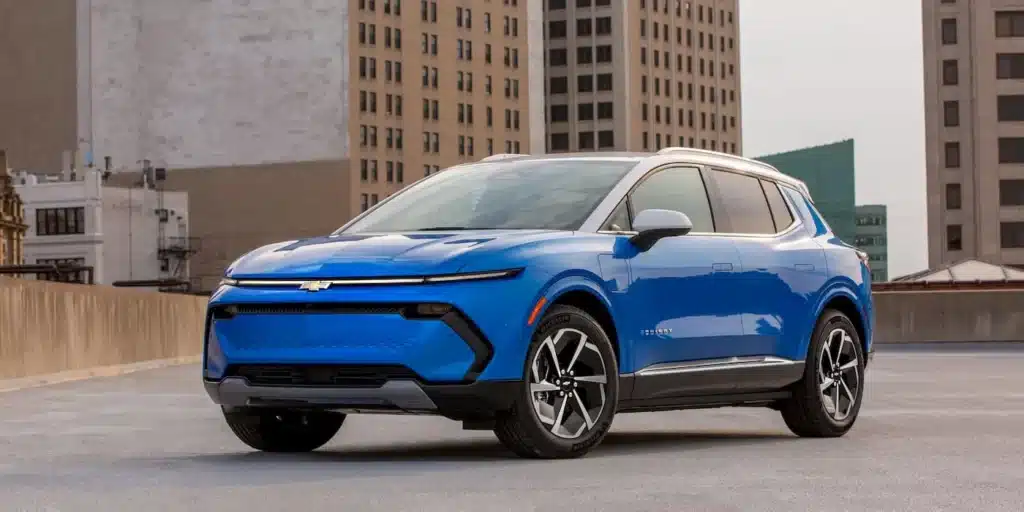
Despite the challenges in the new EV market, there are still some relatively affordable new electric vehicles available for buyers. Models such as the 2025 Nissan Leaf, priced below $30,000, as well as others like the Fiat 500e, Hyundai Kona Electric, and Chevrolet Equinox EV, which have starting prices under $35,000, continue to offer more budget-friendly options. These vehicles are being positioned as affordable choices for consumers who still want to buy a new EV but may not be able to afford the higher-end models. As manufacturers continue to release lower-priced options, it’s likely that these more affordable new EVs will help expand the overall market for electric vehicles, especially as battery costs continue to decline over time.
The 2027 Chevrolet Bolt EV’s price is not yet finalized, but is expected to start around $30,000 to remain the company’s most affordable EV. While the exact cost is still under wraps, GM aims to keep the price slightly above the final 2023 model, which started around $28,795, while offering substantial improvements in range and charging technology. MotorTrend recently covered the exciting new low-cost model’s upcoming release.
Total Cost of Ownership
When considering an electric vehicle, it’s important for consumers to focus on the total cost of ownership, rather than just the initial purchase price. EVs typically have lower long-term expenses, including lower costs for maintenance, repairs, and fuel. These savings can make the lifetime cost of owning an EV significantly less than that of a gasoline-powered car. For example, EVs don’t require oil changes and often have fewer moving parts, which can lead to reduced repair and maintenance costs. However, some factors, such as the accessibility of charging stations, can affect the overall cost. Public charging stations tend to be more expensive than charging an EV at home, which could impact the cost-effectiveness of owning an electric vehicle for individuals who don’t have access to home charging infrastructure.
State and Local Incentives
While the federal tax credit for EVs has expired, many state and local governments, as well as utility companies and automakers, are still offering incentives to help reduce the upfront cost of purchasing an electric vehicle. Several states, including Colorado, California, New Jersey, New York, and Massachusetts, continue to offer substantial rebates, tax credits, and other incentives to encourage the adoption of EVs. In some cases, these incentives can shave thousands of dollars off the price of an EV, making them more affordable for buyers who live in these states. Additionally, utilities may offer discounted rates for EV charging, further lowering the cost of ownership.
Unlocking Confidence in the EV Market: How Recurrent Auto Is Changing the Game
Electric vehicles (EVs) continue to capture attention for their promise of lower emissions and lower operating costs. Yet for many prospective buyers and sellers, uncertainty around battery health, range degradation, and real-world performance still creates hesitation. Recurrent Auto is tackling this challenge by combining large-scale driving data with battery science to provide clarity, trust, and value to the EV market.
The company analyzes millions of miles of real-world driving data every week to produce actionable insights. Its team of battery scientists studies factors like climate, age, charging behavior, and usage patterns to create intuitive reports that show how a particular EV has aged and how it is likely to perform in the future. For buyers and sellers, these insights replace guesswork with confidence when making purchasing or resale decisions.
For those shopping for a used EV, Recurrent offers more than just manufacturer claims or general performance numbers. Its reports provide a transparent look at battery condition and usage history, allowing for more meaningful comparisons between models. Current owners also benefit by connecting their vehicles to the platform and receiving ongoing updates about battery health, which can guide maintenance decisions and boost resale value.
Dealerships and resellers face their own set of challenges with EV valuation, as traditional methods often fail to account for differences in battery condition. Recurrent provides them with tools tailored for both new and used EVs, offering verified data that supports accurate pricing and strengthens buyer confidence. The process not only helps dealers market their vehicles more effectively but also reduces friction at the point of sale.
EVinfo.net’s Take
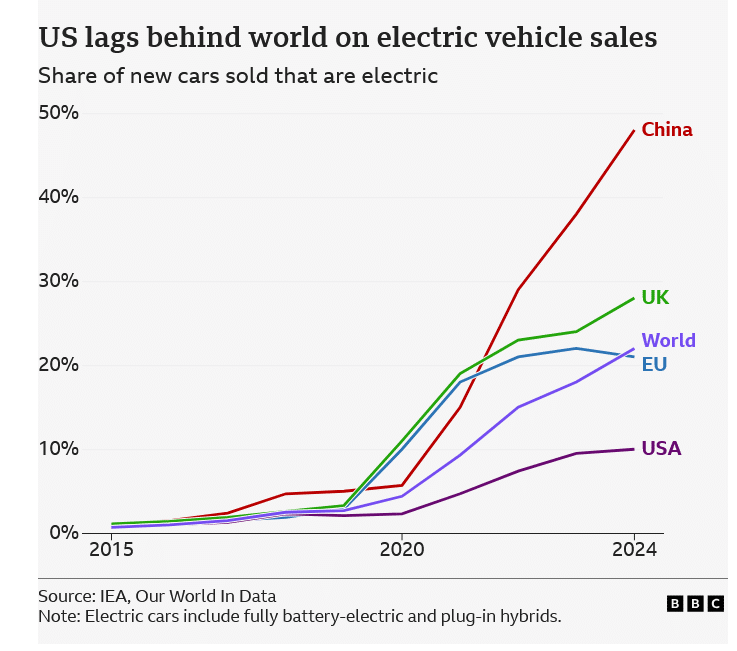
So we’ve lost our federal EV tax credit for new and used EVs. Not a big deal for adoption in the US really, unless you are worried, as I am, about the future of America’s auto industry. China bet big on EVs, so the country leads the world in EV sales. Why should you care? Well, the world’s auto industry is rapidly moving toward electrification. Electrified vehicles now make up 43% of global auto sales as of Q1 2025, up from only 9% in 2019. China boasts more than half of global BEV sales, with Europe and the U.S. trailing behind. All of this means the credit cut, and other cuts to EV industry subsidies, will cause the US auto industry to shrink, lose jobs, and lose profits. It will be a long time, if ever, the US will have a world-leading auto industry again, as we have in the past. Contact government representatives and demand that the credit be immediately re-instated.
For more details, see the BBC’s “How the US got left behind in the global electric car race.” Thanks to Stuart Wiston for the source.
The Credit Cut Is Not a Big Deal for EV Adoption in the US
On September 4, I reported that analysts warn that the cut could slash new U.S. EV sales in half compared to current levels, with one expert predicting market share will sink well below 4% immediately after the incentives disappear. If course I immediately dismissed this as ridiculous. The EV industry will certainly continue to grow without the credit, for both used and new EVs.
For insight on the crazy claim of new EV sales sinking below 4%, EVinfo.net reached out to EV expert Loren McDonald, Chief Analyst at Paren, for comment.
McDonald said: “Yes, of course after you have the biggest quarter in history in Q3 because of a tax credit deadline that motivates consumers to pull the trigger, Q4 2025 and Q1 2026 will drop well below Q3 2025. Duh. But to drop to 4% sales share, well as the old TV commercial said, I’ll eat my hat if that happens. Q4 2025 and Q1 2026 are clearly going to be challenging quarters, but for last 10 years or so, I’ve been on record that the impact of the federal EV tax on sales is overplayed. For a majority of buyers it is a discount, not the main reason to get an EV.”
“The one difference is every time there is a change in the program with a deadline, then everyone rushes out (as I probably will this month) to take advantage of the tax credit because of the deadline. But, after a few quarters, consumers will forget about the loss of the tax credit and focus on wow, the new Chevy Bolt, Nissan LEAF, Chevy Equinox, Honda Prologue, Hyundai IONIQ 5, Toyota CH-R BEV, etc are great vehicles and competitively priced. 2026 is very likely going to be a bit of a challenging year for BEVs — but with a number of exciting new models coming to market later in the year and the following year — 2027 should be a record year in the US for EV sales,” McDonald continued.
I fully agree with McDonald on all points.
I Didn’t Use the Federal Credit
When I bought a used 2024 BEV (battery electric vehicle) this year, I didn’t use the federal credit. The federal used EV tax credit requires used EVs to be at least 3 calendar years older than the year the credit is used, so my used EV was too new. I did get a screaming deal though, with less than 2,000 miles on the car I got it for just over half of new MSRP. I also got a $1,000 rebate from SDG&E, my power utility. It is my favorite car I’ve ever owned, and that includes a previous favorite, a 1965 Plymouth Barracuda. I made my purchase months earlier than previously planned, as I expect all used and new vehicle prices, including EVs, to increase due to economically unsound tariffs. Ford reported a $2 billion net tariff impact. The lower cost of ownership will push more drivers toward EVs, as inflation keeps rising and jobs keep decreasing since January.
I highly recommend Scott Case and the Recurrent team for used EV information and battery health reports. Stephanie Valdez Streaty and the Cox Automotive team are also great, I use Cox stats frequently. Loren McDonald and the Paren team are also highly recommended. Paren is powering electric mobility with unified data insights. Paren’s platform standardizes and enriches real time data to power the exciting and fast-moving EV industry.

Electric Vehicle Marketing Consultant, Writer and Editor. Publisher EVinfo.net.
Services