Jaguar Land Rover Gets £380M Boost as New 1,000-HP EV Era Approaches
Jaguar Land Rover has had a rough stretch. A cyberattack halted production last year, and its shift to electric vehicles has proven difficult, particularly for Jaguar. But the picture is getting clearer, with the British government confirming £380 million this week, roughly $510 million, in support for Tata Group’s battery factory in southwest England.
The grant is designed to keep the U.K. competitive with China and the United States, where policy pressure is pushing automakers to localize EV production or face import costs. Tata’s factory, currently under construction, is expected to produce 40 gigawatt-hours of batteries annually, enough to supply around 500,000 vehicles, and support 4,200 direct jobs with thousands more across the supply chain.
For JLR, the timing matters. Land Rover’s electrified lineup is still mostly hybrids, but a fully electric Range Rover is coming, and the Defender is set to follow. Jaguar is moving faster, expected to launch its first next-generation EV this year as a four-door GT producing up to 1,000 horsepower. The brand is shedding the identity that produced the E-Type in favor of becoming a focused, high-end electric-only marque.
The competitive pressure is real. Chinese automakers have been gaining ground in Europe through faster development cycles and lower costs, with BYD and Geely both expanding their presence. In the U.S., import tariffs remain a complication since most JLR models are still built in Britain, with some assembled in India and China.
The investment won’t solve every problem, but it gives JLR a stronger foundation heading into the most consequential phase of its transition.
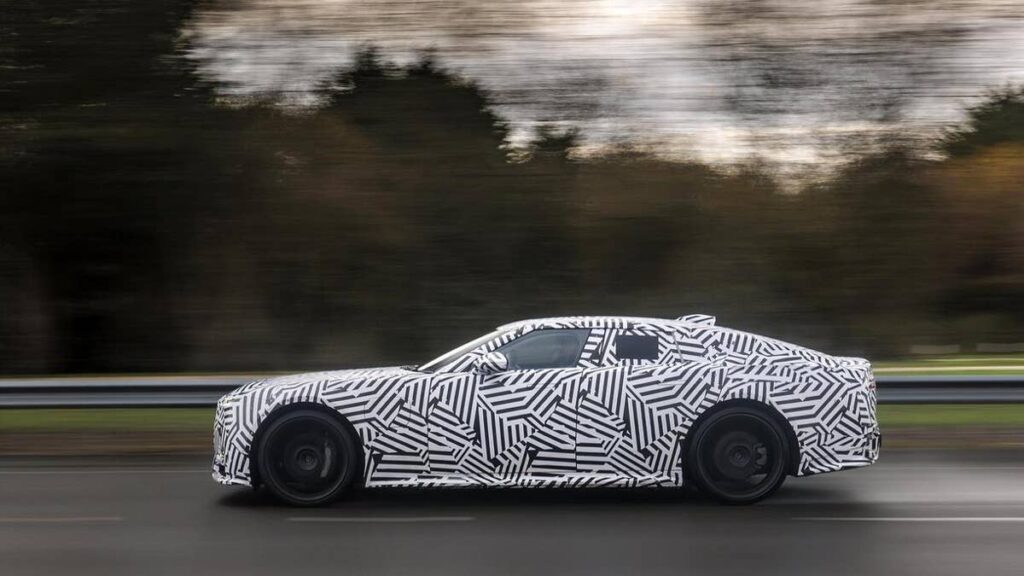
Inside the Engineering of Jaguar’s Most Important Car
Jaguar’s new GT has been five years in the making, and the pressure has been constant. “If we don’t deliver on that promise, we failed,” Dave Doody, the engineer leading the project, said to ABC News. Jaguar ceased production of its existing models and directed all resources here. The full reveal comes in late September. It goes on sale in 2027 at $120,000.
The GT is a four-door electric grand tourer with roughly 400 miles of range, three motors, a 120 kWh battery, and 1,000 horsepower. But Doody is quick to say chasing supercar numbers was never the point. The real engineering targets were comfort, stability, and usable performance. The team spent months driving classic Jaguars to find the thread connecting the brand’s best cars, and what they found was that the great ones were never about steering sharpness. They were about ride quality, composure, and the sense that the car was completely settled at speed.
That philosophy shaped how power gets delivered. Rather than the violent launch common to high-output EVs, the GT builds in a wave, accelerating harder the deeper you press the pedal, with more always in reserve. Doody says it outpaces the Porsche Taycan in the 60 to 100 mph range, which is where real-world passing actually happens.
There is no rear window. The panoramic roof is switchable. The car files more patents than any previous Jaguar. The driver sits low, like a coupe.
Doody tested the Lucid Air, the Porsche, and others. None of them changed the direction. The inspiration was always internal, drawn from the cars that made Jaguar worth saving in the first place.

Electric Vehicle Marketing Consultant, Writer and Editor. Publisher EVinfo.net.
Services