Rivian R2 Production Has Officially Started
On April 22, 2026, Rivian announced it has officially begun production of the Rivian R2 at its manufacturing facility in Normal, Illinois, signaling a critical transition from development into full-scale industrial execution for the company’s next-generation platform.
The start of production follows a multi-year effort to redesign Rivian’s manufacturing approach around scalability, cost structure, and throughput efficiency. At the Normal plant, the company has implemented significant changes to line layout, tooling, and automation strategy. These include more modular assembly processes, improved material flow, and reduced takt time, all aimed at supporting a higher production cadence compared to the earlier R1 program.
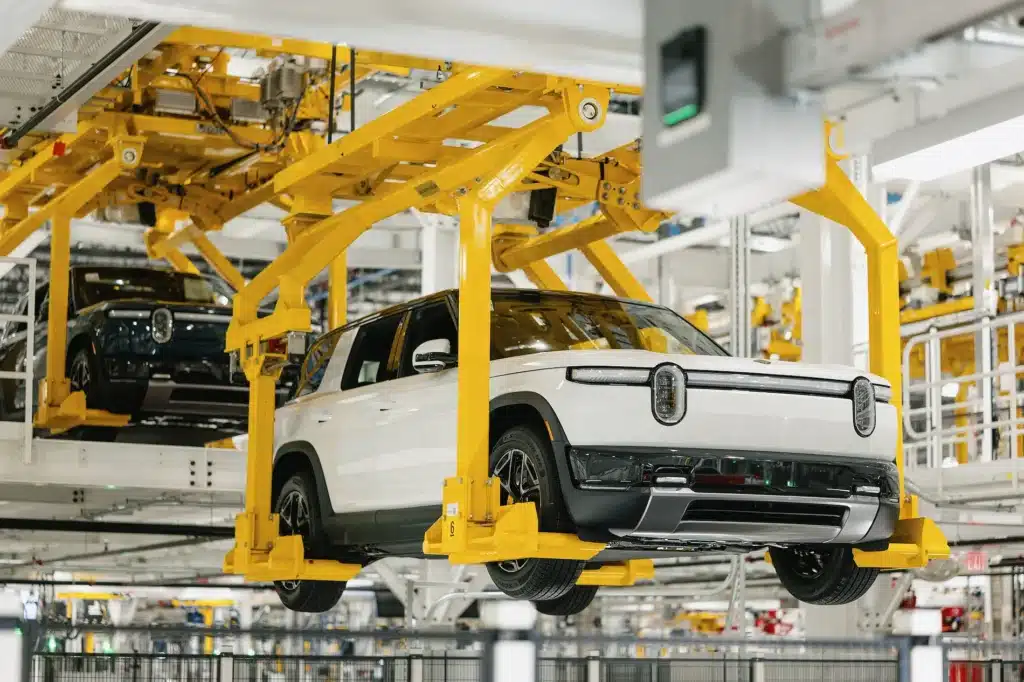
A central engineering objective for the R2 has been system simplification. Rivian has reduced component count across key subsystems, including a more consolidated electrical architecture with fewer electronic control units and a streamlined wiring harness. This not only lowers bill-of-material costs but also reduces assembly complexity and potential failure points in the field. The vehicle’s platform has been designed with a higher degree of parts commonality and standardization, enabling more efficient sourcing and inventory management.
The company has also advanced its vertical integration strategy, bringing more design and engineering capabilities in-house while strengthening supplier alignment for critical components. This includes long-term agreements and localized sourcing where feasible, helping to mitigate supply chain volatility and support consistent production output.
On the software side, the R2 introduces a more centralized computing architecture, enabling tighter system integration and more robust over-the-air update functionality. This approach supports continuous improvement of vehicle performance, features, and diagnostics post-delivery.
With production now underway, Rivian enters the ramp phase, where execution will be defined by yield rates, quality control, and supply chain stability. The R2 is expected to play a pivotal role in expanding Rivian’s addressable market, moving the company toward higher-volume manufacturing while maintaining its focus on performance, capability, and user experience.

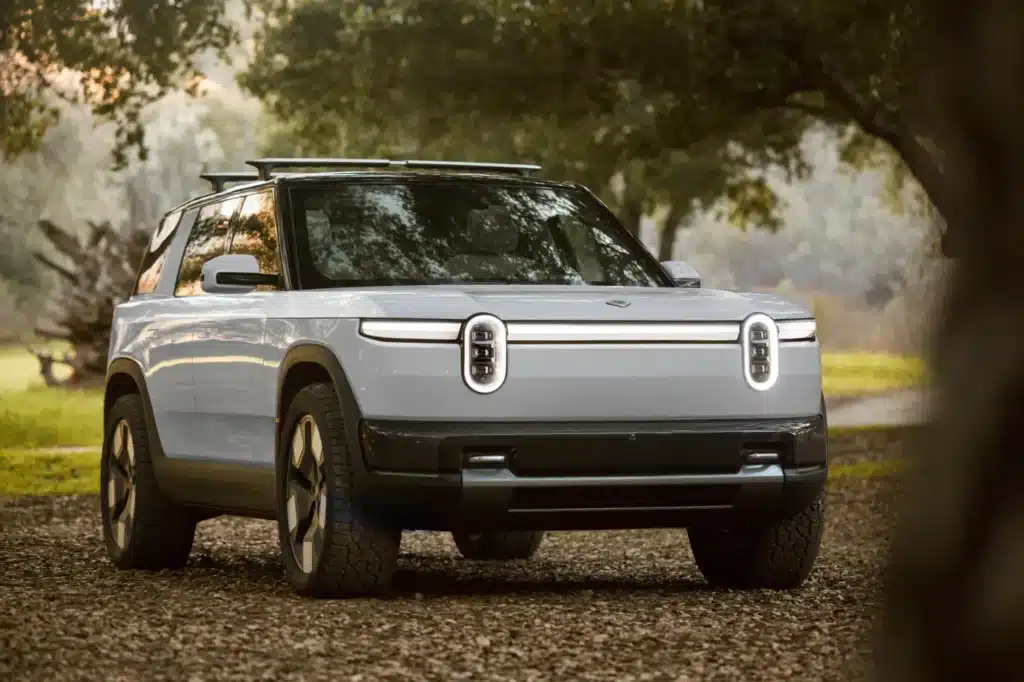
The Rivian R2 is a midsize electric SUV from Rivian and represents the company’s most important step toward mainstream, high-volume EV production.
At a high level, the R2 sits below Rivian’s larger R1S and R1T, targeting a broader market with a lower price point while retaining the brand’s focus on performance, utility, and adventure-oriented design. It’s built on an entirely new platform that is smaller, lighter, and significantly more cost-efficient than the R1 architecture.
Positioning and pricing
The R2 is designed to compete directly in the midsize crossover segment, going up against high-volume EVs. Pricing is expected to start around the mid-$40,000 range, with higher trims reaching the high-$50,000s.
Performance and range
Rivian is offering multiple configurations:
- Up to ~345 miles of estimated range depending on trim
- Dual-motor AWD and single-motor RWD options
- Up to 656 horsepower in the Performance version
- 0–60 mph as quick as ~3.6 seconds
Design and capability
Despite being smaller than the R1S, the R2 is still built with off-road capability in mind:
- About 9.6 inches of ground clearance
- Available all-terrain drive modes (snow, sand, rally)
- Semi-active suspension on higher trims
Inside, Rivian is emphasizing practicality and clever packaging:
- Fold-flat seating for flexible cargo use
- Around 90 cubic feet of total storage
- Features like a retractable rear window and dual gloveboxes
Technology
The R2 introduces a more advanced software and electrical architecture:
- Centralized computing system for better performance and OTA updates
- Compatibility with Rivian’s Autonomy+ driver-assistance system
- Fast charging capability (10–80% in under 30 minutes at peak rates)
Make-or-Break
The R2 is widely seen as Rivian’s “make-or-break” vehicle. It’s expected to cost significantly less to build than the R1 lineup and is central to the company’s plan to scale production, improve margins, and reach a much larger customer base.
The R2 is Rivian’s transition from a niche premium EV brand into a direct competitor in the mass-market electric SUV segment.

Electric Vehicle Marketing Consultant, Writer and Editor. Publisher EVinfo.net.
Services