Waymo Suspends Robotaxi Operations on All U.S. Highways Following California Ban
Alphabet-owned Waymo temporarily suspended driverless robotaxi operations on all U.S. freeways after the California Department of Motor Vehicles (DMV) barred the company from operating on state highways, citing an imminent public safety hazard.
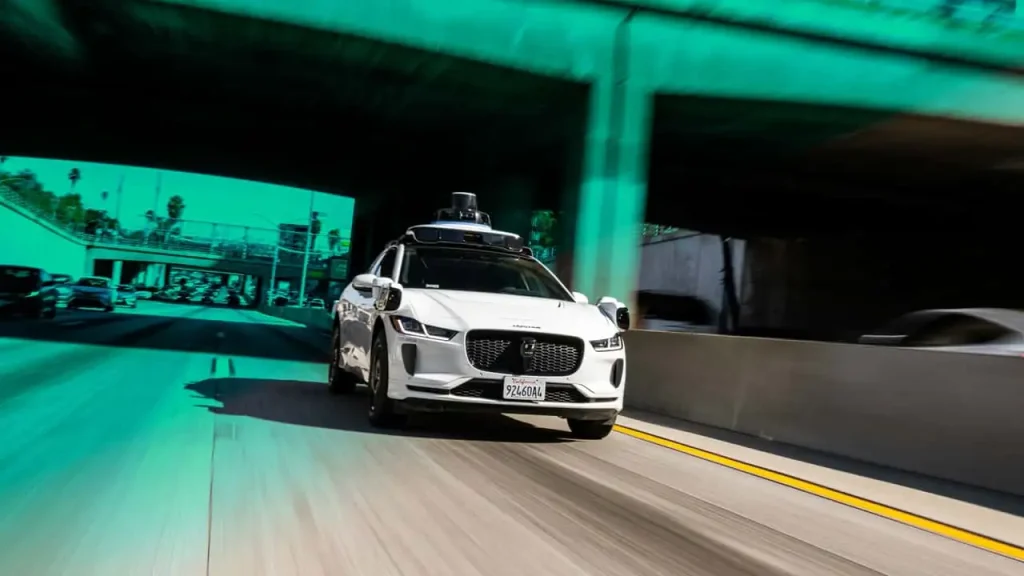
A recent incident involved a Waymo Jaguar I-PACE attempting to pass a California Highway Patrol traffic break on Interstate 280. CHP officers had slowed traffic to remove road debris, but the driverless vehicle attempted to bypass the police blockade before an officer stopped it.
The California restriction took effect last week following multiple incidents involving Waymo vehicles entering active construction zones. Although the ban applies only within California, Waymo extended the suspension nationwide while evaluating its autonomous driving technology. Robotaxi services on city streets continue operating.
“The Department determined that Waymo’s driverless freeway operations pose an imminent hazard to public safety,” the California DMV said.
This marks the second time in 2026 that Waymo suspended highway operations. In June, the company recalled 3,871 fifth-generation autonomous electric vehicles over concerns that their software could direct them into highway lanes closed for construction.
Waymo said it is working with the California DMV and other state officials to resume freeway operations. The company currently operates in 15 U.S. cities and began offering driverless rides on California highways in November 2025.
The suspension comes amid additional regulatory scrutiny. Earlier this month, the National Highway Traffic Safety Administration opened an investigation into a Waymo software update designed to prevent robotaxis from passing stopped school buses.
Waymo’s fifth- and sixth-generation autonomous driving systems use lidar, cameras and radar to navigate mapped environments. The company claims its technology is 95% safer than human drivers in crashes involving serious injuries or worse.
The latest incidents underscore the challenges of expanding autonomous transportation. Highway construction zones, emergency traffic controls and unexpected road conditions remain difficult situations for driverless systems, highlighting the importance of rigorous testing and regulatory oversight before expanding operations.
GM Executive Criticizes Tesla’s Camera-Only Self-Driving Strategy
GM Chief Product Officer Sterling Anderson sharply criticized Tesla’s decision to eliminate radar and rely exclusively on cameras for its self-driving technology, arguing that the approach ignores fundamental limitations of physics.
In an October 27, 2026, interview with The Verge, reported by Electrek, Anderson called Tesla’s camera-only strategy “a weird religious stance that ignores physics.”
Anderson explained that cameras cannot see through dense fog or directly measure instantaneous vehicle velocity, capabilities provided by radar. He also questioned why automakers would eliminate relatively inexpensive radar technology and argued that lidar can improve camera-based systems when the technologies are combined during training.
His criticism carries particular weight given his background. Anderson led Tesla’s Model X program and Autopilot development in 2015 and 2016 before co-founding autonomous driving company Aurora. He joined GM as chief product officer in 2025.
GM is taking a different approach. The Cadillac Escalade IQ is expected to introduce the automaker’s eyes-off driving technology in 2028, combining lidar, radar and cameras. Anderson also cautioned against eyes-off marketing claims that could encourage drivers to become complacent about their responsibilities.
Tesla’s Radar Removal and Visibility Challenges
Tesla began removing radar from the Model 3 and Model Y in May 2021, replacing its sensor-based approach with Tesla Vision, a camera-only system. Initial limitations included a 75 mph Autosteer speed restriction, increased minimum following distances and temporarily disabled features such as Smart Summon and Emergency Lane Departure Avoidance. Tesla also removed ultrasonic sensors in 2022.
Some Tesla engineers reportedly opposed eliminating radar, but CEO Elon Musk argued that sufficiently high-resolution radar technology was unavailable at the time.
Camera visibility remains a significant safety concern. In March 2026, the National Highway Traffic Safety Administration (NHTSA) upgraded its Tesla Full Self-Driving investigation to an Engineering Analysis covering 3,203,754 vehicles operating under reduced-visibility conditions.
The investigation involved nine crashes, including a pedestrian fatality in November 2023. NHTSA found that Tesla’s camera degradation detection failed to identify common visibility problems involving sun glare, fog and airborne dust, sometimes warning drivers only shortly before crashes.
The debate highlights an important distinction in autonomous driving development: relying on multiple complementary sensors can provide redundancy when individual technologies encounter environmental limitations. No single sensing approach eliminates every risk.
EVinfo.net’s Take: Pause Everything Until New Congress Can Examine
Robotaxis trying to pass police cars, a tech CEO cheating on his wife and possibly giving secrets to China, unregulated data centers quickly getting built, polluting the air and raising electricity costs. Tens of thousands of flights affected by a nationwide FAA ground stop. Obviously the U.S. federal administration isn’t capable of governing in an orderly way and can’t keep up with new technology challenges.
EVinfo.net suggests highway robotaxi use and data centers be paused until the new congress takes office in January, along with all major decisions. Obviously it was not good advice to give Jensen Huang his job back at NVIDIA until a thorough investigation is completed. The new congress should require Lidar on all robotaxis, which would make them safer than camera-only systems.

Electric Vehicle Marketing Consultant, Writer and Editor. Publisher EVinfo.net.
Services