China Brags About Having World’s Largest EV Charging Network
Chinese officials announced that the country has successfully built the world’s largest electric vehicle (EV) charging network during its 14th Five-Year Plan, marking a milestone in both infrastructure and energy policy. The announcement came from the State Council Information Office in Beijing, with Newsweek reporting the news on August 26, 2025.
China’s charging network expansion matters well beyond its borders. Charging availability is a critical factor shaping EV adoption rates, global automotive supply chains, and the competitiveness of national clean-energy policies. For Beijing, the build-out underpins its strategy to pivot the economy toward electrified transport and renewable energy. Internationally, the sheer scale of the network influences trade debates, as Chinese EV exports surge and some trading partners reassess subsidies and trade practices tied to electrification.
According to a spokesperson from the National Development and Reform Commission (NDRC), China had installed about 9.92 million charging stations by the end of May 2025. That figure includes 3.05 million public chargers and 6.87 million private chargers, reflecting year-on-year growth of roughly 56 percent.
Officials also highlighted renewable energy gains, with renewables climbing from around 40 percent to nearly 60 percent of China’s total installed power generation capacity during the same planning period.
However, not all signs point to smooth progress. Reuters noted that many public chargers sit idle for long stretches, and that much of the installed capacity is skewed toward slower, residential units. As a result, average daily revenue at public charging sites remains low, underscoring operational challenges despite the network’s vast size.
The accomplishment fits a broader pattern in China’s approach to infrastructure. Since 2008, the country has built out nearly 25,000 miles of high-speed rail, more than double the length of the rest of the world’s networks combined, long enough to circle the Earth. Planning for these megaprojects often dates back decades: in the 1990s, during periods of rapid economic growth and mounting infrastructure strains, China launched its “speed up” campaign to accelerate transport modernization.
The EV charging push echoes that legacy, an ambitious, state-driven effort to build at scale, quickly, and with global impact.

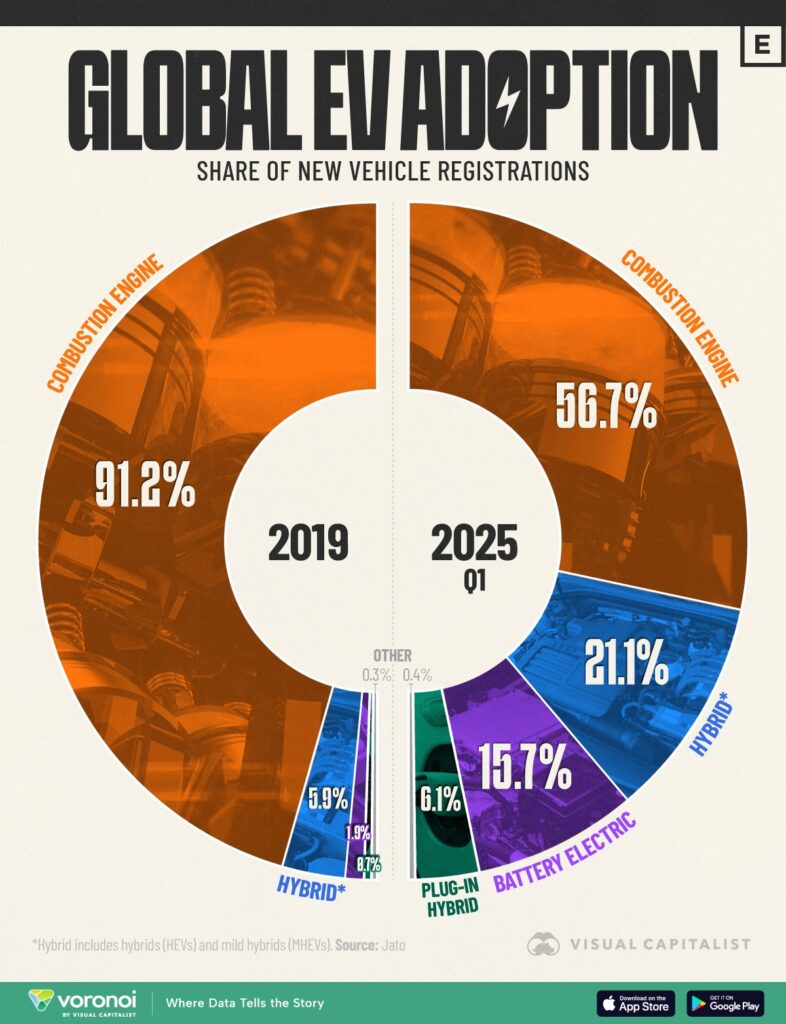
Electrified Vehicles Now Make Up 43% of Global Auto Sales as of Q1 2025, up From Just 9% in 2019
China bet big on EVs, while EV adoption and production moved slowly in the US and Europe. Global electric vehicle adoption has accelerated at a pace few could have predicted just six years ago. In the first quarter of 2025, electrified vehicles, battery electric, plug-in hybrid, and hybrid combined, accounted for 43 percent of global auto sales, up from only 9 percent in 2019. The shift marks the fastest transformation the automotive sector has seen in over a century, as internal combustion engines rapidly lose ground to cleaner alternatives. This shift is due to China’s bold pro-EV policies, with the US and Europe playing much smaller roles. Visual Capitalist, using data from JATO, reported on this and other trends.
In Early 2025, China Was Responsible for 57 Percent of All Global Battery Electric Vehicle Registrations
China has emerged as the clear leader in this transition. In early 2025, it was responsible for 57 percent of all global battery electric vehicle registrations, a dominance built on its massive domestic market, extensive government support, and unrivaled position in battery manufacturing. Europe accounted for 22 percent of BEV sales, while the United States held 12 percent, both trailing significantly behind China’s pace.
Hybrids, meanwhile, have carved out an important role as a transitional technology. Their share of the market grew from 6 percent in 2019 to 21 percent in 2025, offering consumers a bridge between the familiarity of combustion engines and the efficiency of electrification. For many drivers, hybrids provide reassurance with range and fueling convenience while still delivering environmental benefits.
The data points to a clear conclusion: the global auto industry is undergoing a historic shift. As combustion engines steadily decline, electrification is no longer a distant goal but a reality shaping the future of transportation. China’s lead sets the tone for the rest of the world, while hybrids continue to ease the transition for millions of drivers. The trajectory is unmistakable—mobility in the twenty-first century is increasingly electric.
EVinfo.net’s Take: The US Must Step Up EV and Renewable Energy Support
In 2025, electric vehicles and renewable energy are more than technological trends, they are vital pillars of the global shift toward a sustainable future. EVs are transforming the way people move, cutting emissions from one of the world’s largest polluting sectors, while renewables are reshaping power generation by reducing reliance on fossil fuels and stabilizing energy costs. Together, they represent the backbone of efforts to combat climate change, strengthen energy security, and drive economic growth through innovation and new industries. Their importance this year lies not only in environmental impact but also in shaping global competitiveness, as countries that lead in these sectors will define the pace and direction of the twenty-first century economy. Countries that ignore these trends will find their economies failing over the coming years.
The United States is at a crossroads when it comes to the future of transportation and energy. While adoption of electric vehicles has grown steadily in recent years, the pace still lags behind China.
The U.S. has taken a more fragmented approach. Federal tax credits and state-level programs have helped drive EV adoption, but inconsistent policy, permitting hurdles, and limited charging availability continue to slow progress. The cuts to the federal EV tax credit and other EV and renewable energy support could not have come at a worse time. These horrible mistakes must be reversed immediately.
Public charging stations are growing in number, yet reliability and coverage remain concerns, particularly outside of major metropolitan areas. Meanwhile, renewable energy expansion has been uneven, with wind and solar deployment often stalled by regulatory delays and grid integration challenges.
If the U.S. is to remain competitive in the global automotive and energy markets, stronger support for both EVs and renewables will be essential. This means scaling up domestic battery production to reduce dependence on imports, streamlining permitting for renewable projects, investing in nationwide charging infrastructure, and ensuring incentives reach not just early adopters but also middle- and lower-income households. It also requires long-term policy certainty so that automakers, utilities, and consumers alike can plan with confidence.
The stakes extend far beyond economics. As China continues to shape global trade rules and industrial standards in the EV sector, the U.S. risks falling behind in one of the most important technological shifts of the century. By committing to a clear and ambitious national strategy for electrification and clean energy, the U.S. has the chance to become a leader rather than a follower in the race toward a sustainable future.
Rivian CEO Says It ‘Blows My Mind’ That the US Auto Industry Is Reprioritizing Capital Toward Gas-Powered Vehicles
On the Inside EVs podcast, RJ Scaringe, Rivian CEO, said that it ‘blows my mind‘ that the US auto industry is reprioritizing capital toward gas-powered vehicles. I agree RJ. Investing in gas-powered vehicles in 2025 is like investing in flip phones in 2025. It will never work and it will create an economic disaster. EVs are the way to go. EVs are a better tech than gas vehicles, offering eco-friendly and cost-savings benefits. To support an outdated tech like gas vehicles over a new important tech like EVs is a big mistake.

Electric Vehicle Marketing Consultant, Writer and Editor. Publisher EVinfo.net.
Services