Nissan, UC Berkeley and CCTA Show How Connected Vehicles Can Reduce Congestion
Nissan reported on September 10, 2025, that it is taking a forward-looking approach to tackling one of the most frustrating aspects of daily driving: traffic jams that seem to appear out of nowhere. These so-called “phantom traffic jams” happen when small fluctuations in speed or braking ripple backward through a line of cars, eventually causing sudden slowdowns and stop-and-go traffic even when there is no actual obstruction. Nissan, in collaboration with the University of California, Berkeley, Contra Costa Transportation Authority (CCTA), and several local government partners, is exploring how connected cars can help smooth out traffic flow, reduce congestion, and cut down on wasted fuel and emissions.
Called Cooperative Congestion Management (CCM), the program represents a broader effort to understand how vehicle-to-vehicle and vehicle-to-infrastructure communication can transform the way cars interact on busy roads. Computer simulations established the concept, showing travel times could be reduced by 18% and fuel economy could improve by up to 42%.
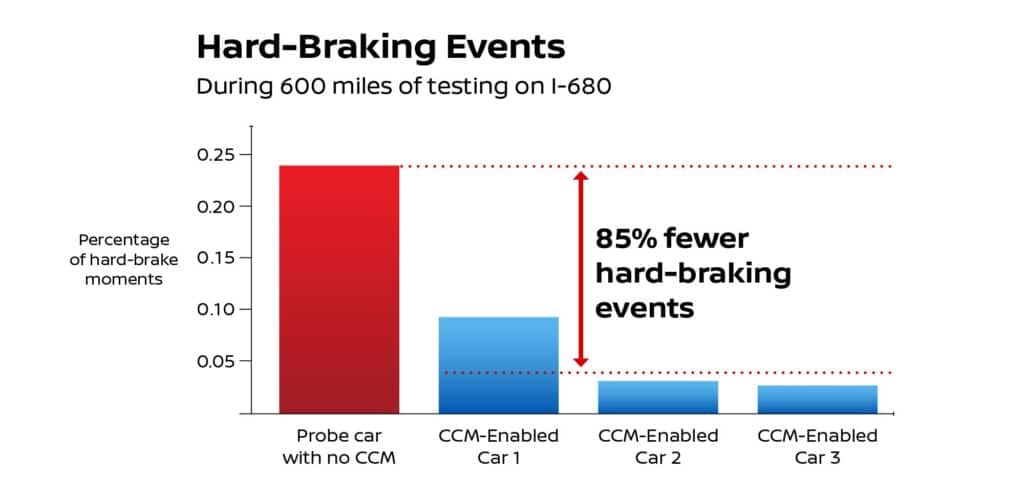
During 600 miles of testing in the San Francisco Bay Area, vehicles with CCM software logged 85% fewer hard-braking incidents and 70% less time stopped in traffic. The system also reduced the incidence of vehicles following too closely and risking rear-end accidents.
The idea builds on adaptive cruise control, a feature already available in many modern vehicles that allows a car to automatically adjust its speed based on the vehicle in front. Traditionally, adaptive cruise control systems operate in isolation, responding only to immediate conditions. Nissan’s trial modifies this approach by enabling participating vehicles to share real-time data on speed, position, and traffic conditions not just with the nearest car ahead, but across a network of connected vehicles and infrastructure nodes.
This information is then aggregated and analyzed in the cloud, where algorithms can determine optimal speed adjustments designed to minimize stop-and-go waves. The connected cars receive these recommendations and use artificial intelligence to make small but significant changes to acceleration and braking patterns.
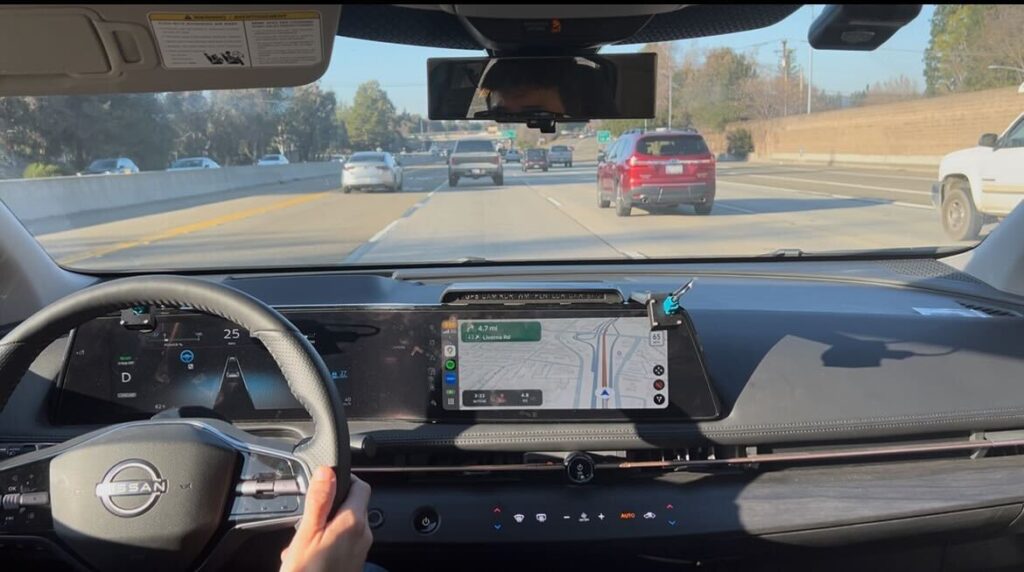
By coordinating behavior across multiple cars rather than leaving each vehicle to react independently, the system reduces the chain reactions that typically lead to phantom congestion. The practical effect is smoother traffic flow, fewer unnecessary slowdowns, and a driving experience that feels less stressful and more predictable. Early results from the trials have been promising.
Even when only a relatively small percentage of vehicles are connected and following the system’s recommendations, the benefits ripple out to surrounding drivers, easing congestion for everyone on the road. This means that the technology does not require universal adoption from day one to make a difference; incremental improvements are possible as more vehicles begin to participate.
The environmental implications are significant as well. Stop-and-go traffic is not only frustrating for drivers but also highly inefficient, causing vehicles to burn more fuel and release higher levels of greenhouse gas emissions. By smoothing out the flow of traffic, Nissan’s connected car technology can help reduce fuel consumption for internal combustion vehicles and extend the driving range of electric cars. Lower emissions contribute to cleaner air and align with Nissan’s broader sustainability goals, making the project about more than just convenience, it becomes a matter of environmental responsibility.
Of course, challenges remain before such a system can be widely deployed. For the technology to achieve its full potential, participation rates will need to increase significantly, which means more cars on the road will have to be equipped with the necessary connectivity and communication features. Standards for vehicle-to-vehicle and vehicle-to-infrastructure communication will need to be consistent across manufacturers, and the reliability of the communication networks must be high to ensure that real-time data can be exchanged without delay. Human behavior also remains a factor; non-participating drivers may still engage in sudden braking or erratic lane changes, which can reintroduce inefficiencies into the flow of traffic.
Despite these hurdles, Nissan sees strong promise in this connected approach. The company has long emphasized innovation as part of its brand identity, and projects like this highlight how it is thinking beyond traditional automotive design. Rather than focusing solely on the performance of individual vehicles, Nissan is looking at the broader transportation ecosystem and asking how smart, cooperative systems can improve efficiency and quality of life for drivers everywhere. If successful, these trials could lay the groundwork for a future in which cars do more than just carry passengers from one place to another, they could also communicate, cooperate, and actively contribute to making roads safer, cleaner, and more efficient.
Nissan’s work with communicating cars is an ambitious effort to address a problem every driver has experienced. By blending adaptive cruise control with advanced connectivity and cloud-based algorithms, the company is testing a way to make phantom traffic jams a thing of the past. While widespread adoption and infrastructure upgrades will be required, the early results suggest a future where traffic flows more smoothly, drivers experience less stress, and the environmental impact of road travel is significantly reduced.

Electric Vehicle Marketing Consultant, Writer and Editor. Publisher EVinfo.net.
Services