Sila’s New Washington Plant Begins Production of Batteries Offering 20% More Energy
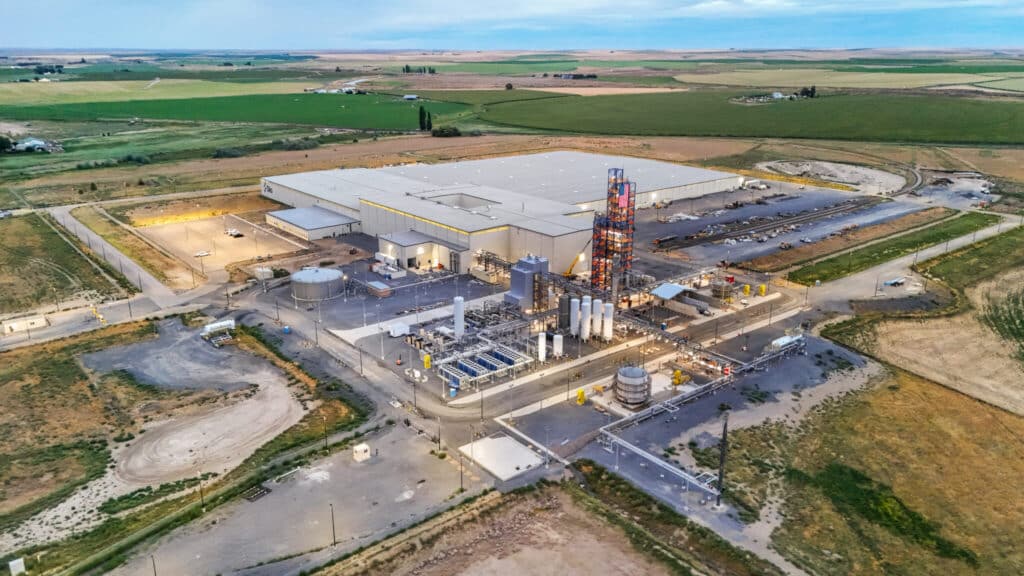
Climate tech just got a major boost. Battery materials company Sila announced on September 23, 2025, that it has officially begun operations at its new, automotive-scale manufacturing facility in Moses Lake, Washington. It’s one of the first plants in the United States dedicated to producing next-generation silicon-carbon anode materials at scale, a milestone for both the EV industry and U.S. manufacturing.
At the center of Sila’s work is Titan Silicon, a silicon-carbon composite that replaces or augments graphite anodes in lithium-ion batteries. Batteries built with this material can store about 20 percent more energy than traditional graphite-based designs, which translates into longer driving range, denser energy storage, and higher overall performance for electric vehicles.
The new facility spans 600,000 square feet on a 160-acre site. In its initial phase, it will produce enough anode material for between two and five gigawatt-hours of battery capacity, enough to power tens of thousands of vehicles depending on application. By the end of the decade, Sila plans to scale to 250 gigawatt-hours of output, positioning the site as one of the world’s largest silicon-anode manufacturing facilities.
The project arrives at a critical moment, as the U.S. works to build more resilient domestic supply chains for essential battery materials. Sila previously secured support from the Department of Energy to make this vision a reality, and the new plant also strengthens a growing battery materials cluster in Eastern Washington. Other companies in the region are already contributing to the ecosystem, creating momentum for a larger manufacturing hub.
For Sila’s leadership, the factory is more than a production site. CEO Gene Berdichevsky has emphasized that domestic manufacturing is essential to keeping innovation in the U.S., warning that without execution, breakthroughs risk flowing overseas to countries with more established supply chains.
The implications for the EV industry are significant. With silicon-enriched anodes, automakers can deliver greater range without ballooning battery size, while reducing dependence on imported graphite and easing cost pressures as production scales. This development not only strengthens U.S. supply chains but also brings high-quality jobs and investment to the region.
Challenges remain, including scaling production smoothly, ensuring quality, and securing long-term agreements with automakers. But Sila’s step into large-scale manufacturing shows that the next generation of EV innovation is not just about research and design—it is about building factories that turn cutting-edge science into tangible products.
Battery Breakthroughs Are Powering the Next Wave of EV Adoption
The exciting and fast-moving electric vehicle revolution is being driven as much by advances in batteries as by the fast, fun-to-drive electric cars themselves. For years, concerns about cost, range, and charging speed have shaped public perception of EVs. Today, those barriers are rapidly falling away thanks to a new generation of battery innovations.
The biggest change is cost. Battery packs used to be the single most expensive part of an electric vehicle, often accounting for nearly half the total price. But as manufacturing scales and new chemistries emerge, costs have dropped dramatically. Between 2008 and 2023, the cost fell by 90%, from $1,415 per kilowatt-hour (kWh) in 2008 to $139/kWh in 2023, adjusted for constant dollars.
Automakers are now producing batteries with fewer expensive raw materials, while recycling efforts promise to keep supply chains more sustainable and affordable in the long run. For drivers, that means EVs are no longer luxury purchases—many are entering the same price range as their gasoline counterparts.
Range is also improving. Early EVs were often limited to under 100 miles per charge, fueling “range anxiety.” Today, most new models easily exceed 250 miles, and some push past 400. These gains come from higher-density batteries, better thermal management, and smarter vehicle design. With every leap forward, the question shifts from “Can an EV get me there?” to “Which EV do I want to take?”
Charging speed has seen equally impressive progress. What once took hours on early home chargers can now take minutes at fast-charging stations. Next-generation batteries are being designed to safely handle higher charging rates, slashing downtime and making road trips more practical. Combined with the growing network of chargers, this means EV ownership fits more seamlessly into everyday life.
The cumulative effect of these improvements is simple: EVs are becoming more convenient, more affordable, and more appealing to a broader audience. As batteries continue to evolve, they will unlock even greater possibilities, from grid integration to second-life storage, further solidifying electric vehicles as the cornerstone of the future of transportation.
EVinfo.net’s Take: EV Battery Innovations Coming Fast and Furious, Will Kick off Mass EV Adoption
This impressive breakthrough by Sila is just one of many EV battery breakthroughs we have seen in the last few years. One of the most significant developments is the rise of silicon-based anodes, which companies like Sila and Group14 have already begun scaling production, with automakers eyeing the technology for next-generation models.
Solid-state batteries are also moving closer to commercialization. By replacing liquid electrolytes with solid materials, these batteries promise higher safety, faster charging, and dramatically improved lifespan. Toyota, QuantumScape, and other innovators are pushing toward scaled production later this decade, a development many see as a game-changer for the industry.
In May 2025, the BMW Group announced a significant milestone in its battery innovation strategy: the integration of large-format, pure all-solid-state battery (ASSB) cells, developed in collaboration with Solid Power, into a BMW i7 test vehicle.
At the same time, researchers are working on fast-charging innovations that could cut refueling times to just minutes.
StoreDot and Polestar completed a landmark demonstration. Since introducing its extreme fast charging (XFC) silicon-dominant EV battery cells, StoreDot has received overwhelmingly positive feedback for its tested cells. In a groundbreaking demonstration, the world’s first 10-minute charge of an EV equipped with a standard 77 kWh battery pack powered by silicon-based technology, StoreDot showcased the transformative potential of its innovation.
Advanced thermal management systems and new electrolyte blends are making it possible to charge at higher rates without damaging cells, bringing EV convenience closer to what drivers expect from gas stations.
In March, China’s BYD announced its super e-platform is capable of delivering peak charging speeds of up to 1,000 kilowatts (kW), enabling EVs that are equipped with it to charge for 5 minutes and travel up to 400 kilometers (249 miles).
EV battery second-life use cases and recycling are gaining momentum. Breakthroughs in battery recycling allow valuable materials like lithium, nickel, and cobalt to be recovered efficiently, reducing the need for new mining and helping stabilize supply chains. These innovations also lower long-term costs, a win for automakers, consumers, and the environment.
All of these breakthroughs mean lower costs, faster charging, and longer ranges for EVs. All of these things mean that EVs are now one step closer to mass adoption in the USA. It will happen soon.

Electric Vehicle Marketing Consultant, Writer and Editor. Publisher EVinfo.net.
Services