800-Volt EV Architecture is a Key Driver of EV Innovation
Electric vehicle technology is advancing at an exceptional pace, fundamentally reshaping sustainable transportation. Central to this progress is the rapid development of EV batteries and, in particular, the move toward higher-voltage battery systems. The introduction of 800-volt EV architecture offers meaningful gains in vehicle performance, charging speed, and overall efficiency.
EV architecture encompasses batteries, motors, inverters, control units, wiring, sensors, and auxiliary systems. The specific components used, and how they are engineered to work together, depend on whether the vehicle employs a 400-volt or 800-volt battery system.
Most EVs on the road today utilize 400-volt architecture. However, an increasing number of manufacturers are transitioning to 800-volt platforms to leverage higher efficiency, better performance, and significantly faster charging capability.
400-volt Architecture
Despite the name, 400-volt systems do not operate at a fixed 400 volts. Instead, the typical range spans 300 to 500 volts depending on battery state of charge, temperature, age, and operating conditions. Systems within this range are classified as 400-volt architecture.
400-volt platforms have long served as the industry standard. They benefit from mature supply chains and high-volume components, making vehicles built on these systems generally more cost-effective. These EVs can use both 400-volt and 800-volt DC fast chargers, but when connected to 800-volt chargers they are limited to 400-volt output, which can restrict charging speed.
800-volt Architecture
Similarly, 800-volt systems operate across a range, typically from 600 to 900 volts. While fewer vehicles currently use 800-volt platforms, availability is growing. These vehicles typically deliver quicker charging and improved performance compared with 400-volt models, though costs remain higher due to newer technology and developing supply chains.
Higher voltage reduces the current required for the same power level, enabling thinner cables, smaller components, lower heat loss, and improved efficiency. This can translate to lighter vehicles, increased driving range, faster acceleration, and greater regenerative braking capability.
800-volt EVs can take full advantage of high-voltage DC fast chargers, provided the charger supports 800 VDC output. To charge on 400-volt chargers, additional onboard hardware such as DC/DC conversion is required. Today, most public fast chargers are still built primarily around 400-volt systems.
Key Differences Between 400V and 800V Systems
400-volt vehicles are typically limited by current constraints and resulting heat generation, which slows charging at high power levels. 800-volt vehicles support faster charging because they require less current for the same power, enabling greater charge acceptance when paired with compatible chargers.
400-volt systems generally experience higher heat losses and may require heavier components. 800-volt systems reduce heat loss and can recapture more energy through regenerative braking, improving overall efficiency. 400-volt systems often rely on heavier cables and components. 800-volt systems enable lighter wiring and electronics due to lower current requirements.
400-volt EVs benefit from mature, large-scale production and lower component costs. 800-volt EVs are more expensive today but are expected to decline in cost as adoption increases. Most DC fast chargers currently deployed are designed around 400-volt EVs. Realizing the full benefit of 800-volt vehicles requires wider deployment of high-voltage charging stations.
800-Volt Electric Vehicles
A growing number of automakers are adopting 800-volt electric architectures to enable faster DC charging, improved efficiency, and high-performance power delivery. The following manufacturers currently offer production EVs utilizing 800-volt systems:
- Porsche: Taycan
- Kia: EV6, EV9
- Hyundai: IONIQ 5, IONIQ 6
- BYD: ATTO 3, Dolphin, Seal, Song
- XPeng: G9
- GMC: Hummer EV Pickup, Hummer EV SUV
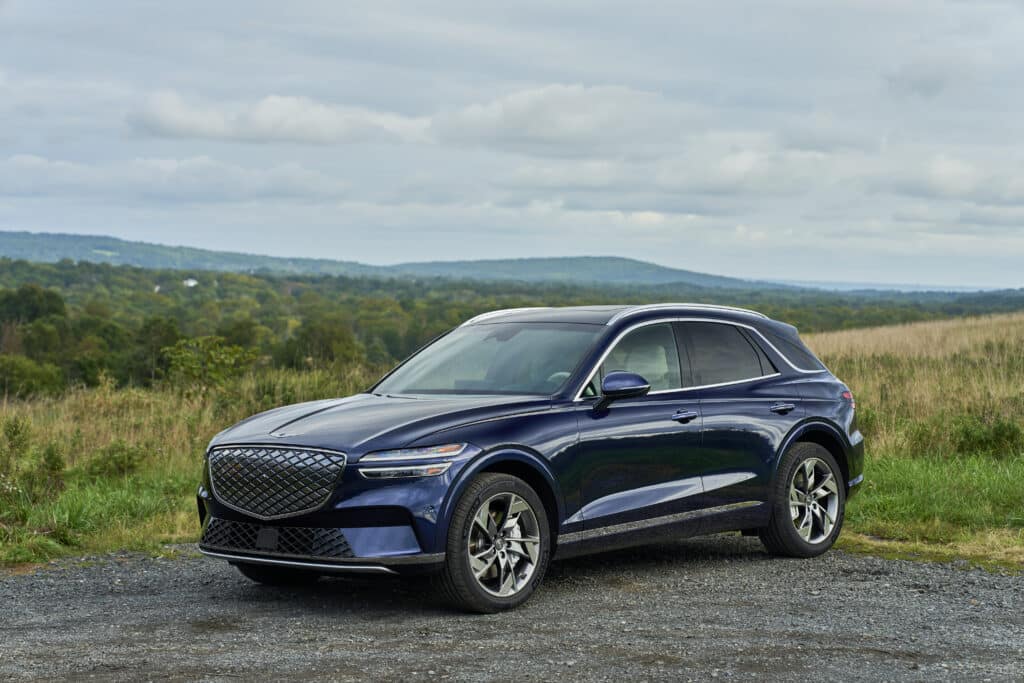
- Genesis: GV60, GV70, G80
- Lucid: Air (features a 924-volt electrical system)
- Zeekr: 001
- Tesla: Cybertruck
- Polestar: 3
Upcoming 800V EVs
Upcoming electric vehicles with 800-volt (or similar high-voltage) architecture are expanding rapidly as manufacturers prioritize faster DC charging, improved efficiency, and higher performance capability. Several brands have already confirmed next-generation platforms that will support 800-volt systems in their forthcoming models.
Upcoming electric vehicle (EV) models featuring 800-volt electrical systems include the Volvo EX60 and the updated Volvo EX90, as well as the next iterations of the Polestar 3 and the high-performance Polestar 5. BMW’s Neue Klasse vehicles, including the upcoming iX3 replacement, are moving to 800-volt architecture as part of the company’s next-generation electric drive technology. Nissan is developing the NX8 electric crossover with an 800-volt system, and XPeng’s X9 is expected to utilize high-voltage silicon-carbide power electronics.
Hyundai will continue expanding its 800-volt E-GMP lineup with future models beyond the current IONIQ range. Renault is also preparing future 800-volt commercial and passenger EV offerings, building on its next-generation platforms.
Mercedes-Benz plans to introduce the new Mercedes-Benz CLA electric sedan on the MMA platform, which is designed around 800-volt technology. This model is expected to deliver very fast charging rates and high efficiency, positioning it as one of the key upcoming premium EVs utilizing high-voltage architecture.
800V Charging and Infrastructure Challenges
The benefits of 800-volt systems are compelling, but infrastructure remains the primary constraint. Only a small percentage of installed fast chargers currently support 800-volt output. Upgrading networks will require substantial public and private investment, grid coordination, and staged deployment in high-demand locations.
A coordinated effort among policymakers, utilities, and charging providers will be necessary to expand the availability of 800-volt charging and ensure EVs can realize the performance advantages designed into them.
Why 800-volt Charging is Faster
Charging power (in kW) is the product of voltage and current. Increasing voltage while keeping current constant increases available charging power without pushing current, and thermal management, to impractical limits. As long as both the charger and the vehicle can safely accept that power level, charging time decreases.
Charging performance, however, is also influenced by temperature, battery condition, state of charge, and the vehicle’s charge acceptance limits.
The transition to 800-volt battery architecture represents a major milestone in EV evolution. It enables faster charging, higher efficiency, and enhanced performance. Realizing the full potential of this technology will depend on accelerating the deployment of compatible charging infrastructure. As that build-out occurs, 800-volt systems will become central to the next generation of electric mobility.

Electric Vehicle Marketing Consultant, Writer and Editor. Publisher EVinfo.net.
Services