Cadillac Formula 1 Team Reveals Special Edition One-off Livery, Formula 1 Plans Net Zero Carbon by 2030
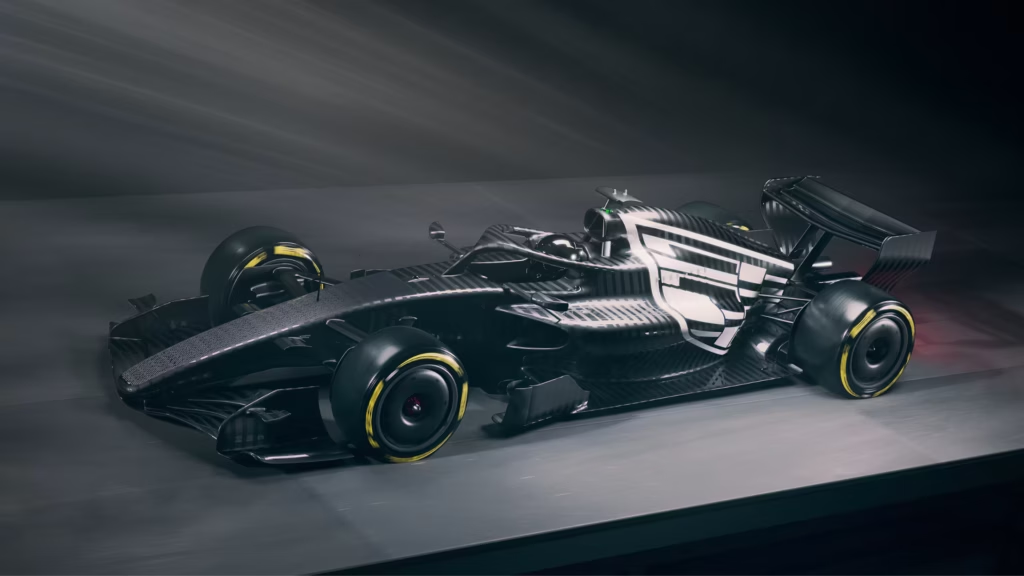
On January 13, 2026, Formula 1 reported that the Cadillac Formula 1 Team has unveiled a special one-off livery that will be used during the all-team Barcelona Shakedown later this month.
The American outfit is set to make its Formula 1 debut this season, fielding an experienced driver pairing as Valtteri Bottas and Sergio Perez return to the grid to lead the team’s inaugural campaign.
Cadillac will reveal its official race livery for the 2026 Formula 1 season on February 8 during the Super Bowl, just days before pre-season testing begins in Bahrain. As a result, the Barcelona running, scheduled for January 26–30, will feature a unique testing livery created specifically for the shakedown.
The one-off design adopts a monochrome theme with a geometric pattern rendered in alternating gloss and matte finishes, complemented by a prominent Cadillac crest across the rear of the car. The concept is intended to obscure key aerodynamic surfaces, a common practice during pre-season testing, particularly in years marked by significant regulatory changes.
Adding a personal element, the livery also incorporates the names of the team’s founding members from both the United States and the United Kingdom.
General Motors President Mark Reuss said the testing livery reflects Cadillac’s design roots while maintaining competitive discretion. “Our new testing livery celebrates Detroit’s design heritage and the strength of the global Cadillac Formula 1 team, while keeping our design secrets under wraps,” he said. “The Barcelona test is just the beginning—we’re excited to share our official race livery with fans around the world next month.”
Team CEO Dan Towriss echoed that sentiment, emphasizing the team’s broader vision. “The Cadillac Formula 1 Team is committed to innovation on and off the track. The combination of TWG and General Motors allows us to challenge convention and introduce the team in bold, unconventional ways,” he said. “Revealing our race livery during a globally televised championship broadcast brings Cadillac Formula 1 to a worldwide audience. Paired with this special-edition testing livery from the GM Design studios, we’re honoring our automotive heritage while looking ahead as we build toward the 2026 season.”
Cadillac is expected to complete an initial shakedown at Silverstone before heading to Barcelona for the all-team test.
Formula 1 on Track to Be Net Zero by 2030 With 26% Reduction in Carbon Footprint
Formula 1 remains firmly on course to achieve its goal of reaching Net Zero by 2030, having cut its carbon emissions by 26 percent by the end of 2024 compared with its 2018 baseline. In July 2025, Formula 1 reported the news.
This progress has been driven by close collaboration across the sport, including Formula 1 teams, commercial partners, race promoters, and the FIA. Notably, these reductions have been achieved during a period of significant growth. Since 2018, the race calendar has expanded from 21 events to 24 races in each of the past two seasons, while annual attendance has increased from 4 million to 6.5 million spectators.
Over the same period, Formula 1’s global fanbase has grown to more than 826 million. According to the latest sustainability update, the sport’s carbon footprint would have risen by an estimated 10 percent compared with 2018 had no operational changes been implemented.
The report confirms that Formula 1 has already surpassed the halfway mark toward its minimum target of a 50 percent emissions reduction under its Net Zero by 2030 commitment. Any remaining emissions that cannot be eliminated will be addressed through credible offsetting programmes aligned with current best-practice standards.
At the conclusion of the 2024 season, Formula 1’s total carbon footprint stood at 168,720 tonnes of CO₂ equivalent, down from 228,793 tonnes in 2018. The update also includes a re-baselining of the 2018 emissions figure, reflecting improved supplier data and alignment with internationally recognised accounting standards. As a result, the 2018 baseline was revised from 256,551 to 228,793 tonnes of CO₂ equivalent, ensuring that reported reductions reflect genuine performance improvements rather than changes in methodology.
Formula 1 President and CEO Stefano Domenicali reaffirmed the sport’s commitment to sustainability, noting that the emissions reductions already achieved demonstrate that global growth and environmental responsibility can progress in parallel. He emphasized that innovation remains central to Formula 1’s approach, with upcoming initiatives including the introduction of advanced sustainable fuels across all Formula 1 cars.
Domenicali added that these developments have the potential to deliver broader benefits for road vehicles and other transport sectors, and thanked the FIA, teams, partners, and promoters for their continued support in advancing the sport’s Net Zero ambitions.