New Report Says Costs for Next-Gen AVs Beginning to Approach Parity With Human-Operated Rideshares
In January 2026, Emil Koenig, Senior Research Analyst, Power & Renewables at Wood Mackenzie, reported that variable operating costs for next-generation autonomous electric vehicle (AEV) platforms are approaching parity with traditional human-operated rideshare services. This inflection point positions the sector for rapid fleet expansion, reshaping urban mobility and introducing significant new electricity demand.
In AI on Wheels: Autonomous EV Fleets and Their Impact on the Grid, Wood Mackenzie examines how declining costs across hardware, energy consumption, and cloud storage are unlocking scalable deployment. The report also evaluates diverging technology strategies, multi-modal sensor stacks versus vision-only systems, and how these approaches will influence competitive positioning, capital intensity, and rollout timelines. As fleets scale, charging demand will concentrate in urban depots, requiring new infrastructure configurations and grid-planning frameworks that leverage the inherent flexibility of managed charging.
The Cost Barrier Is Eroding
For years, the autonomous vehicle industry faced a core economic challenge: proving that self-driving systems could compete with the cost of a human driver. Wood Mackenzie’s modeling indicates that AEV operators are now nearing variable cost parity. With that threshold in sight, companies can shift from pilot-scale validation to large-scale fleet deployment aimed at absorbing substantial AI development and engineering overhead.
Cost compression has occurred across several vectors. Sensor hardware expenses have declined sharply as multi-modal platforms streamline lidar, radar, and camera configurations, with manufacturing scale reducing total sensor costs by up to 75% compared to early prototypes. Simultaneously, improvements in drivetrain efficiency and vehicle architecture are cutting electricity consumption per mile by as much as one-third on next-generation platforms.
Cloud storage—a previously dominant variable cost—has also fallen. Early-stage fleets retained extensive vehicle data for machine-learning training. As algorithms mature and accumulate autonomous driving miles, data retention requirements decline substantially. Mature operators now retain only a fraction of the data once required, materially lowering ongoing storage expenditures.
Diverging Technology Strategies: Waymo Safer Than Tesla Robotaxis
The industry is pursuing two primary technological pathways.
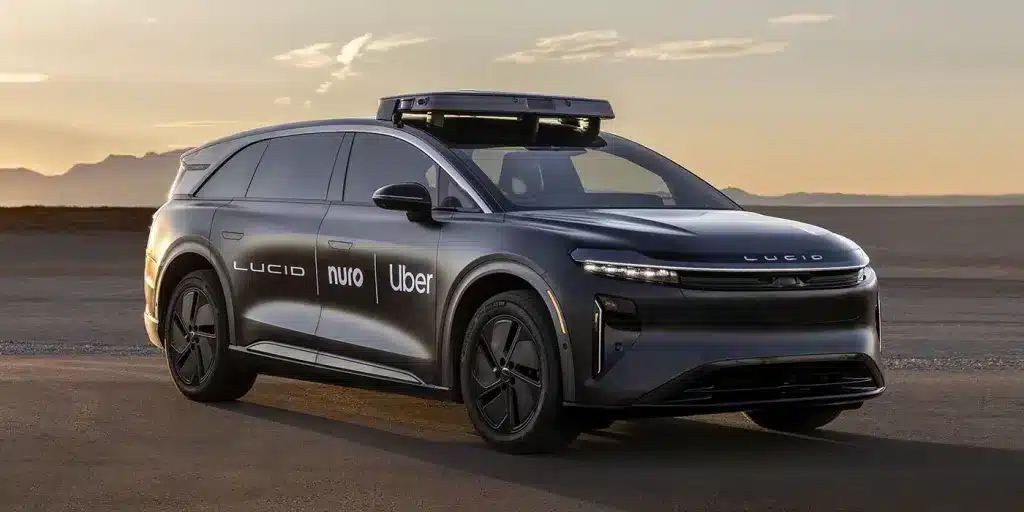
The multi-modal approach, backed by companies such as Waymo, Uber (in partnership deployments such as Lucid), and Zoox, integrates cameras, lidar, radar, and high-definition mapping. These systems currently account for 20–30% of total vehicle energy consumption but have demonstrated Level 4 autonomy in defined environments. Next-generation iterations are expected to reduce energy intensity by 40–60%.
By contrast, Tesla is pursuing a vision-only strategy built around camera systems and advanced AI. This architecture promises lower variable costs through simplified sensor arrays and lightweight vehicle design. However, its commercial viability depends on proving that camera-based systems can meet or exceed the safety performance of multi-modal stacks without heavy reliance on human oversight. So far, it has been proven as less safe.
Automotive World reported in October 2025 that updated filings from the National Highway Traffic Safety Administration (NHTSA) show that Tesla’s vehicles have reported four crashes across roughly 250,000 miles since June 2025, or one crash roughly every 62,500 miles; this is far more than Waymo’s 1,267 crashes over some 125 million driverless miles, equating to one every 98,600 miles.
From Parity to Scale
Wood Mackenzie projects U.S. autonomous EV fleets growing from approximately 2,500 vehicles today to 116,000 by 2030, a 46-fold increase concentrated in dense urban markets where utilization rates are highest and economics are strongest.
Electricity demand from these fleets is expected to increase 30-fold over the same period. While modest relative to total U.S. power consumption, this demand will be geographically concentrated at urban depot charging hubs, amplifying local grid impacts.
Infrastructure Evolution and Grid Integration
Current AEV fleets rely heavily on single-power-level DC fast charging to support midday turnaround between peak ridership windows. However, modeling suggests that hybrid charging strategies, combining Level 2 AC with DC fast charging, offer superior economic and operational outcomes.
Hybrid systems lower total charging costs by increasing reliance on lower-cost AC infrastructure and off-peak electricity rates. Although they require incremental upfront investment, operational savings enable rapid payback. More importantly, diversified charging infrastructure reduces peak power demand at depots and enables dynamic load management aligned with local grid conditions.
In many regions, this translates to shifting load to overnight hours when grid capacity is abundant and wholesale prices are lower. In solar-heavy markets, flexible charging can instead absorb low-cost midday renewable generation during peak output periods.
This operational flexibility aligns fleet economics with utility objectives. Managed charging programs can enhance renewable integration, smooth demand curves, and improve overall grid utilization—while simultaneously lowering operating costs for autonomous fleet operators.
The transition to AI-enabled electric mobility will not only transform transportation economics; it will also introduce a new class of controllable, high-density electrical loads. The extent to which grid infrastructure evolves alongside fleet deployment will determine whether this growth becomes a strain, or a strategic asset, for power systems.

Electric Vehicle Marketing Consultant, Writer and Editor. Publisher EVinfo.net.
Services