ParkENT Provides the World’s First Universal Secure E-Bike Charging Station
ParkENT was founded after a friend of the founders in college had two bicycles stolen in the same week. In a final insult, the thief left behind a sticky note that read “THANKS.”
The original concept was a smart bicycle rack designed to deter theft and improve security. While participating in the Georgia Tech Flashpoint Accelerator program, the team refined the concept and pivoted toward secure e-bike charging stations—an idea aligned with the rapid growth of e-bikes and micromobility devices.
Additional momentum came from the The FARM | Boomtown Comcast NBCUniversal Accelerator program, which helped sharpen Parkent’s market positioning and amplify its visibility.
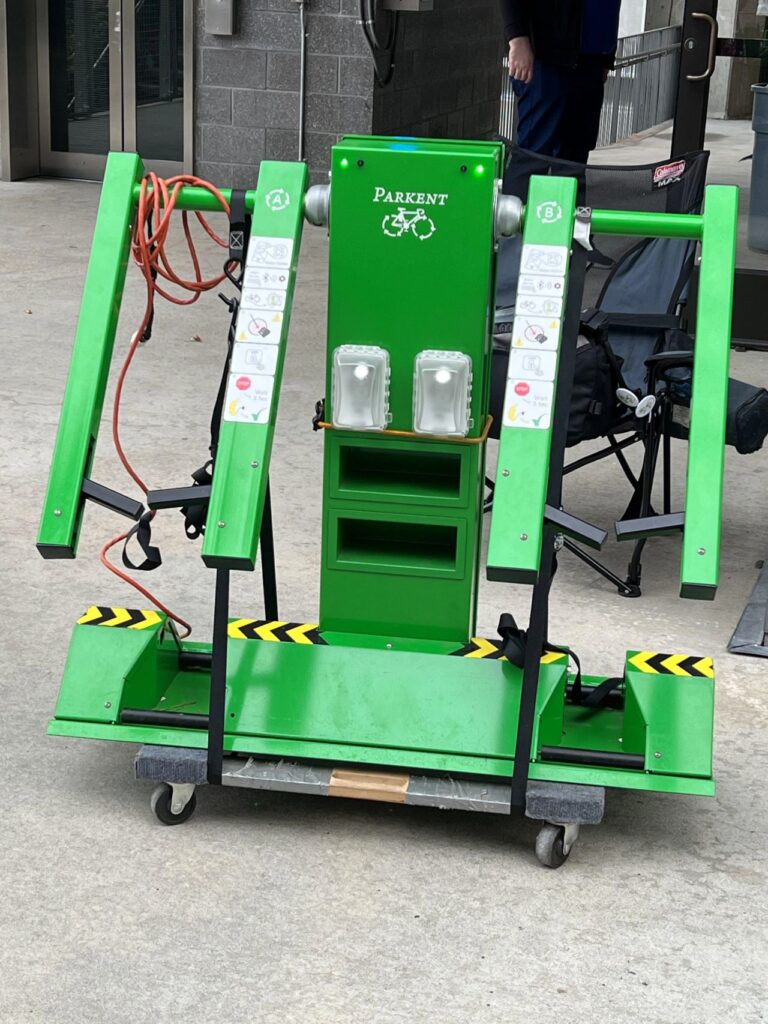
Today, ParkENT proudly delivers what it describes as the world’s first universal secure e-bike charging station, purpose-built to meet the evolving needs of modern micromobility users. ParkENT stations can securely park and charge any e-bike, e-cargobike, e-trike, and e-pedicab on the market. Each station employs second life batteries from e-scooters.
At the Atlanta Corporate Innovation Summit, hosted by The Bridge Community and the Metro Atlanta Chamber, ASBN interviewed Thad Oviatt, founder and CEO of ParkENT Cycles, about addressing Atlanta’s growing demand for sustainable transportation.
ParkENT Cycles designs secure electric bicycle charging stations to support the rapidly expanding e-bike market. Oviatt noted that in the previous year, 100,000 more e-bikes were sold in the U.S. than electric cars, highlighting the sector’s momentum. With e-bikes offering 20 to 70 miles of range, users often face “range anxiety,” particularly since most charging currently happens at home.
ParkENT’s solution combines secure locking and universal charging compatibility for all e-bike chargers on the market. Users can locate stations through a mobile app, check availability, dock their bike, activate charging, and leave it securely while they visit nearby businesses.
The company’s business model targets property owners, mixed-use developments, municipalities, and campuses. Hosts lease or purchase the stations, benefit from EV tax rebates, and potentially increase revenue, as secure bike parking can drive higher foot traffic. Charging costs are minimal, making the offering financially attractive.
Based in Georgia, ParkENT has installed prototypes, is developing stations in Woodstock and Suwanee, and is working with Georgia Power to identify pilot sites across metro Atlanta. The startup, currently operating from a garage, is seeking seed funding to scale deployment.
E-Bike Charging Station Market: Powering the Next Phase of Urban Micromobility
The e-bike charging station market is shifting from pilot programs to structured urban infrastructure as cities expand sustainable transportation systems and shared micromobility networks.
The global market is valued at approximately USD 3.25 billion in 2026 and is projected to reach USD 4.37 billion by 2035, growing at a CAGR of 3.76 percent between 2026 and 2035. Growth remains steady rather than rapid, reflecting infrastructure-driven deployment, municipal budgeting cycles, and integration with broader mobility planning initiatives.
Asia-Pacific accounts for roughly 80 percent of global charging deployments, led by China and India. Level-2 charging represents about 70 percent of installations and is the preferred standard for public and shared mobility hubs. Public docking installations increased 45 percent between 2021 and 2023, driven by bike-share expansion and city programs. Urban planning frameworks typically target one to five stations per square kilometer in high-usage areas. Subsidies and grants frequently cover 20 to 50 percent of capital expenditures, accelerating adoption in early-stage rollouts.
Solar-enabled and microgrid-supported stations now account for approximately 25 percent of new deployments. Modular charging hubs with two to four connectors are gaining traction due to ease of installation and scalability. IoT-enabled smart stations with usage analytics and predictive maintenance capabilities represent about 30 percent of new installations. Integration with shared e-bike and e-scooter fleets is improving utilization rates, while buffer storage systems in the five to ten kilowatt-hour range are increasingly used to manage peak load and grid constraints.
The competitive landscape remains moderately consolidated, with leading vendors securing roughly 40 percent of municipal contracts. Competition is increasingly defined by durability, renewable integration, modular design, and intelligent software platforms rather than hardware scale alone.
E-bike charging is evolving into critical urban infrastructure rather than a supplemental micromobility feature. Vendors that align with smart city planning, renewable energy integration, and shared mobility ecosystems are positioned to capture long term contract based growth.