Hyundai Motor Introduces Its Electric Powered, Unmanned Firefighting Robot
On March 3, 2026, Hyundai Motor Group released a campaign video titled “A Safer Way Home,” introducing its Unmanned Firefighting Robot, a next-generation disaster response platform developed jointly with South Korea’s National Fire Agency.
The robot is the product of collaboration across multiple Hyundai affiliates, including Hyundai Motor Company, Kia, Hyundai Rotem, and Hyundai Mobis. It was first unveiled and formally donated to the National Fire Agency at an official ceremony on February 24, 2026. The campaign video, which features footage from a real-world deployment and narration from an active-duty firefighter, is intended to demonstrate how robot technology can protect and rescue people in environments too dangerous for human responders.
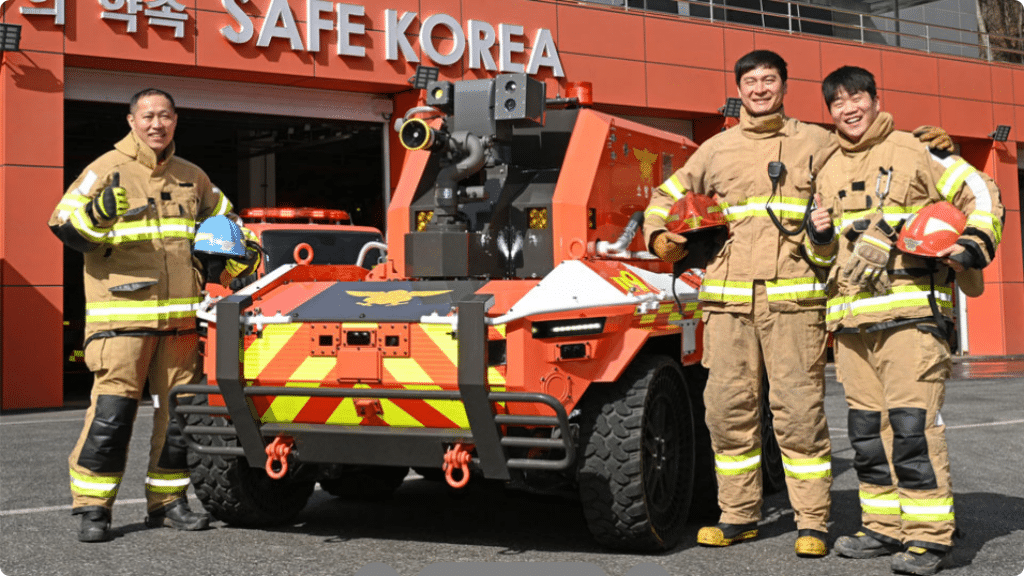
A key component of the robot’s mobility system is a 6×6 in-wheel motor system developed by Hyundai Mobis, which places a motor in each of the six wheels. This configuration enables 360-degree rotation in place for precise maneuvering in confined spaces, while waterproof and dustproof electrical modules provide durability in harsh conditions. By eliminating the need for a conventional drive shaft, the design improves drive efficiency and control, and Hyundai sees potential for this architecture in other applications requiring low-speed precision, including last-mile logistics robots and autonomous shuttles.
Beyond fire suppression, the robot is positioned as a data acquisition platform that digitizes disaster scenes in real time, capturing information on smoke volume, fire scale, and temperature. That data is intended to feed machine learning systems that will make future versions of the robot progressively more capable. The long-term vision shared by Hyundai Motor Group, the National Fire Agency, and the National Fire Research Institute is a fully autonomous system able to independently assess a situation upon arrival, identify the fire’s origin, determine suppression priorities, and calculate the most efficient path to extinguishing the blaze without human direction.
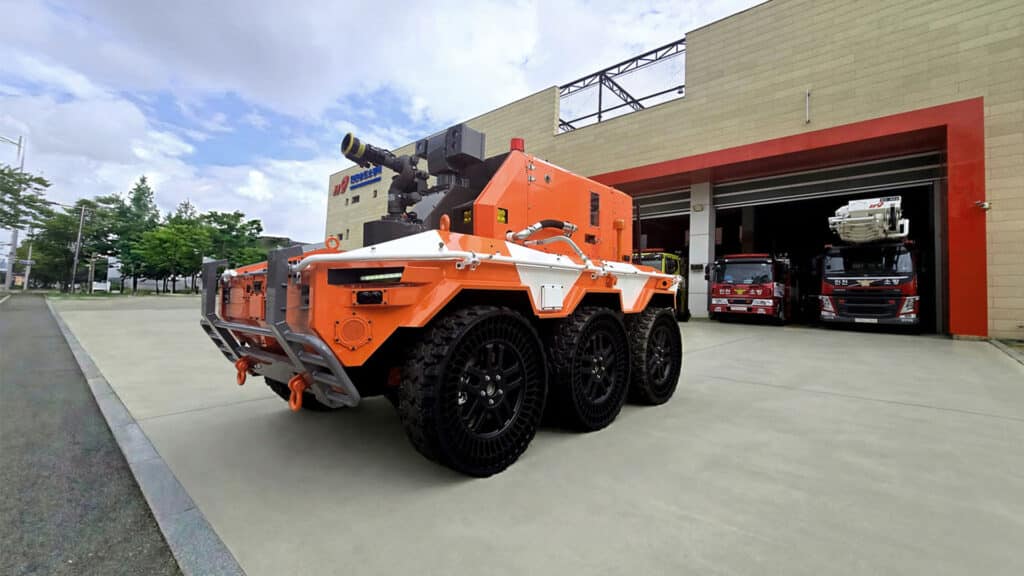
The National Fire Agency expects the robot to play a significant role in scenarios where direct firefighter access is limited, and has signaled its intent to continue modernizing firefighting equipment to improve both safety and operational efficiency in disaster response.
Why Electric-Powered Robots Are the Future of Firefighting
Firefighting has always demanded extraordinary courage from the people who do it. But even the most skilled and experienced firefighter faces hard limits when a building is fully engulfed, a chemical plant is burning, or a structure is at risk of collapse. Robots purpose-built for disaster response are changing what is possible in those situations, and the way those robots are powered matters enormously.
Electric powertrains are a natural fit for firefighting robots, and not simply because the industry is moving toward electrification broadly. The case for electric in this specific application is grounded in the realities of the environment these machines operate in.
The Problem With Gas Power in a Fire
A gasoline or diesel-powered robot carries its own fuel source into one of the most dangerous environments imaginable. Combustion engines rely on flammable fuel, and in a fire scenario where temperatures can exceed a thousand degrees and the air is saturated with accelerants, that fuel becomes a liability. A robot powered by an internal combustion engine is, in a meaningful sense, a vehicle that could catch fire, which is exactly the opposite of what you want when you are sending it into a blaze.
Electric motors eliminate that risk. There is no fuel tank to rupture, no combustion cycle to sustain, and no flammable fluid coursing through the system. The energy source is a battery, which, when properly engineered with robust thermal management and protected housing, is far less susceptible to ignition from external heat than a tank of gasoline or diesel. Electric robots can be built to withstand extreme thermal environments in ways that their gas-powered counterparts fundamentally cannot.
Beyond fire risk, electric powertrains offer other operational advantages in this context. They produce no exhaust, which matters in enclosed or partially enclosed structures where visibility and air quality are already severely compromised. They operate more quietly, which is a practical benefit when human operators and incident commanders need to communicate clearly. And they deliver torque instantly and precisely, which translates into more responsive, controllable movement in the kind of tight, obstacle-filled environments firefighting robots regularly encounter.
AI and Human Operators Working Together
The most capable firefighting robots are not fully autonomous and they are not purely remote-controlled. The most effective architecture combines both: artificial intelligence handling the continuous, high-speed processing demands of the environment, and a human operator providing judgment, oversight, and strategic direction.
A fire scene generates enormous amounts of data in real time. Temperatures shift, structural elements move, smoke obscures visibility, and conditions that were stable thirty seconds ago may no longer be. AI systems can process sensor input from cameras, thermal imaging, smoke detectors, and environmental monitors simultaneously, building a continuously updated picture of the scene and adjusting the robot’s behavior accordingly. They can detect the origin point of a fire, model how it is spreading, identify the most efficient suppression path, and flag structural hazards before a human operator would notice them.
At the same time, a human operator brings something AI currently cannot fully replicate: contextual judgment built from experience, the ability to weigh factors that fall outside a sensor’s field of view, and accountability. A remote operator watching a live feed from inside a burning structure can make calls that require understanding not just what the robot sees, but what the broader incident command knows about the building, the occupants, and the resources available.
The ideal system positions AI as the robot’s fast-thinking, data-processing layer, handling navigation, obstacle avoidance, and real-time environmental response, while the human operator functions as the decision-maker for higher-level strategy and intervention. Neither replaces the other. Together, they extend what is possible far beyond what either could achieve alone.
Protecting the People Who Protect Everyone Else
The ultimate argument for electric-powered, AI-assisted firefighting robots is not technical. It is human. Firefighters die in the line of duty every year, often in the exact scenarios where a robot could operate instead: fully involved structures, hazardous material fires, environments where the risk of collapse or explosion makes human entry unconscionable.
Sending a robot in first, or instead, does not diminish the role of firefighters. It protects them. It reserves their irreplaceable skills and experience for the situations where human presence is genuinely necessary, and keeps them out of the ones where it is simply too dangerous to justify. Electric power makes those robots more reliable and less dangerous in the environments where they are needed most. AI makes them smarter and more capable with every deployment. And remote human operators ensure that the judgment and accountability of an experienced professional remains in the loop at all times.
That combination is not just a technological advancement. It is a better way to keep the people who run toward fires alive to do it again.

Electric Vehicle Marketing Consultant, Writer and Editor. Publisher EVinfo.net.
Services