Suzuki Announced it is Acquiring Kanadevia Corp’s All-Solid-State EV Battery Business
Suzuki Motor is the latest Japanese automaker to go all-in on solid-state batteries, announcing an agreement to acquire the all-solid-state battery business of Kanadevia Corp, a leading Japanese industrial and engineering firm that has been developing the technology since 2006. Suzuki made the announcement on March 4, 2026.
The acquisition includes Kanadevia’s proprietary dry manufacturing process and a battery with a remarkable track record. These are not lab prototypes. Kanadevia’s solid-state batteries have already been deployed in real-world conditions, including space.
In February 2022, in partnership with JAXA, the Japan Aerospace Exploration Agency, Kanadevia launched an all-solid-state battery to the International Space Station in what was described as a world first. The batteries operate across an extreme temperature range of -40 to +120 degrees Celsius, making them viable for aerospace, high-temperature, and vacuum environments.
Safety is another compelling advantage. In nail-piercing tests, a standard benchmark for battery safety, Kanadevia’s solid-state batteries showed no ignition, no smoke, and no explosion. A traditional lithium-ion battery would ignite under the same conditions.
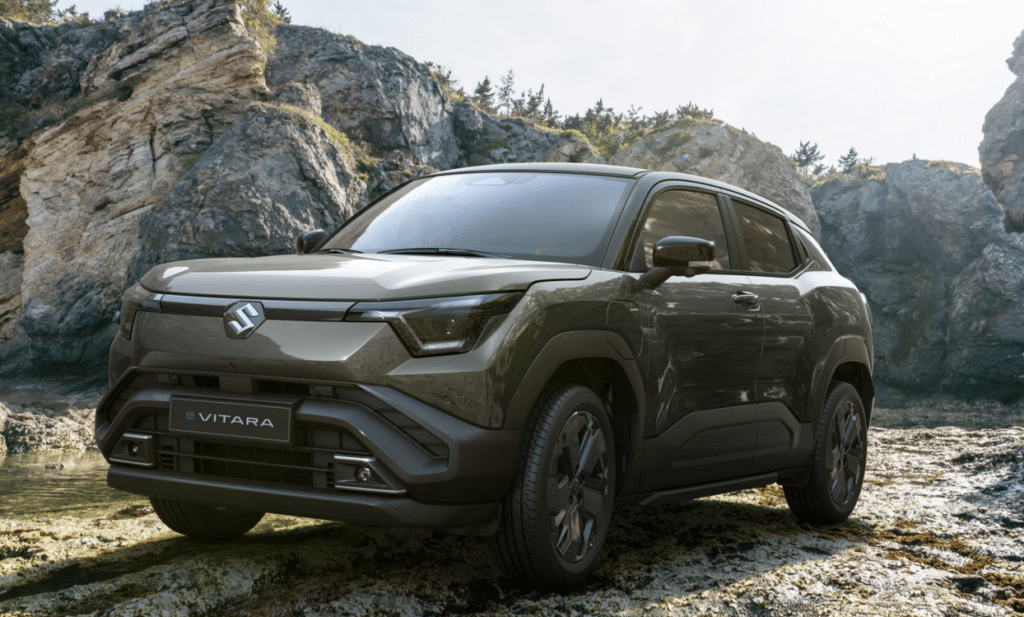
The deal is expected to close July 1, 2026. It comes as Suzuki is just entering the EV market, having launched its first mass-produced electric vehicle in Europe, the e-Vitara, in late 2025.
Solid-state batteries are widely considered the holy grail of EV technology, promising greater energy density, faster charging, and significantly improved safety over conventional lithium-ion cells. Suzuki is now firmly in that race.
Japan’s EV Makers Racing to Win Solid State Race
Japan’s major automakers are now aligned behind solid-state batteries as the next leap forward for electric vehicles. Suzuki’s acquisition of Kanadevia’s solid-state battery business puts it alongside Toyota, Honda, and Nissan, all of which are targeting EV launches equipped with the technology around 2027 or 2028, with mass production expected toward the end of the decade.
Progress is already visible. In January, Japanese oil giant Idemitsu broke ground on a large-scale solid electrolyte pilot plant in collaboration with Toyota, which will supply materials for Toyota’s future solid-state EVs. Toyota has also revealed a solid-state battery pack claiming a range of 745 miles and a charge time of under 10 minutes. Suzuki has not yet shared equivalent specs from its newly acquired technology.
Japan is not alone in this race. Chinese and German automakers have also reported recent breakthroughs, with solid-state batteries moving steadily from laboratory research into real-world applications. The momentum is global and accelerating.
For drivers, the direction is clear. Solid-state batteries promise greater range, faster charging, and improved safety compared to today’s lithium-ion cells. Whether the timeline holds or slips, as it has before with some of these manufacturers, the underlying technology is maturing across multiple continents at once. Electric vehicles are not standing still. The next generation will be meaningfully better, and the generation after that better still.

Electric Vehicle Marketing Consultant, Writer and Editor. Publisher EVinfo.net.
Services