UK’s Reading Buses Adds 24 Electric Buses, Including One With ‘Global Warming Stripes’
The first fully electric, battery-powered buses in the Reading Buses fleet entered service in February, marking a major milestone in the company’s 125th anniversary year. The timing is symbolic: in 1901, Reading Borough Council acquired the town’s horse-drawn tramway to electrify it. To celebrate the anniversary, bus number 4 carries a distinctive gold livery. Reading is a large, historic town and unitary authority in Berkshire, England, located in the Thames Valley, 38 miles west of London. Reading Buses been transporting customers in and around Reading for over 120 years.
The new fleet was officially launched on February 5, 2026, at the Great Knollys Street depot in Reading. The Zero Emission Buses for the Reading Area, known as ZEBRA, were unveiled alongside a new mascot, Zippy the Zebra, who will appear at future public events including the company’s charity Open Day.
A total of 24 electric buses will operate on two of the network’s busiest 24-hour routes: the purple 17 linking Tilehurst, Central Reading and Wokingham Road, and the claret 21 serving Central Reading, the University of Reading and Lower Earley. The fleet includes high-specification interiors and bold branding, plus several specially themed vehicles. These include a zebra-inspired ZEBRA design, a bus featuring the Berkshire warming stripes created by Professor Ed Hawkins of the University of Reading to highlight climate change, and the anniversary gold bus.
The striking global warming stripes graphic, developed by climate scientist Ed Hawkins, presents a sequence of colored bands that transition from cool blues to deep, intense reds. Each stripe corresponds to a single year of global temperature data, compressing more than a century of warming into a clear, data-driven visual narrative. The progression is unmistakable: as your eye moves along the bus, the colors grow progressively hotter.
Previously confined to lecture theatres, social media feeds, and climate demonstrations, the climate stripes will now reach a far broader audience. Displayed on a zero-emission bus, the design will pass through the town centre and surrounding neighborhoods each day, bringing a stark representation of rising temperatures directly into the daily routines of thousands of commuters.
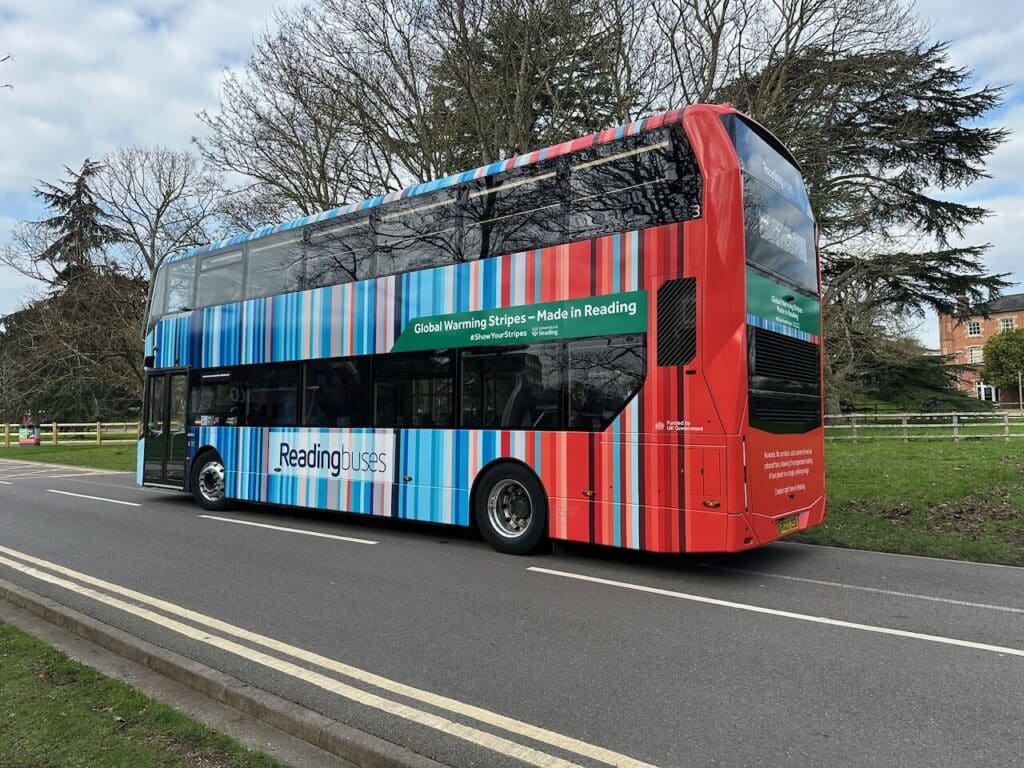
Ed Hawkins is a Professor of Climate Science at the University of Reading, and announced spotting the buses on the Reading campus on March 3, 2026.
Hawkins said: “The new Reading ‘warming stripes’ double-decker electric bus came to campus today. The bus is painted in the local warming stripes to start climate conversations throughout the town. Well done Reading Buses!”
Each electric vehicle replaces a diesel bus on a one-for-one basis under the fleet renewal programme and can be recharged without disrupting round-the-clock operations. Existing biomethane-powered purple 17 buses will be refurbished and redeployed to routes 23/24 and 15/16. A further six electric buses are due to join the yellow 26 route in 2026.
The zero-emission buses are expected to reduce carbon emissions by approximately 1,819 tonnes of CO2e annually compared with the diesel vehicles they replace, based on current grid electricity. Passenger features include heat pump-driven air conditioning and heating, audio-visual next-stop information with hearing loop, USB-A and USB-C charging at every seat, wireless charging, high-back seating, LED lighting, tables, extra luggage space, free WiFi, dual wheelchair bays, and tap-on tap-off ticketing.
Driver and safety enhancements include camera mirrors, reversing sensors, a PA system, a curved windscreen design, and comprehensive CCTV coverage.
With 75 biomethane buses already in operation, more than 60 percent of the fleet is now low or zero emission. The project was supported by funding secured by Reading Borough Council through the Department for Transport’s ZEBRA scheme, covering 75 percent of incremental costs and infrastructure. The buses were built by Alexander Dennis in Larbert, Scotland, with charging infrastructure supplied by Zenobe.