Vauxhall, Kerbo Charge Partner, Over 40% of UK Councils to Provide Cross-Pavement EV Charging by End of 2026
Stellantis, parent company of Vauxhall, announced that Vauxhall has added Kerbo Charge to its Electric Streets of Britain campaign, expanding access to practical at home charging for drivers without driveways. The company made the announcement on April 16, 2026.
The partnership comes as new research from Vauxhall shows growing momentum for cross pavement charging. By the end of 2026, 42% of councils are expected to offer this solution. Among tier one councils across England, Scotland, and Wales, 56 already provide or plan to introduce cross pavement charging this year, opening up access for millions of drivers.
Currently, only seven of the 134 councils that responded to a Freedom of Information request have fully operational cross pavement charging. Another 21 are running trials, while 28 plan to roll out the solution in 2026. Despite this progress, approaches vary widely between councils. Installation costs range from free in some areas to more than £1,000 in others, and application processes often lack consistency.
The challenges have also been highlighted by Electric Vehicle Association England, which reported confusion among residents about how to apply, limited transparency, and long approval timelines.
Kerbo Charge has emerged as a leader in this space, installing more than 1,000 cross pavement channels since early 2024 with backing from investor Deborah Meaden. Its research shows that 53% of drivers would only consider an EV if they could charge at home, underscoring the importance of accessible solutions.
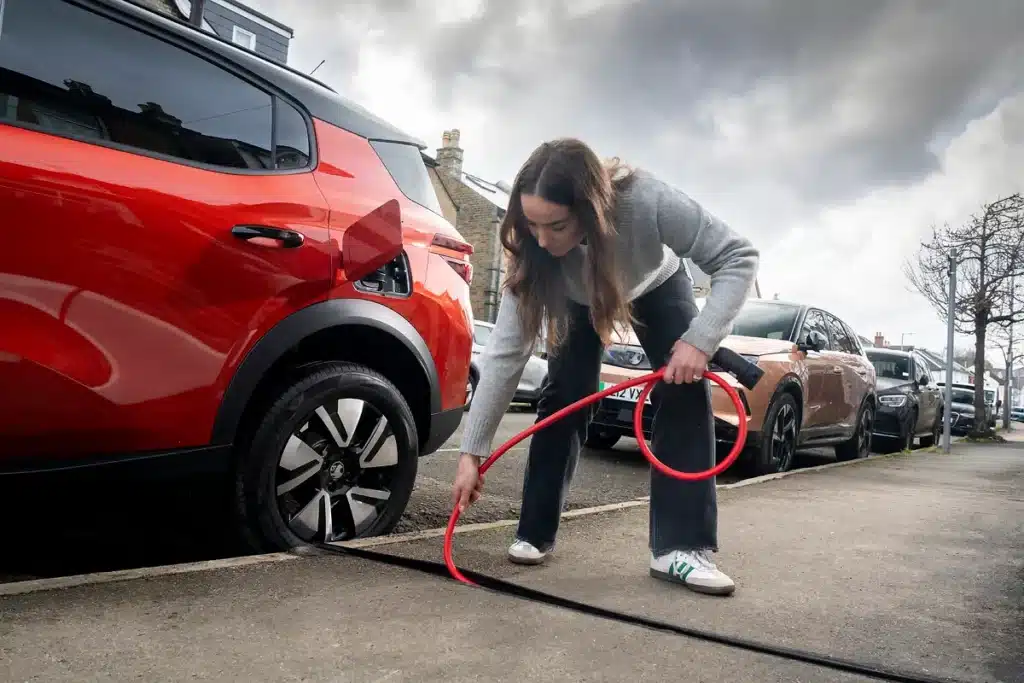
As part of the collaboration, Vauxhall is offering new EV buyers £500 toward a Kerbo Charge installation through its Electric All In program. Cross pavement charging works by routing a cable through a discreet channel embedded in the sidewalk, allowing safe connection from a home charger to a parked vehicle. This enables urban residents without driveways to access lower cost home charging.
Launched in 2023, Electric Streets of Britain aims to improve charging access for the roughly 40% of UK households without off street parking. Vauxhall continues to gather data from drivers and share it with councils to help guide future infrastructure planning.
The initiative aligns with Vauxhall’s broader electrification strategy. Since 2024, the company has offered an electric version of every car and van in its lineup, with all electric models priced under £40,000 and eligible for government incentives.
Eurig Druce, Managing Director, Vauxhall and Group Managing Director, Stellantis UK, said: “Cross-pavement charging is a great way to ensure EV charging access is available for the millions of drivers wanting to be able to charge at home, opening the door for many who are thinking about making the switch but still have concerns about practical charging near them. To allow drivers across the country to feel confident going electric, councils need to ensure they are providing drivers with as much clarity as possible about the options available to them, and how they can install EV charging outside their door.
“We are looking forward to working with Kerbo Charge to help even more drivers access practical charging solutions near them, and support councils on their own journeys to help more local residents to go electric.”
EVinfo.net’s Take: Would Cross-Pavement Channel Installation Work In the US and Canada?
A major barrier to EV adoption in the United States and Canada is not technology or demand, but simple access to charging at home. Millions live in houses or housing without garages or driveways, especially in older urban neighborhoods and dense suburban areas. For these residents, installing a traditional home charger is often not possible, which means they miss out on one of the biggest advantages of EV ownership: convenient, low cost overnight charging.
That gap has real consequences. Without home charging, EV ownership becomes less practical and often more expensive, relying on public infrastructure that can be less reliable or more costly. This slows adoption, particularly among middle income households and renters who would otherwise benefit the most from the lower operating costs of electric vehicles.
One potential solution gaining traction abroad is cross-pavement EV charging. This approach allows a homeowner to run a charging cable from their house to a vehicle parked on the street through a protected channel embedded in the sidewalk. It provides a safe, permanent way to enable at home charging without requiring a driveway.
Could this work in the United States and Canada? Technically, yes. The concept is straightforward and aligns well with existing residential electrical systems. It could unlock home charging for millions of households, especially in cities with widespread street parking.
However, the challenge is not engineering, but regulation and standardization. Sidewalks are typically controlled by local governments, and any modification raises questions about accessibility, liability, and permitting. The U.S. also has strict requirements under the Americans with Disabilities Act, which means any solution must ensure sidewalks remain fully accessible for pedestrians, including those with mobility devices.
There is also the issue of fragmentation. Unlike more centralized national policies seen elsewhere, U.S. cities and states each have their own rules, which could lead to inconsistent rollout, permitting delays, and widely varying costs. These are the same issues already being observed in early international deployments.
That said, the potential upside is significant. If cities can develop clear standards and streamline approvals, cross pavement charging could become a scalable, relatively low cost solution to expand home charging access. It would complement, not replace, public charging networks by giving more drivers the option to charge where they live.
The broader takeaway is clear. Expanding EV adoption in the U.S. and Canada will require solutions tailored to real world housing conditions. Cross pavement charging is one of the more practical ideas on the table. If implemented thoughtfully, it could remove a key barrier and bring the benefits of EV ownership to millions more drivers.

Electric Vehicle Marketing Consultant, Writer and Editor. Publisher EVinfo.net.
Services