Final Saab Cars at Trollhättan Factory Head to Auction, Including EVs, EREV
On December 12, 1949, the first mass-produced Saab Automobile vehicle rolled out of the factory in Trollhättan, beginning a chapter that would become a defining part of Sweden’s automotive and industrial history. More than 75 years later, the final Saab vehicles still remaining at the legendary factory site are now preparing to leave the gates for the last time.
An upcoming auction hosted by Klaravik represents both the end of an era and a tribute to one of Sweden’s most iconic automakers.
Since that first production car debuted in 1949, Saab manufactured millions of vehicles that found homes across Sweden and around the world. Known for distinctive Scandinavian design, aviation-inspired engineering, and a fiercely loyal owner community, Saab became one of the country’s most recognizable automotive brands.
At the company’s height, approximately 10,000 workers operated on the factory floor in Trollhättan, helping turn Saab into a major industrial employer and export success story.
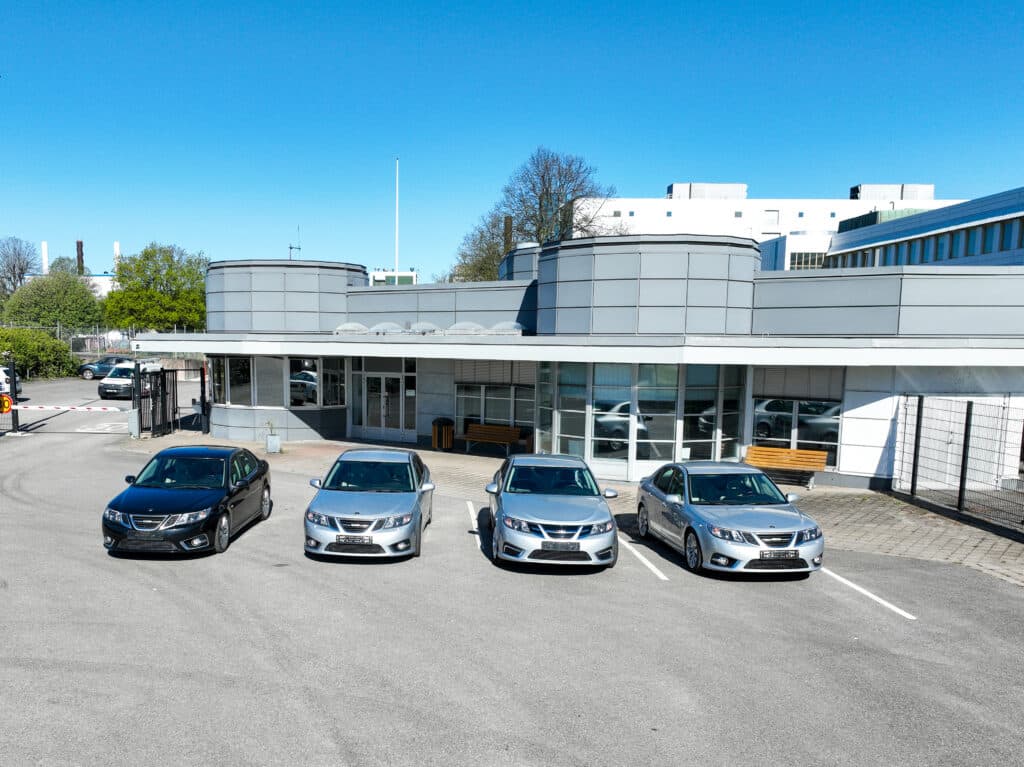
Now, decades after the brand’s production peak, the final remaining Saab vehicles at the historic site are being offered to enthusiasts and collectors through Klaravik’s auction platform. For Saab fans, the event is expected to be a rare and emotional moment, offering one final opportunity to own a direct piece of the company’s legacy as the last cars officially depart the factory grounds.
The final three Saab cars are Saab 9-3 Aero models from model year 2014 with low chassis numbers, among the very last mass-produced Saab cars ever built. Several unique development vehicles from the subsequent Nevs era will be sold:
– An electric 9-3, built in China, developed in Trollhättan.
– A 9-3 Aero, a test car used to collect road data in developing autonomous driving.
– An electric vehicle equipped with in-wheel motors.
– An Extended-Range Electric Vehicle (EREV), where a combustion engine is used to extend range.
The story of Saab Automobile came to a close in 2011, marking the end of one of Sweden’s most recognizable automotive brands. While Saab’s aerospace and defense divisions continued evolving into successful global businesses, the passenger car division faced a far more difficult path.
Following the end of Saab’s two-decade merger with Scania-Vabis in 1989, General Motors acquired a 50 percent stake in the newly formed Saab Automobile company. In 2000, General Motors took full ownership, effectively ending Saab’s independence as a Swedish-owned automaker.
From that point forward, Saab Automobile’s future became closely tied to General Motors’ financial stability. When GM entered a severe financial crisis during the global recession in 2008, Saab’s position quickly deteriorated as well.
An attempt to revive the automaker through a sale to Dutch sports car manufacturer Spyker Cars ultimately failed to reverse the company’s decline. Despite efforts to restructure and secure new investment, Saab Automobile AB filed for bankruptcy in December 2011, bringing an end to the iconic carmaker’s production history.
The bankruptcy closed the chapter on a brand long known for its aviation-inspired engineering, turbocharged performance, and uniquely Scandinavian design philosophy. Even after production ceased, Saab maintained a loyal global following, with enthusiasts continuing to preserve and celebrate the vehicles that once made the company a standout presence in the automotive world.

Electric Vehicle Marketing Consultant, Writer and Editor. Publisher EVinfo.net.
Services