Why is Ferrari’s Luce EV So Controversial?
The internet blew up with outrage about Ferrari’s new Luce, unveiled this week, the company’s first electric vehicle (EV). Ferrari is unique among automakers, and so are its product launches. Ferrari is based in Italy, and the company is so revered in the company’s home country that among the first people to sit behind the wheel of its first electric vehicle were the Italian president and Pope Leo.
Very few new vehicles have generated the kind of immediate and near-universal criticism that followed the debut of the Luce. What stands out most is that the outrage has not really been about the car being electric for the most part.
The consensus I would guess from the reactions I saw on Linkedin since the Luce release would be about 98% negative reactions. Nearly everyone seems to hate the Luce for various reasons. I purposely stay off other channels and focus on LinkedIn, as my EV marketing business is based on it.
Instead of the car being electric, people seem far more upset that it does not visually align with what many believe a Ferrari should look like. Comparisons were made to the Nissan Leaf, with many people commenting that the two cars looked remarkably similar, although the prices could not be more different. European sales of the Luce begin later this year with pricing around 550,000 euros, or approximately $640,000. Nissan’s website shows the lowest-priced Leaf price starting at $29,990.
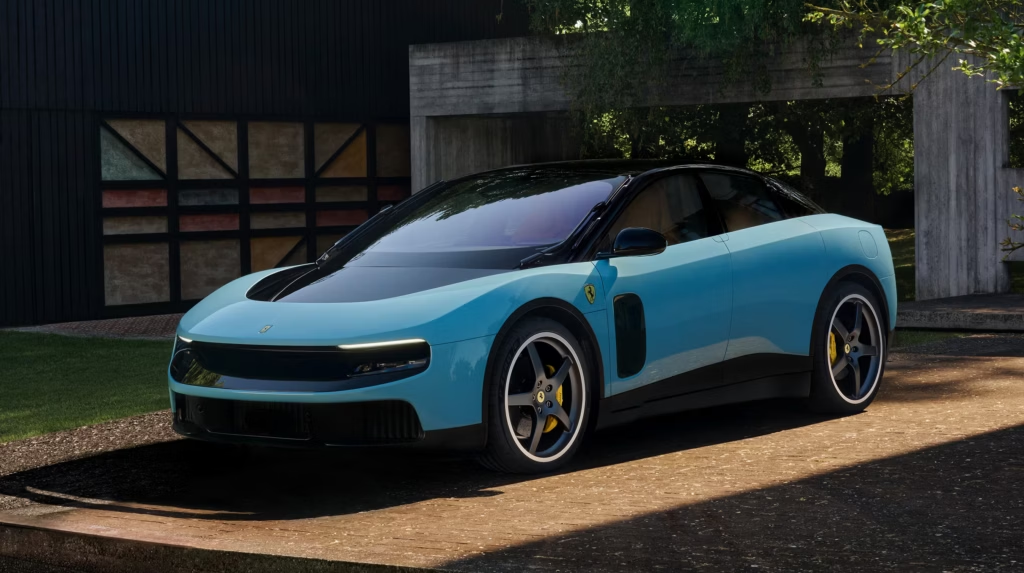
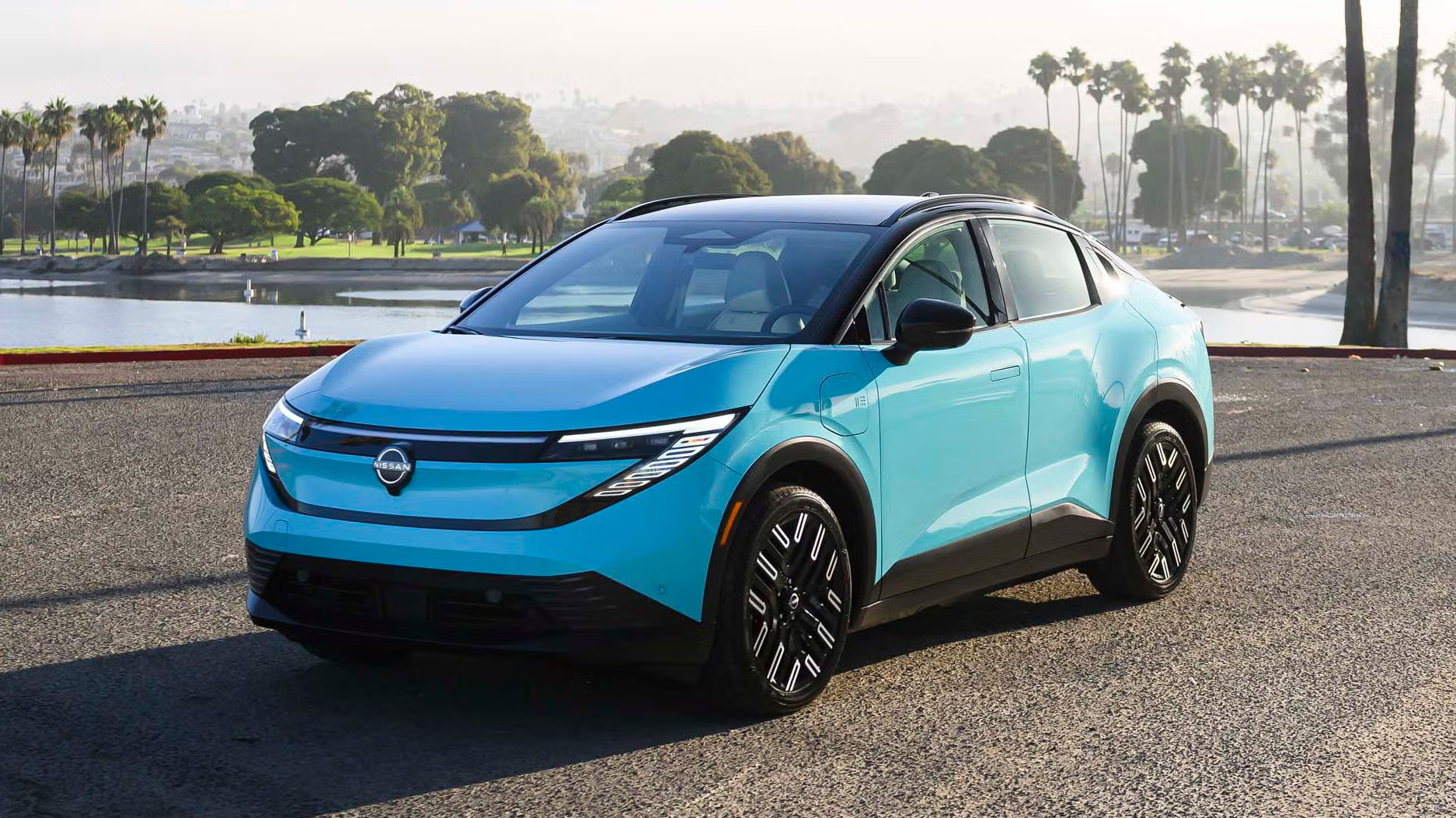
Many expected Ferrari to create something closer to an electrified Purosangue or a dramatic low-profile grand tourer. Instead, Ferrari introduced a vehicle with restrained surfacing and understated proportions that feel intentionally detached from the brand’s traditional styling language. Without the Ferrari emblems, many casual observers likely would not identify the Luce as a Ferrari at first glance.
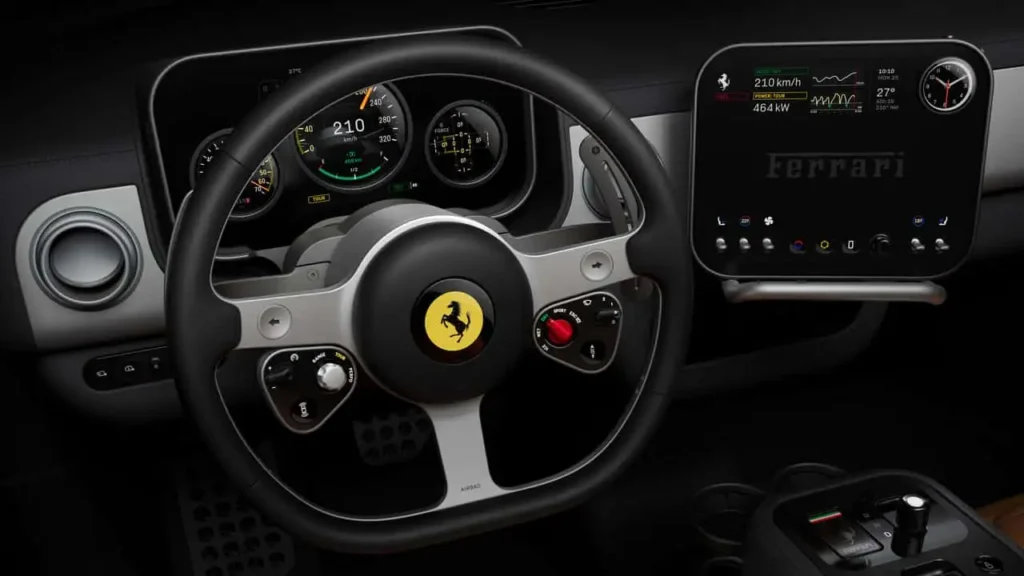
The warning signs that the Luce would be something radically different appeared long before the full car was shown. When Ferrari first revealed the interior, it was obvious the company was leaning heavily into a minimalist design philosophy strongly associated with Jony Ive. The cabin carried the polished, technology-focused atmosphere people normally associate with premium consumer electronics rather than traditional Italian supercars. While most enthusiasts disliked the direction, a few, including me, appreciated the cleaner and more modern approach.
Interestingly, the Luce becomes more coherent when viewed from above. From that perspective, it resembles less of a conventional sports car and more of a carefully designed luxury object. The proportions and simplicity start to feel intentional, almost as if Ferrari approached the project with the mindset of designing a premium piece of technology rather than a traditional performance car. In many ways, it feels closer to an Apple product translated into automotive form.
That connection is hardly accidental. Ferrari specifically brought in LoveFrom, the creative firm founded by Jony Ive and Marc Newson, to help shape the project. Ive built his reputation at Apple by creating products defined by simplicity, smooth surfaces, and minimal ornamentation. The philosophy centers on making products feel refined and complete without relying on aggressive styling or visual excess. Newson’s background also comes primarily from industrial and consumer product design rather than automotive design.
It is difficult to believe Ferrari miscalculated entirely. The company is famously protective of its image and deeply aware of how its products shape public perception of the brand. A design this unconventional was almost certainly backed by extensive research and approval from the type of customers Ferrari actually intends to sell the car to. Ferrari likely expected controversy, but perhaps not this level of unified rejection online.
Ferrari’s First EV faces Tesla and AMG Challenge
The Ferrari Luce enters the market as a 1,035-horsepower electric grand tourer powered by four motors and carrying an estimated price of around $640,000, but it arrives in a performance EV segment that Tesla’s Model S Plaid has already spent years defining. Although the Luce delivers slightly more peak horsepower and benefits from an 800-volt electrical system capable of 350 kW fast charging, the Plaid still leads in several key performance categories, including 0–60 mph acceleration, top speed, and estimated driving range. Tesla’s flagship reaches 60 mph in under two seconds, compared to Ferrari’s projected 2.4 to 2.5 seconds, while also offering a 200 mph top speed versus the Luce’s 193 mph. Range remains another advantage for Tesla, with the Plaid rated at approximately 348 miles compared to roughly 280 miles for Ferrari’s EV.
The comparison underscores how Tesla’s long-established EV platform continues to serve as the benchmark, even against ultra-luxury rivals entering the space. For Ferrari, a brand historically associated with uncompromising performance, falling behind Tesla in several headline specifications risks weakening the narrative surrounding its first electric vehicle launch.
The Luce’s larger 122 kWh battery pack is partly offset by its substantial 4,982-pound curb weight, which limits potential gains in both acceleration and driving range. Tesla’s Plaid, despite using a smaller battery estimated at around 100 kWh, benefits from years of efficiency improvements and software refinement that allow it to maximize both performance and range.
400 miles of EPA range and 400-kilowatt charging are quickly becoming common for luxury offerings from automakers like BMW and Porsche. Mercedes-Benz’s own new super sedan, the Mercedes-AMG GT, boasts over 1,000 horsepower, which is unheard-of in the U.S. The vehicle also offers 600 kW charging, and 700 kilometers (435 miles) of WLTP range. Mercedes says the AMG GT is the first Western production electric vehicle to use axial flux motors, a next-generation technology developed by YASA.
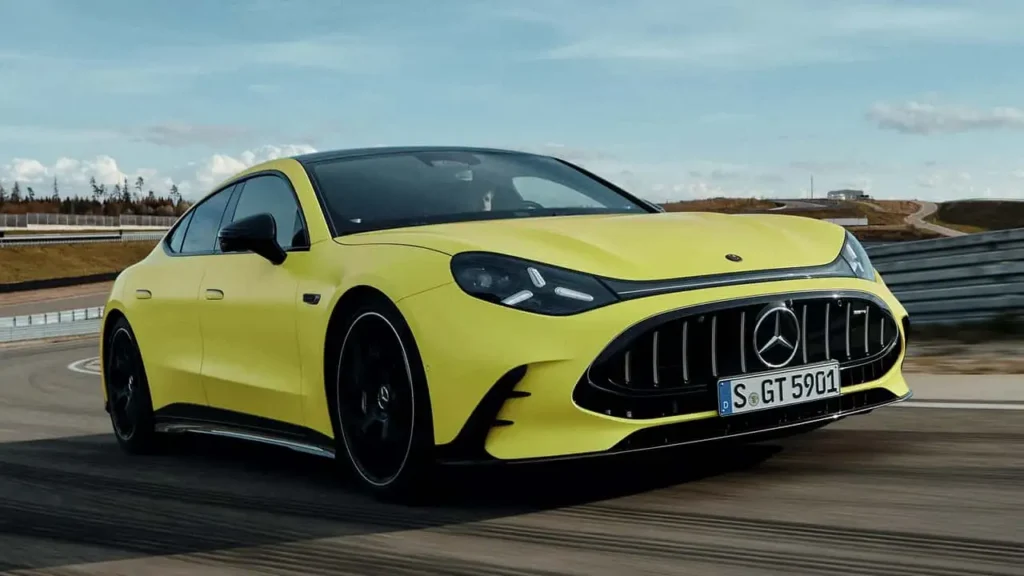
The benefits of the AMG are staggering. The GT 63 trim uses three motors—two mounted at the rear and one at the front—to produce an incredible 1,153 horsepower and 1,475 lb-ft of torque. That allows the sedan to rocket from 0-60 mph in just 2.3 seconds and hit 124 mph in only 6.4 seconds, with a top speed electronically limited to 186 mph. A slightly less extreme GT 55 version still delivers 805 horsepower and 1,328 lb-ft of torque.
Ferrari, however, is focusing on a different kind of advantage. The Luce features advanced per-wheel torque vectoring and sophisticated chassis technologies intended to preserve the brand’s signature driving dynamics. Rather than competing solely on straight-line numbers, Ferrari appears to be emphasizing handling precision and overall driving engagement as the defining characteristics of its EV approach.
Will the Luce Sell?
What matters more amid all the controversy is that if the Luce will actually sell. To determine that, only time will tell. Ferrari does not sell vehicles in huge numbers, unlike other automakers. So this will be interesting to see how it plays out.
If Luce fails, I believe it will be hard to tell why. There’s three main factors at play.
One, most sportscar and Ferrari fans don’t realize yet that EVs are superior in every way to equivalent gas vehicles. Many of the comments I saw on Linkedin were anti-EV as well as anti-Luce.
An example of this superiority is that the fastest production vehicle in the world is now a Chinese EV, BYD’s YangWang U9 Extreme. This is also true for average consumer vehicles, the broader driving public does not realize yet that EVs are the clearly best cost-saving and eco friendly choice, even though many problems still exist, which I have experienced firsthand as an early EV adopter.
Two, Ferrari is trying something brand new with Luce, an appeal to everyday drivers rather than occasional sportscar adventures. The understated look of Luce wouldn’t cause an uproar when dropping off the kids at school that a typical Ferrari would. But then, I’m guessing Ferrari owners enjoy the attention.
Three, Luce does not bring the massive performance offered by the AMG. Doing that would have shut down some of the naysayers at least.
What About Broader EV Adoption?
For broader EV adoption, it doesn’t really matter much if the Luce is successful or not, since Ferrari is a niche vehicle. I certainly won’t be buying one, on my unpredictable young startup income. I opted last year for a used 2024 BEV that I’m extremely happy with. It’s not a luxury model.
It would be best for EV adoption in general for this to be an overwhelmingly positive release for Luce, wowing everyone and converting gas die-hards to EV. But, so far it’s looking like another one of many setbacks EVs have experienced recently.
Over the last year and roughly four months, the current US administration has held back EVs and renewable energy with a variety of strategies and bad policy. But none of this will keep EVs and renewable energy from continuing to grow in the US.
We are seeing massive growth of both EVs and renewable energy globally from the high fuel prices of the Iran war. In the US, used EV sales rose 17 percent year-over-year in April and will keep growing.
I hope Luce sells well and proves the critics wrong, but whether Luce is successful or not won’t matter over the long term for EVs. Drivers are realizing EVs are not just the most eco friendly option, but the most cost effective as well. Home and business economics is what moves the needle on everything most substantially, so that is what really matters.

Electric Vehicle Marketing Consultant, Writer and Editor. Publisher EVinfo.net.
Services