Massachusetts Launches V2G Program Using Electric School Buses to Support the Grid
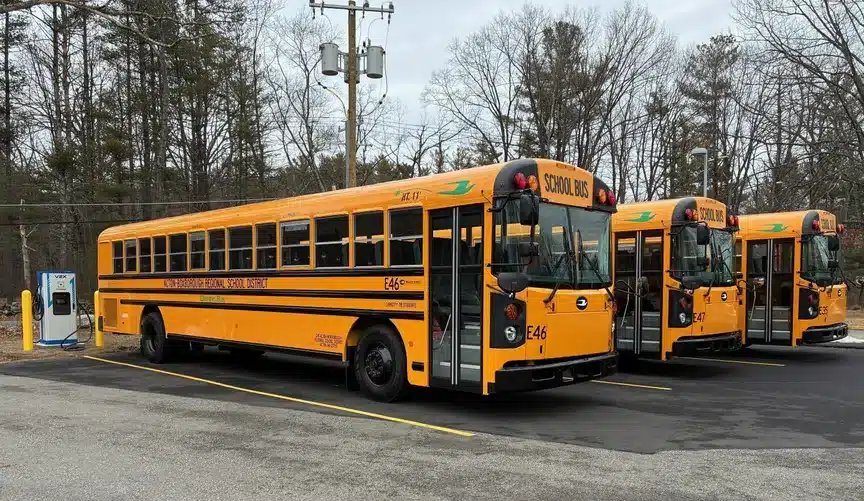
As students in the Massachusetts towns of Acton and Boxborough begin their summer break, the school district’s three electric school buses are taking on a new role. Rather than sitting idle in a parking lot, the buses will participate in one of the state’s first vehicle-to-everything (V2X) demonstration programs, using their batteries to help support the electric grid.
Each bus will charge its nearly 200-kWh battery overnight, when electricity is typically cleaner and less expensive. During periods of peak demand, generally between 4 p.m. and 7 p.m., the buses will discharge electricity back to the grid through bidirectional chargers. The district expects to earn revenue from supplying power, potentially offsetting much of its annual charging costs while helping reduce electricity prices and emissions.
Kate Crosby, energy manager for the Acton-Boxborough Regional School District, said increasing the number of batteries connected to the grid reduces reliance on natural gas peaker plants, helping stabilize the grid, lower electricity costs for ratepayers, and make the state’s energy supply cleaner.
The buses are the first vehicles participating in a Massachusetts initiative focused on demonstrating the potential of vehicle-to-everything technology. V2X systems use bidirectional charging equipment that allows electric vehicles to both receive electricity and send stored energy back to homes, buildings, or the electric grid.
Supporters say V2X offers multiple benefits. It enables EV batteries to store electricity when renewable energy generation is abundant and discharge it during periods of high demand. Participants can earn money by supplying electricity to the grid, improve resilience during power outages, and help utilities reduce the need for expensive peak generation resources.
Despite these advantages, widespread V2X adoption has remained limited. High equipment costs, technical complexity, inconsistent compatibility between vehicles and chargers, and the lack of standardized utility compensation programs have slowed commercial deployment. Numerous pilot projects have demonstrated the technology’s potential, but relatively few have expanded beyond small-scale testing.
The Massachusetts Clean Energy Center (MassCEC) launched its V2X demonstration program in early 2025 with the goal of deploying up to 100 bidirectional chargers across the state. In February 2026, MassCEC selected participants including five school districts, four municipalities, and 30 residential homeowners.
To evaluate V2X under a variety of real-world conditions, the projects were distributed across rural, suburban, and urban communities served by 10 different electric utilities. The demonstration includes six different charger models connected to eight types of electric vehicles, including school buses, pickup trucks, SUVs, and compact passenger vehicles.
Sally Griffith, transportation electrification program manager at Resource Innovations, which is helping administer the initiative, said successful V2X deployment depends on far more than simply matching a compatible vehicle with a charger. She noted that utilities, communications systems, charging hardware, software platforms, and grid operations must all work together seamlessly.
Between 10 and 15 bidirectional chargers have already been installed and are awaiting final authorization before becoming operational. The remaining installations are expected to be completed by September.
Program participants and organizers have already identified several significant challenges, particularly around economics. MassCEC estimates that residential bidirectional charging systems currently cost between $15,000 and $40,000, making widespread adoption difficult without long-term financial incentives.
Another unexpected obstacle involves existing incentive programs. Massachusetts discovered that current technology cannot distinguish whether electricity exported to the grid originated from rooftop solar panels or an EV battery. As a result, homeowners participating in the state’s net metering program for solar installations cannot simultaneously receive payments through the ConnectedSolutions program for exporting battery power.
Because of this limitation, approximately 75% of nearly 300 residential applicants were found ineligible for the V2X demonstration because their homes already had solar panels installed. According to Elijah Sinclair, Senior Program Manager at MassCEC, while officials anticipated some conflict between the programs, the scale of the issue delayed participant selection and charger deployment.
One possible long-term solution would be expanding virtual power plant programs, which compensate integrated energy systems rather than paying separately for individual technologies such as solar panels, stationary batteries, or electric vehicles. Steve Letendre, Senior Adviser at the Vehicle-Grid Integration Council, said this approach could maximize the overall value EVs provide to the electrical grid.
One positive surprise has been the utility interconnection process. Sinclair said connecting bidirectional charging systems to utility networks has been considerably smoother than expected, with utilities working collaboratively to avoid project delays.
MassCEC plans to collect operational data throughout the remainder of the year and publish a comprehensive guide outlining installation costs, system performance, technical lessons, regulatory barriers, and policy recommendations. The goal is to provide a roadmap that other states and organizations can use to develop similar V2X programs.
For the Acton-Boxborough school district, the benefits extend beyond supporting the grid. Students are already riding quieter, zero-emission buses that eliminate diesel exhaust while contributing to a cleaner and more resilient electric system. Crosby said the district is improving students’ quality of life today while helping build a more sustainable future.
Massachusetts V2X Demonstration Program Research Report Lays the Groundwork for Bidirectional EV Charging
To support the demonstration program, MassCEC commissioned a comprehensive research report intended to provide stakeholders with key findings, lessons learned, and background information that can serve as the foundation for successful V2X deployment throughout the state.
The report was prepared by Converge Strategies, LLC (CSL), a consulting firm focused on the intersection of clean energy, resilience, and national security. CSL’s mission is to integrate resilience and security as core principles of the clean energy transition. The firm provides project facilitation, policy research and design, and market strategy development.
The research was also supported by the Vehicle Grid Integration Council (VGIC), a national 501(c)(6) membership organization dedicated to advancing flexible electric vehicle charging and discharging through policy development, education, and research.
The report was authored by Hana Johnson, Charlotte Hay, Sofia Mongeon, and Wilson Rickerson of Converge Strategies. Technical review was provided by Zach Woogen and Steve Letendre of the Vehicle Grid Integration Council and Lexi Hall of Converge Strategies. Design support was provided by Bella Briseño Elalfi of Converge Strategies.
The authors also acknowledged the leadership and guidance of Rachel Ackerman, Elijah Sinclair, Soumya Atnoor, and Jasmine Li of the Massachusetts Clean Energy Center.
Additional contributions and technical review were provided by the program team, including Sally Griffith, Kelly Helfrich, and Laurie Coyle of Resource Innovations; Katie Peterson, Russell Vare, and Taylor Sayward of The Mobility House; Josh Dolittle and Ysabel Espinal of B2Q; Zach Woogen and Steve Letendre of the Vehicle Grid Integration Council; and Jason Postell and William Rigsby of Voltrek.

Electric Vehicle Marketing Consultant, Writer and Editor. Publisher EVinfo.net.
Services