Lemonflow’s AI Agents Help An EV Driver in Europe Every 90 Seconds, in More than 90 Languages
Lemonflow develops artificial intelligence agents designed to improve electric vehicle charging reliability through 24/7 driver support, automated troubleshooting, and charging network monitoring. Its technology helps EV drivers resolve charging problems while giving operators tools to identify equipment failures and improve network performance.
The company’s support agents operate around the clock in more than 90 languages and currently assist an EV driver approximately every 90 seconds. Lemonflow supports more than 40 charging networks across 17 countries, covering over 250,000 charging points.
The technology addresses a significant challenge for the EV industry. Lemonflow estimates that between 15% and 25% of charging attempts in Europe end in failure. Drivers encountering malfunctioning stations frequently face long customer service queues or struggle to determine whether problems involve payment authorization, charging equipment, network connectivity, or vehicle settings.
Lemonflow connects conversational AI to approximately 30 Charge Point Management Systems, allowing its agents to retrieve live charger information, analyze equipment logs, and initiate corrective actions. Depending on the problem, agents can remotely restart charging stations, unlock stuck cables, terminate failed sessions, send information to drivers, and notify service technicians.
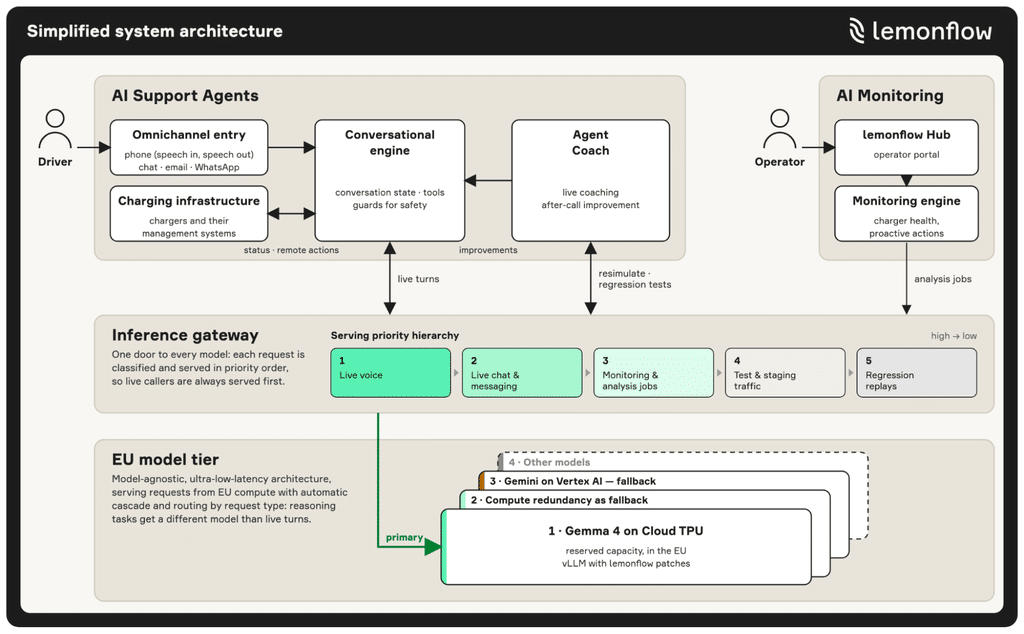
To improve response times, Lemonflow migrated from managed AI APIs to Google’s Gemma 4 models running on dedicated Google Cloud TPU v6e hardware in the European Union. The transition reduced median serving latency to approximately 350 milliseconds and 90th-percentile latency to 600 milliseconds, roughly three times faster than its previous infrastructure. It also eliminated HTTP 429 rate-limit errors during peak traffic.
Lemonflow reports that its agents answer virtually every call, resolve more than 80% of conversations without transferring them to human representatives, and achieve 95% driver satisfaction. Prompt updates and testing now take approximately 10 minutes, compared with two to three hours previously.
The company also developed Agent Coach, a background coaching engine that analyzes actual conversations, supplies relevant information during live calls, and converts real-world interactions into permanent test cases. Automated regression testing across thousands of conversational scenarios helps maintain performance as agents and charging network integrations evolve.
Beyond customer support, Lemonflow operates monitoring agents powered by Gemini that analyze conversations and charging station logs to identify recurring equipment problems. This capability could help operators detect and address faults before additional drivers encounter charging failures, shifting network management from reactive troubleshooting toward proactive maintenance.
Lemonflow plans to expand its infrastructure and eventually migrate to Google’s seventh-generation Ironwood TPUs, which are expected to provide six times more high-bandwidth memory per chip than the current generation.
EVinfo.net’s Take: Lemonflow Demonstrates the Impressive Potential of AI in EV Charging
Lemonflow’s numbers are impressive, supporting more than 40 charging networks across 17 countries.
However, perhaps the most impressive aspect of Lemonflow’s technology is what its AI agents can actually do. They can retrieve live charger information, analyze equipment logs, identify problems, and initiate corrective actions.
Consider the practical implications. When an EV driver encounters a malfunctioning charging station, an AI agent can investigate the problem, identify a stuck charging session, remotely restart the equipment, and remain connected with the driver until charging begins. Other capabilities include unlocking stuck charging cables, terminating failed sessions, and notifying service technicians.
This represents a significant advancement in how AI can interact with the physical world to increase EV charging reliability.

Electric Vehicle Marketing Consultant, Writer and Editor. Publisher EVinfo.net.
Services