New Meter Attachment Makes It Easier to Deploy Ford EV as Home Backup Power Generator
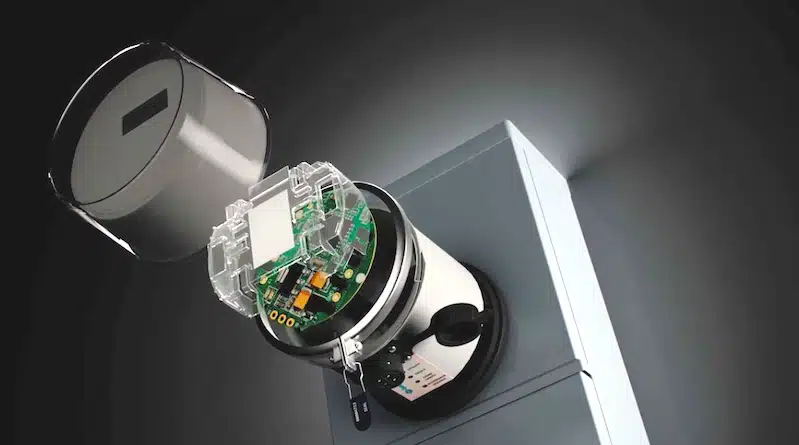
Ford recently announced a partnership with GenerLink to provide an additional home backup power solution for F-150 Lightning and F-150 PowerBoost Hybrid owners. The system connects directly to a home’s electric meter, allowing eligible trucks to serve as a backup power source during outages.
What is Ford Home Backup Power?
Ford offers two home backup power solutions. Both systems enable a vehicle to provide electricity to a home when grid power is unavailable, helping homeowners reduce the impact of power outages.
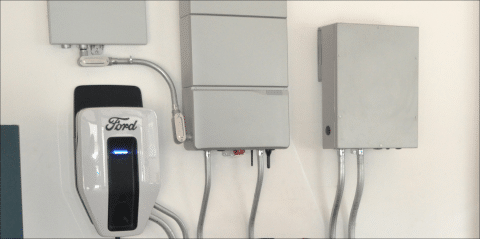
Owners of an F-150 Lightning or F-150 PowerBoost Hybrid equipped with 7.2 kW or 9.6 kW Pro Power Onboard can use Pro Power Onboard-enabled Essential Home Backup Power. F-150 Lightning owners who have installed a Ford Charge Station Pro and Home Integration System (HIS) can also access Automatic Home Backup Power.
Pro Power Onboard-Enabled Essential Home Backup Power
Through its partnership with GenerLink, Ford is expanding access to essential home backup power for customers with eligible F-150 Lightning and F-150 PowerBoost Hybrid models equipped with 7.2 kW or 9.6 kW Pro Power Onboard.
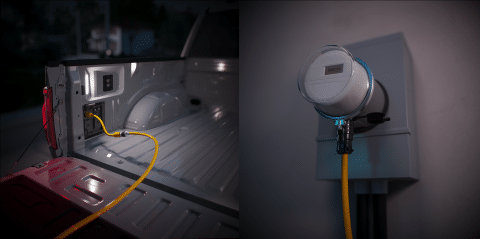
Using a GenerLink transfer switch, available to most customers, 2021-2026 F-150 PowerBoost Hybrid and 2022-2025 F-150 Lightning trucks can provide electricity to an average home during a power outage. Ford estimates that a PowerBoost Hybrid can supply power for up to five days, while a Lightning can provide power for approximately two to three days depending on whether it has the Standard Range or Extended Range battery pack.
The system requires a professionally installed GenerLink transfer switch, a GenerLok cable, and a Ford Vehicle Connector. Availability is subject to approval from local utility providers. Actual runtime depends on battery size and household energy consumption.
Automatic Home Backup Power
For F-150 Lightning owners equipped with the Ford Charge Station Pro and the Sunrun Home Integration System, Home Backup Power can operate automatically. If the truck is plugged in when an outage occurs, the system can immediately begin supplying power to the home without requiring any action from the owner.
When utility service is restored, the F-150 Lightning automatically returns to its scheduled charging routine.
Ford’s runtime estimates are based on an average household energy consumption of 30 kWh per day, which aligns with the U.S. Energy Information Administration’s national average residential electricity use of approximately 899 kWh per month. Actual backup duration will vary based on a home’s energy needs and the vehicle’s available battery capacity.
Customers interested in the GenerLink solution can learn more through GenerLink, while additional operating instructions and requirements can be found in the vehicle owner’s manual.
EVinfo.net’s Take: Why V2H-Enabled EVs Are Better Than Home Gas Generators
Extreme weather events due to human caused climate change are causing more and more blackouts. As weather, aging grid infrastructure, and rising electricity demand are increasing the risk of power outages, homeowners are looking for reliable backup power solutions. For decades, gasoline and diesel generators have been the default choice. Today, however, vehicle-to-home (V2H) technology is emerging as a cleaner, quieter, safer, and more versatile alternative.
V2H-enabled electric vehicles allow energy stored in a vehicle’s battery to power a home during an outage. Models such as the Ford F-150 Lightning and several upcoming bidirectional EVs can automatically supply electricity to a residence when the grid goes down. Compared with traditional generators, the advantages are significant.
One of the biggest benefits is zero local emissions. Gas generators burn fossil fuels and release carbon dioxide, nitrogen oxides, and other pollutants directly into the air. They must also be operated outdoors due to the risk of carbon monoxide poisoning, and require storing highly flammable gasoline at home. A V2H-capable EV produces no tailpipe emissions while powering a home, making it safer and more environmentally friendly.
Noise is another major difference. Anyone who has lived through a prolonged outage knows the constant loud noise of a gas generator. Electric vehicles operate silently, allowing homeowners to maintain backup power without disturbing neighbors or disrupting daily life.
V2H systems are also more convenient. Gas generators require dangerous fuel storage, expensive regular maintenance, oil changes, and periodic testing to ensure they will work during an emergency. EV batteries are already charged as part of normal vehicle ownership. When paired with a home integration system, many V2H solutions can automatically detect an outage and begin powering a home without manual intervention.
The economics are becoming increasingly attractive as well. Instead of purchasing and maintaining a dedicated backup generator that sits unused most of the year, homeowners can leverage an asset they already own. The EV serves two purposes: transportation and energy storage.
Battery capacity is another area where many modern EVs excel. The extended-range Ford F-150 Lightning, for example, stores more than 130 kWh of energy, far exceeding the usable energy available from most portable generators. Depending on household consumption, that can provide multiple days of backup power.
V2H technology also aligns with the future of distributed energy. As more homes adopt solar panels, battery storage, and smart energy management systems, electric vehicles can become an integral part of a home’s energy ecosystem. A bidirectional EV can store excess solar energy during the day and provide electricity when needed, reducing dependence on the grid, while in most cases also earning financial rewards for EV drivers.
Dangerous, loud, expensive and polluting gas generators will continue to have a role in some situations, particularly where extended outages require continuous operation and refueling is readily available. However, as automakers expand bidirectional charging capabilities and utilities modernize grid infrastructure, V2H-enabled EVs are rapidly becoming the more advanced and preferred solution.
Rather than investing in a machine that only produces power during emergencies, homeowners can choose a vehicle that provides daily transportation while also serving as a powerful home energy resource. For many households, that makes V2H-enabled EVs not just a backup power option, but a smarter long-term investment.

Electric Vehicle Marketing Consultant, Writer and Editor. Publisher EVinfo.net.
Services