The A2 E-Tron EV Is the Most Efficient Audi of All Time
Audi says its upcoming A2 e-tron will become the most efficient model the company has ever produced. According to preliminary WLTP measurements, the compact electric vehicle in its 140-kW configuration with the optional efficiency package achieves energy consumption of just 12.8 kWh per 100 kilometers.
The impressive efficiency is the result of a combination of advanced electric drive technology, refined aerodynamics, and a battery system designed for everyday usability.
Audi CEO Gernot Döllner says the new A2 e-tron carries forward the spirit of the original Audi A2, including its focus on efficiency.
“The Audi A2 has been a constant in my career ever since I joined the Volkswagen Group in the 1990s. Even then, its groundbreaking three-liter version made efficiency its hallmark,” Döllner said. “This is precisely the vision we are carrying forward with the new A2 e-tron: outstanding efficiency, excellent everyday usability, and a clear understanding of what customers expect from modern electric mobility,” said Döllner.

A major factor behind the A2 e-tron’s efficiency is its aerodynamic design. With a drag coefficient of 0.24, the model has the lowest aerodynamic drag of any Audi compact vehicle. Audi says aerodynamic improvements reduce energy consumption by up to 0.9 kWh per 100 kilometers compared with an otherwise identical vehicle without these enhancements.
The vehicle’s streamlined shape includes a rounded front end, flowing roofline, and sharply defined rear design. Additional aerodynamic features include air curtains that guide airflow around the front corners, gap reducers and gap breathers around the wheel arches, and an active cool-air intake that remains closed during normal driving to minimize drag.
During charging, rapid acceleration, or high-temperature conditions, the active intake opens to help cool the battery and electronics. Together, these solutions help the A2 e-tron achieve its preliminary WLTP consumption rating of 12.8 kWh per 100 kilometers.
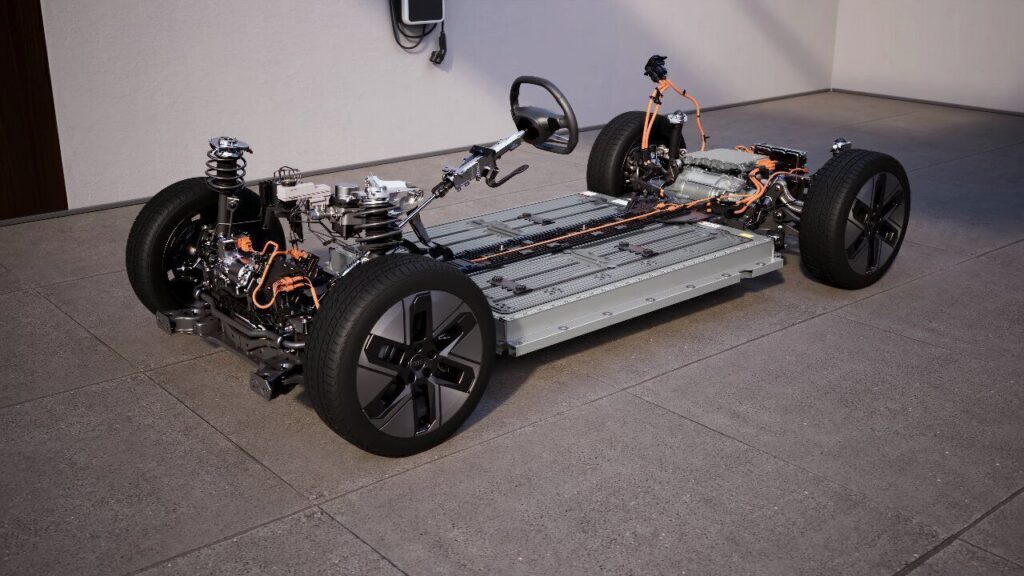
The electric drivetrain has also been optimized for efficiency. The A2 e-tron uses a permanently excited synchronous motor paired with improved power electronics, an upgraded electric motor, and a more efficient transmission.
Silicon carbide semiconductors replace traditional silicon technology in the power electronics, reducing switching losses, especially during partial-load operation. Audi says variable switching frequency can reduce losses by up to 20 watts, while alternative modulation methods reduce switching losses by up to 33%.
The electric motor benefits from thinner laminations that reduce iron losses, while a revised stator winding design improves efficiency across common operating ranges. A new low-friction transmission oil and a 10.2:1 gear ratio further reduce energy consumption, particularly at higher speeds.
The A2 e-tron 140-kW model uses a 61-kWh lithium iron phosphate (LFP) battery in a cell-to-pack configuration. By integrating cells directly into the battery housing, Audi increases packaging efficiency while reducing space requirements.
The LFP battery does not use rare earth elements, offers strong durability, and can be regularly charged to 100% in everyday use. Its stable voltage characteristics also help maintain consistent performance as the battery state of charge decreases.
Although the range was not mentioned, it’s reasonable to assume the A2 E-Tron will at least match the driving range of the ID.3 Neo, which gets 391 miles (630 kilometers) on a single charge in the WLTP cycle with its larger 79-kWh battery.
Audi says battery efficiency is not determined solely by cell chemistry. The interaction between battery management, thermal controls, charging systems, and software plays a critical role. An optimized cooling strategy improves wallbox charging efficiency to 89.6%, helping reduce energy losses during charging.
The A2 e-tron will also support bidirectional charging capabilities. Vehicle-to-Load technology allows the vehicle to power external devices, while Vehicle-to-Home enables the EV to function as an energy storage system for a home when paired with compatible charging equipment.
Th new A2 e-tron is adding an all-electric entry-level model to Audi’s compact vehicle lineup. With its focus on low energy consumption, aerodynamic efficiency, and advanced battery technology, the A2 e-tron represents Audi’s effort to make efficiency a central part of future electric mobility.
The Audi A2 e-tron is not available in the United States, and Audi has not announced plans to bring it to the U.S. market. It is primarily designed for European markets, launching with an expected starting price around €38,200. It is set to be fully unveiled and go on sale in Europe in fall 2026.

Electric Vehicle Marketing Consultant, Writer and Editor. Publisher EVinfo.net.
Services