From Monitoring to Autonomous Reliability: How EV Charging Operations Are Evolving
WattsUp CEO Hilary Taylor takes the stage at EV Charging Infrastructure Xchange USA 2026 in Houston on October 21 to make the case that the industry’s next phase won’t be won by installing more chargers — it will be won by keeping them working.
America built the network. Now comes the hard part.
The U.S. public charging network has more than doubled since 2020, reaching roughly 260,000 public ports nationwide, according to the Joint Office of Energy and Transportation. The fastest-growing segment is the one drivers depend on most: public DC fast charging reached 72,514 ports as of May 2026, per the Department of Energy’s Alternative Fuels Data Center, expanding at roughly 30% year over year. Charging has spread from highway corridors into cities, workplaces, retail lots and fleet depots.
Deployment, in other words, is no longer the bottleneck.
Reliability is.
The good news — and the catch
To the industry’s credit, the trend line is finally bending the right way. J.D. Power’s 2026 U.S. Electric Vehicle Experience (EVX) Public Charging Study, released in August and drawn from 6,594 EV owners surveyed through the first half of 2026, found the non-charge visit rate — a driver arrives at a public charger but cannot complete a charge — fell to 12%, the lowest level in the study’s six-year history. That’s down from 14% a year ago and 19% two years ago: a 37% improvement in the failure rate in just two years. Satisfaction with DC fast charging climbed 12 points to 666 on a 1,000-point scale, with charger availability posting the single largest gain, and the newest OEM-backed networks setting the reliability pace for everyone else.
Real progress. But sit with the headline number for a moment: one in eight charging visits still ends in failure. For a driver planning two charging stops on a 400-mile trip, that failure rate builds a meaningful chance of a dead charger into every itinerary. J.D. Power’s own research underscores what’s at stake — public charging reliability consistently ranks as the top reason new-vehicle shoppers reject EVs. Reliability isn’t just an operations metric; it’s the adoption bottleneck.
And the improvement is uneven. While DC fast charging surged, satisfaction with public Level 2 charging actually declined 12 points this year, to 595 — dragged down by payment friction and failed session starts, the quiet failure modes that rarely trip an alarm. Plug In America’s 2026 Annual EV Driver Survey adds the driver’s-seat view: 52.4% of non-Tesla EV drivers encountered a broken charger in the past year.
Progress is real. Solved, it is not.
Uptime isn’t truth
The deeper problem is that the industry’s favorite metric flatters it.
ChargerHelp’s 2025 State of EV Charging Reliability report captured the gap in one comparison: charging networks routinely report uptime of 98.7% to 99.9%, yet field data across more than 100,000 sessions showed only about 71% of charge attempts actually succeed on the first try. Both numbers can be technically true at once — and that’s precisely the issue. A charger can be powered, connected, and reporting “Available” to its network while still failing drivers on payment, communication handshake, connector faults or power delivery. The station is online. The session still dies.
The same pattern shows up wherever regulators have started demanding proof. In the United Kingdom, the Public Charge Point Regulations now legally require 99% annual reliability across rapid networks, with penalties of up to £10,000 per charge point. Yet in a September 2025 Monta survey of more than 200 senior UK charge point operator decision-makers, only about 4% reported average uptime at or above 99.5% — the band clearly aligned with the mandate. More telling than the compliance gap was the visibility gap behind it: just 17% of operators said they could access key diagnostics such as uptime and charge success rate on demand, and 45% named slow maintenance response as their single biggest operational obstacle.
Online doesn’t mean operational. And the distance between those two words is where the industry’s money quietly leaks: every failed session is lost energy, lost revenue and an increasingly expensive asset sitting idle — often while its status light glows a reassuring green.
The economics just got less forgiving
If reliability were only a customer-experience issue, it might wait. In 2026, it can’t — because the financial context around charging has tightened from two directions at once.
The first is capital. Federal support has become less dependable: after the Federal Highway Administration suspended the NEVI program in early 2025, Congress rescinded just over $503 million in NEVI funding across 30 states and territories in January 2026. The network is increasingly being built and operated on private capital — and private capital expects assets to earn. A charger that can’t complete sessions isn’t infrastructure; it’s inventory.
The second is the market’s own maturation. Operators themselves have named the priority: in Driivz’s 2026 State of EV Charging Network Operators survey of 300 charging professionals, around-the-clock network availability topped the list of planned 2026 investments, cited by 47% — ahead of expansion itself. The era of growth covering operational sins is ending. As utilization rises and networks scale, every point of failure rate converts directly into foregone kilowatt-hours, stranded capacity and drivers who don’t come back.
Which raises the operational question this year’s conference circuit keeps circling: monitoring tells you a charger failed. Who — or what — actually gets it fixed, proves the fix held, and keeps it from happening again?
From watching chargers to fixing them
This is the gap WattsUp was built to close. The company describes its platform as an Autonomous Reliability Layer for charging infrastructure — a system designed to move operators from seeing problems to resolving them, without operational headcount scaling in lockstep with charger count.
The operating sequence is deliberately simple: predict earlier, diagnose more accurately, resolve remotely where possible, dispatch better when trucks must roll — and verify the fix actually held.
Under the hood, the platform fuses data that most operators have never combined in one place: OCPP telemetry and charge-management system data, OEM diagnostics and firmware information, plus grid and power conditions, weather, site observations and driver feedback. That breadth matters because charger failures rarely announce their own root cause — a “faulted” status might trace to hardware, firmware, connectivity, payment systems or the site’s power supply, and each demands a different response.
Three modules turn that fused picture into action. Insight establishes session-level truth — surfacing silent failures and revenue leakage that status feeds miss, and separating what is actually happening at a charger from what the charger claims. Foresight scores failure risk before downtime occurs, ranking emerging problems by likelihood and business impact so work gets scheduled instead of suffered. And Oversight runs resolution as a closed loop: remote fixes where software can reach; and when field service is required, a higher-quality scope of work with likely parts identified before the truck rolls — followed by verification against real charging sessions, so an issue is never marked “resolved” simply because a ticket closed or a technician left the site.
That last step is the philosophical break from the monitoring era. In a closed-loop model, a fix isn’t a fix until the charger proves it — by delivering successful sessions, over time, in the real world. Every verified outcome then feeds back into the system, sharpening the next prediction and the next diagnosis.
The operational results map directly onto the metrics that increasingly define this industry’s scoreboard: higher remote resolution rates, better first-time-fix rates, lower true mean time to repair, and — the number drivers actually feel — improved session success. WattsUp positions the platform as a complement to existing CMS, OEM and maintenance systems rather than a replacement: those systems run the network; the reliability layer makes sure it delivers.
Catch the session in Houston
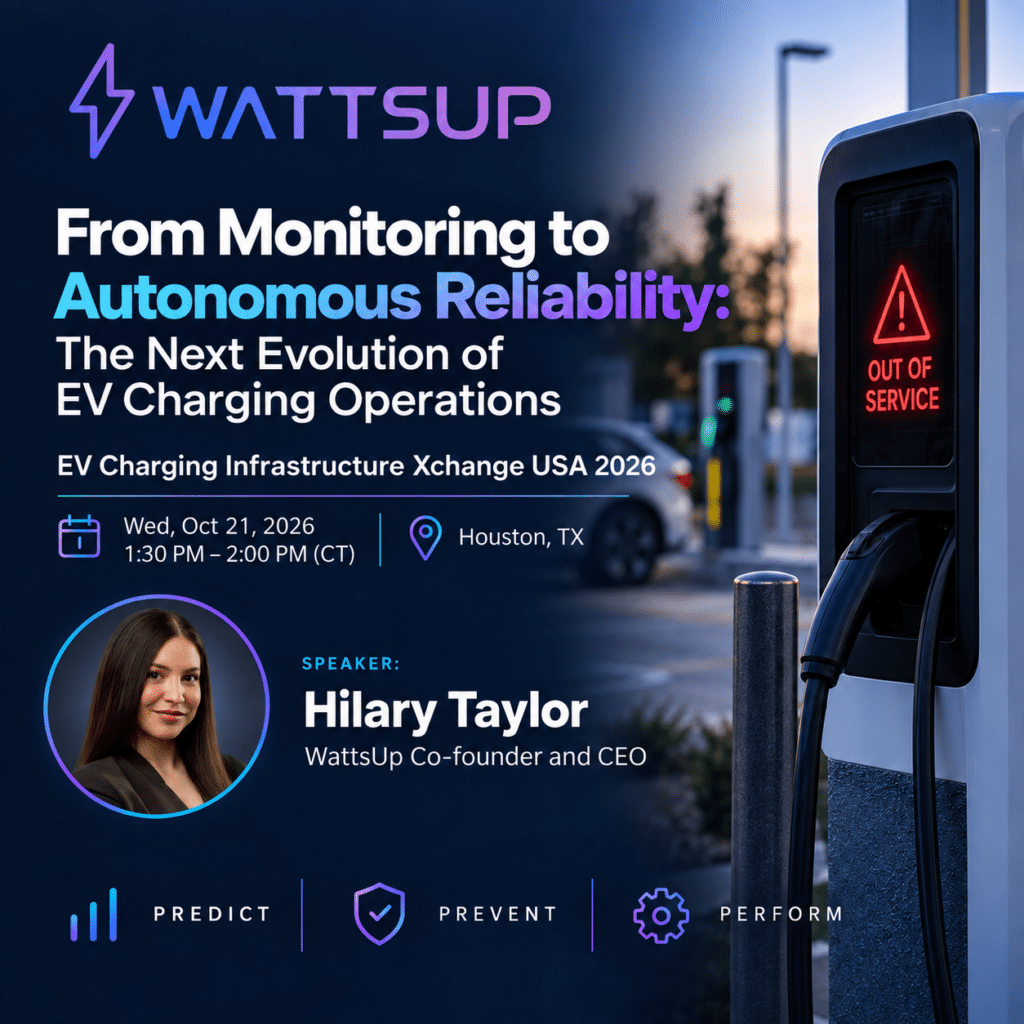
Taylor’s session — “From Monitoring to Autonomous Reliability: The Next Evolution of EV Charging Operations” — runs October 21, 2026, from 14:00 to 14:30 at EV Charging Infrastructure Xchange USA in Houston, Texas.
Attendees can expect a candid, operator’s-eye examination of three questions: why reported uptime and delivered charges diverge — and which number actually pays the bills; where the hidden costs of downtime accumulate across truck rolls, repeat visits and silent failures; and what it takes, organizationally and technically, to close the loop from detection to verified resolution as networks scale.
Taylor, a Georgia Tech electrical engineering graduate, brings more than a decade of engineering leadership, product development and field deployment in EV charging, with a focus on building scalable, operationally efficient systems that help charging reliability accelerate — rather than hinder — EV adoption. WattsUp’s founding team draws on more than two decades of combined EV charging and automotive industry experience.
EV Charging Infrastructure Xchange USA 2026, presented by Thought Xchange Network, convenes charge point operators, utilities, automakers, fleet operators, investors, technology providers and policymakers on October 21 to address the industry’s shift from rapid deployment toward reliable, scalable and commercially sustainable networks. Sessions span ultra-fast and megawatt charging, grid integration, interoperability, financing, asset monetization and fleet electrification — with reliability, diagnostics, remote monitoring and software resilience running through the agenda as the connective theme of the industry’s next phase.
Sources (2025–2026)
- Joint Office of Energy and Transportation, driveelectric.gov (2026): approximately 259,900 public EV charging ports nationwide, more than double the 2020 count.
- U.S. DOE Alternative Fuels Data Center (May 2026): 72,514 public DC fast-charging ports, growing roughly 30% year over year.
- J.D. Power, 2026 U.S. Electric Vehicle Experience (EVX) Public Charging Study (released Aug. 12, 2026): 12% non-charge visit rate (vs. 14% prior year, 19% two years prior); DC fast-charge satisfaction +12 points to 666; Level 2 satisfaction −12 points to 595; 6,594 BEV/PHEV owners surveyed Jan.–Jun. 2026; public charging reliability cited as the top reason shoppers reject EVs.
- Plug In America, 2026 Annual EV Driver Survey: 52.4% of non-Tesla EV drivers encountered a broken charger in the past year.
- ChargerHelp, 2025 EV Charging Reliability Report (Sept. 2025; 100,000+ sessions across 2,400 chargers): networks report 98.7%–99.9% uptime while ~71% of charge attempts succeed on the first try.
- Monta, The Pain Points and Growth Opportunities Impacting Charge Point Operators in 2025 (Sept. 2025; 200+ senior UK CPO decision-makers): ~4% report average uptime ≥99.5%; 17% can access key diagnostics on demand; 45% cite slow maintenance response as their biggest obstacle.
- Driivz, 2026 State of EV Charging Network Operators (survey of 300 charging professionals): 24/7 network availability is the top planned 2026 investment, cited by 47%.
- U.S. DOE AFDC / federal program reporting (2025–2026): FHWA suspension of NEVI in early 2025; January 2026 congressional rescission of just over $503 million in NEVI funding across 30 states and territories.
- EV Charging Infrastructure Xchange USA 2026 official speaker page: session scheduled Oct. 21, 2026, 14:00–14:30.

Electric Vehicle Marketing Consultant, Writer and Editor. Publisher EVinfo.net.
Services