V2G Operating in Several Markets, But Regulation Still Limits Adoption
Commercial vehicle-to-grid (V2G) technology is now operating in several markets, including the UK, Germany, France and Australia, according to an October 9, 2026, report by Versinetic. After more than a decade of trials, electric vehicles can increasingly return stored electricity to the grid, helping balance renewable energy generation, reduce peak demand and provide additional energy storage. However, regulatory barriers continue to prevent widespread adoption, with many countries, including Norway, still at the pilot stage.
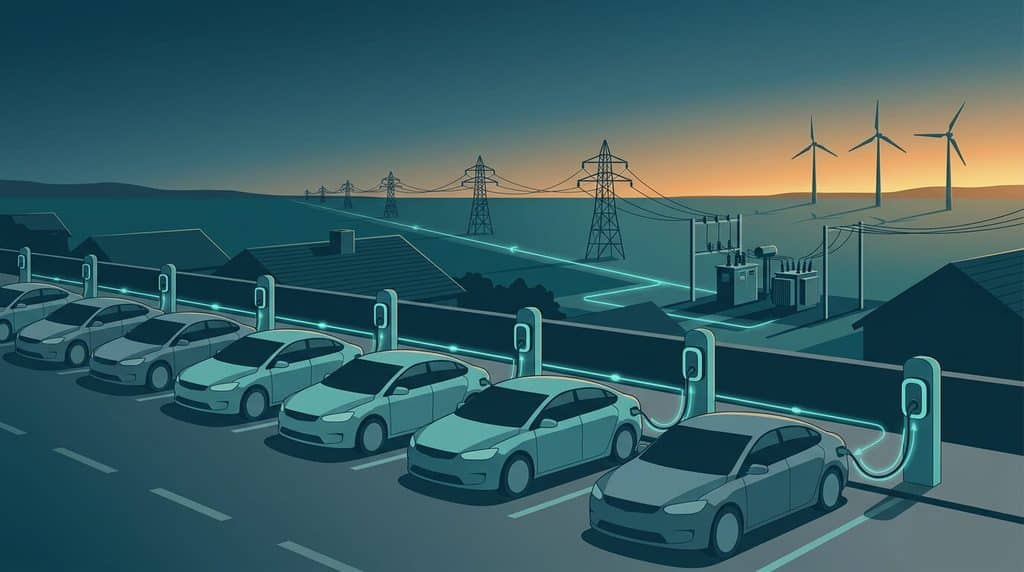
V2G allows battery-electric vehicles (BEVs) to function as mobile energy storage systems rather than simply drawing electricity from the grid. Vehicles can charge overnight when wind generation is high, export electricity during morning demand peaks, recharge using workplace solar power and return electricity during evening peaks. Owners may receive payments for supplying energy when demand and prices are high.
The UK illustrates the technology’s potential. By the end of September 2026, the country had more than 2.28 million BEVs. Assuming an average battery capacity of 50 kWh, these vehicles represent approximately 114 GWh of potential storage. Combined with 7.5 GW of stationary battery storage, equivalent to 137 GWh, the grid could theoretically access 251 GWh. This could supply average UK electricity demand of 30 GW for approximately eight hours, assuming no other generation sources were available.
V2G can also address localized grid constraints. A local distribution substation typically supplies between 100 kW and 1 MW, while 300 homes could theoretically draw 5.8 MW. In one example involving 300 homes with 1.5 EVs each, overnight charging requiring 5.3 kWh per vehicle would create approximately 296 kW of sustained demand over eight hours, approaching a 300 kW substation’s capacity. V2G could spread charging across 24 hours, reducing average power demand to approximately 100 kW. A German study cited in the report found V2G could reduce the need for grid upgrades by about 6%.
Commercial deployment is progressing through different national approaches. The UK streamlined G99 grid-connection approval in 2025, combining certification, bidirectional charging hardware and automatic distribution network operator approval. Octopus Energy’s Power Pack is a live commercial tariff, while UK Power Networks offers automatic V2G connection approval. Nissan also became the first automaker to obtain G99 grid-code certification for an AC-based V2G solution, and Nissan and Valeo signed an agreement in June 2026 to commercialize bidirectional AC charging stations across Europe, beginning in the UK.
Germany introduced commercial V2G through an E.ON and BMW partnership that pays owners for remaining connected and supplying electricity. Volkswagen and energy brand Elli announced another offering in June 2026, targeting a fourth-quarter launch and estimating potential annual customer earnings of €700 to €900 under best-case conditions.
France moved into commercial deployment in October 2024 through Renault, Mobilize and Mobility House. Australia has progressed from trials to commercial V2G and vehicle-to-home (V2H) services, supported by widespread rooftop solar adoption. Quasar launched in 2025, followed by the V2Grid Numbat charger, an Amber Electric and BYD collaboration, and RedEarth’s Australian-made bidirectional chargers.
The Netherlands is introducing V2G city by city, combining the technology with car-sharing. Utrecht began supporting V2G in mid-2025, Eindhoven followed at the end of 2025, and Ghent joined in early 2026.
The United States has no unified federal pathway for V2G deployment and instead relies on automaker partnerships with individual utilities. California, Maryland, Massachusetts and New Jersey are among the states leading development.
Japan began investigating V2G seriously after the 2011 Tōhoku earthquake and Fukushima nuclear disaster, recognizing the potential of EV batteries to provide emergency power. However, BEVs accounted for only approximately 1.5% of new Japanese vehicle sales in the report’s assessment.
The technology’s history stretches back to a 1997 research paper by Willett Kempton and Steven Letendre. California’s 2000-2001 electricity crisis helped drive early demonstrations, while the 2011 Japanese disaster renewed interest in using vehicle batteries for emergency storage. Commercialization has taken nearly 30 years, with energy crises helping accelerate progress.
V2G’s principal obstacle is regulation rather than basic technical feasibility. Electricity grids were designed around centralized power generation, while bidirectional charging introduces distributed energy resources that require coordinated standards, grid approvals and commercial arrangements. In the UK, G98 rules cover smaller distributed-generation systems up to approximately 3.68 kW, while practical V2G generally requires G99 approval because EVs can export substantially more power. Typical single-phase charging can reach approximately 7.3 kW, with three-phase systems potentially reaching 22 kW.
Effective V2G also depends on load balancing and standards-compliant charging technologies, including IEC 61851 and ISO 15118. These systems must coordinate vehicle batteries, charging equipment, local electricity demand and grid requirements. While stationary batteries, including emerging lower-cost sodium-ion technologies, will remain important, EV batteries could provide a substantial share of available storage during the remainder of the decade.
V2G can help integrate renewable energy, smooth grid fluctuations, support neighborhoods during localized power shortages and reduce the need for immediate infrastructure upgrades. Yet commercial products remain fragmented, often relying on specific combinations of automakers, energy providers and charging hardware. Wider deployment will require simpler regulations, interoperable equipment and standardized commercial offerings to turn the technology’s considerable potential into a practical, widely available service.

Electric Vehicle Marketing Consultant, Writer and Editor. Publisher EVinfo.net.
Services