GM Announces 3 Additional EV Charging Adapters to Address ‘Adapter Hell’
EV drivers are still struggling with the lack of standardization in EV charging. This problem stems from the “Wild West” of EVs and charging, before NACS became the dominant standard. Today, there are many different EV charging connector adapters, and this leads to a lot of confusion for EV drivers.
The North American Charging Standard (NACS), standardized as SAE J3400, is an electric vehicle (EV) charging connector standard developed by Tesla. It is maintained by SAE International, a global standards development and professional association with over 128,000 engineers and technical experts in mobility engineering. It has been publicly endorsed by the U.S. government since December 2023.
Last year, Loren McDonald, a charging-network analyst at Paren, said: “The next few years may be ‘adapter hell’ as everyone — drivers, automakers, charging equipment providers, the federal government and states — navigate a confusing straddle between other systems and the NACS standard and connectors, ” when referring to the industry’s transition to NACS.
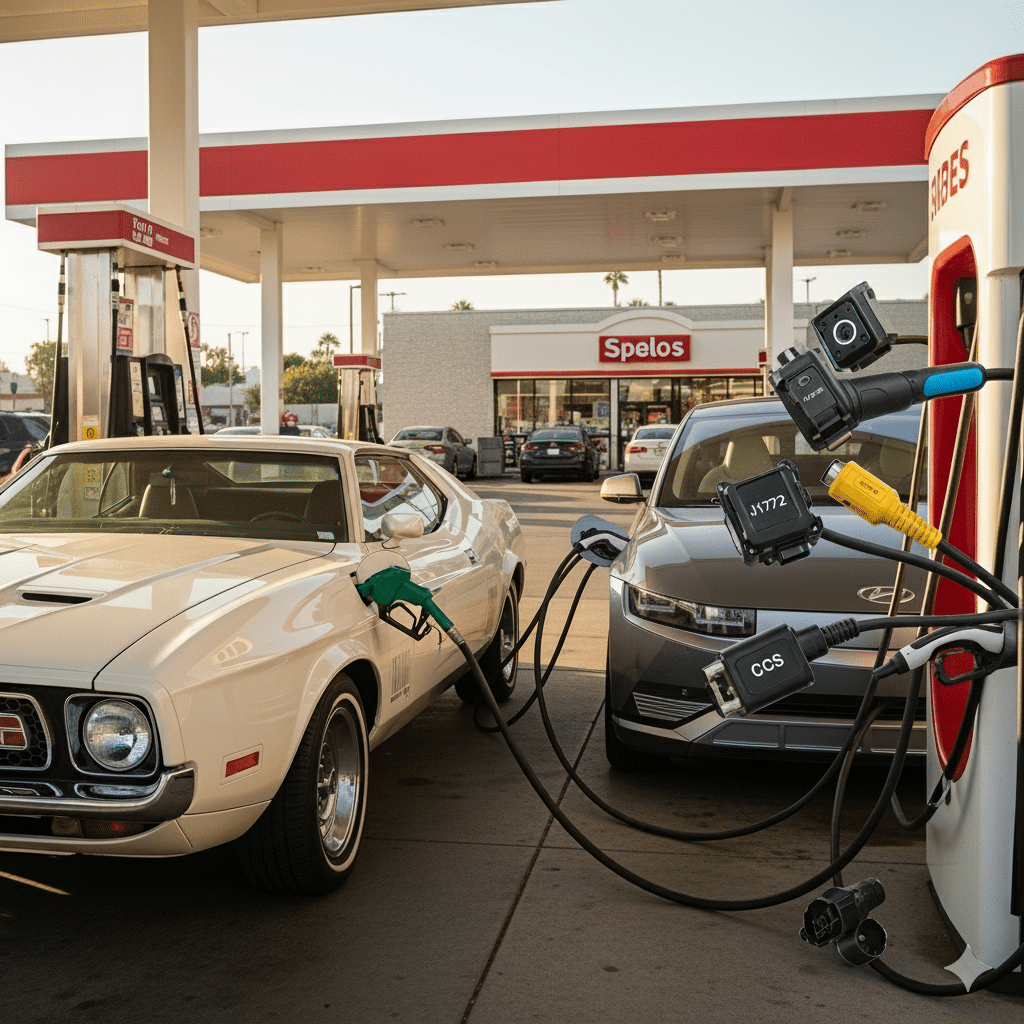
GM Adds More EV Charging Adapters, Highlighting the Awkward Transition Between CCS and NACS
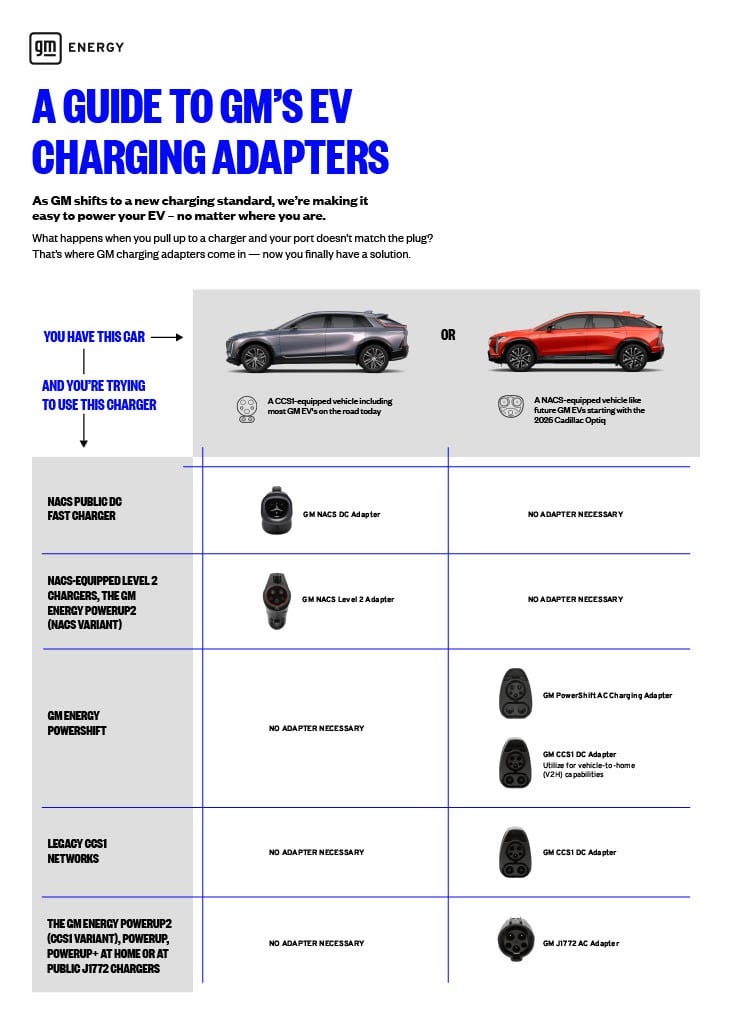
General Motors announced on August 28, 2025, three additional charging adapters designed to help EV owners navigate the ongoing shift in charging standards. While the move is positioned as customer-friendly, the complexity of dongles and adapters may leave everyday drivers scratching their heads.
The vast majority of automakers have committed to adopting NACS as the future standard, but the transition has been gradual. The 2025 Hyundai Ioniq 5 was the first non-Tesla EV to ship with a native NACS port, followed by the 2026 Rivian R1T, R1S, and Kia EV6. GM says its upcoming Cadillac Optiq-V will be its first EV equipped with a built-in NACS port, but that model isn’t expected until later this year. The 2027 Chevy Bolt will also follow suit.
In the meantime, adapters remain the bridge between old and new. Most automakers already provide CCS-to-NACS adapters so their customers can access Tesla’s Supercharger network. GM’s latest additions include a NACS-to-J1772 adapter for Level 2 charging and, once GM launches EVs with native NACS ports, two more options: J1772-to-NACS dongles for slow charging and CCS-to-NACS ones for fast charging. J1772 is the part of the CCS plug used for slower level 1 or level 2 charging.
This growing “family of dongles” underscores the awkward in-between moment the EV market is facing. While the industry is moving toward a universal solution, drivers are left managing a tangle of adapters, a stark reminder that the convenience of a single, standardized plug is still just out of reach.
Why Gas Cars Still Hold an Advantage: Universal Refueling vs. EV Charging Adapters
Around the world, gas cars are quickly being replaced with electrified vehicles. In 2019, traditional combustion engines comprised more than 90% of new vehicle sales worldwide. In 2025, that share has fallen to just 57%.
The shift to electric vehicles (EVs) is accelerating, but the transition hasn’t been without growing pains. One area where gas-powered cars still hold a clear advantage is in the simplicity and universality of refueling.
With a gas car, the experience is straightforward: any driver can pull into virtually any gas station in the world, fill up, and be back on the road within minutes. The nozzle fits, the process is standardized, and there’s no guesswork. Drivers don’t need to carry adapters or wonder whether a given pump will be compatible with their vehicle.
EV drivers, on the other hand, face a more fragmented reality. While progress is being made, the charging ecosystem still suffers from competing standards and a patchwork of connectors. Tesla has its own plug, while many non-Tesla EVs rely on the CCS standard in the U.S. Meanwhile, some older models still use CHAdeMO, and in Europe the situation varies further.
This means EV owners often need to carry multiple adapters, or plan trips around specific charging networks, to ensure they can plug in. For newcomers to the EV world, this complexity can feel like a barrier compared to the simplicity of a gas car.
That’s not to say the problem is unsolvable. Momentum is building around the North American Charging Standard (NACS). But until a truly seamless, standardized charging experience becomes the norm, gas-powered vehicles retain a major convenience advantage: one pump, one nozzle, everywhere.
EVinfo.net’s Take
Obviously, this situation is far from perfect and is one of the barriers to EV adoption, along with high new EV prices, charging reliability, payment problems, the lack of charging availability, and more. As an EV driver, I have experienced the barriers first-hand.
As mass EV adoption approaches in America, those upcoming first-time EV adopters will have an easier experience adopting EVs as these barriers are all going away.
I was honored to work with leading payments company Payroc, detailing EV charging payment problems, and offering solutions. See: “5 Things EV Drivers Hate About Charging Network Payments—And How Payroc Can Help Your Software Application Fix Them.”
It’s really gratifying to know that because of my work with well-respected companies such as Payroc, EV adopters will have an easier time with EV adoption in the future.
My passionate, talented EV professional colleagues around the world are working hard on breaking down all the barriers. And they are succeeding. One example is ChargePoint’s Omni Port, which allows drivers to charge any EV in any parking space, regardless of connector type.
Just a few out of many extraordinary EV professionals I’ve had the great honor of working with are: Autel Energy’s Dario Pagani, Wevo Energy’s Lisa Bennett, it’s electric’s Tiya Gordon, and Chargerhelp’s Kameale C. Terry. There are many more fantastic leaders such as these.
Influencer Marketing Growing Astoundingly Fast in the US and Around the World
Influencer marketing has experienced astounding growth over the past decade, evolving from a niche tactic into a multibillion-dollar industry that reshapes how brands connect with consumers. What began with bloggers and early YouTube personalities has exploded across platforms like Instagram, TikTok, and LinkedIn, where creators command massive followings and wield significant cultural influence.
Companies now recognize that partnerships with influencers often drive higher engagement, stronger trust, and more authentic connections than traditional advertising. As consumer behavior shifts toward valuing peer recommendations and authentic voices, influencer marketing has become not just a trend, but a central strategy in modern brand building, one that shows no signs of slowing down.
EVinfo.net is unique as the only solopreneur-led EV influencer publication. See our services page for more of our exciting industry’s great leaders that we have been honored to work with. If your’e in the EV or EV charging industries, and haven’t worked with us yet, what are you waiting for? No time like the present. Do away with FOMO (fear of missing out) forever and contact us on LinkedIn today.

Electric Vehicle Marketing Consultant, Writer and Editor. Publisher EVinfo.net.
Services