EV Realty Breaks Ground on Big Rig EV Charging Hub in CA, With a $75M Boost
EV Realty has officially broken ground on its first large-scale truck charging hub in San Bernardino, California, marking a major milestone in the company’s mission to electrify freight.
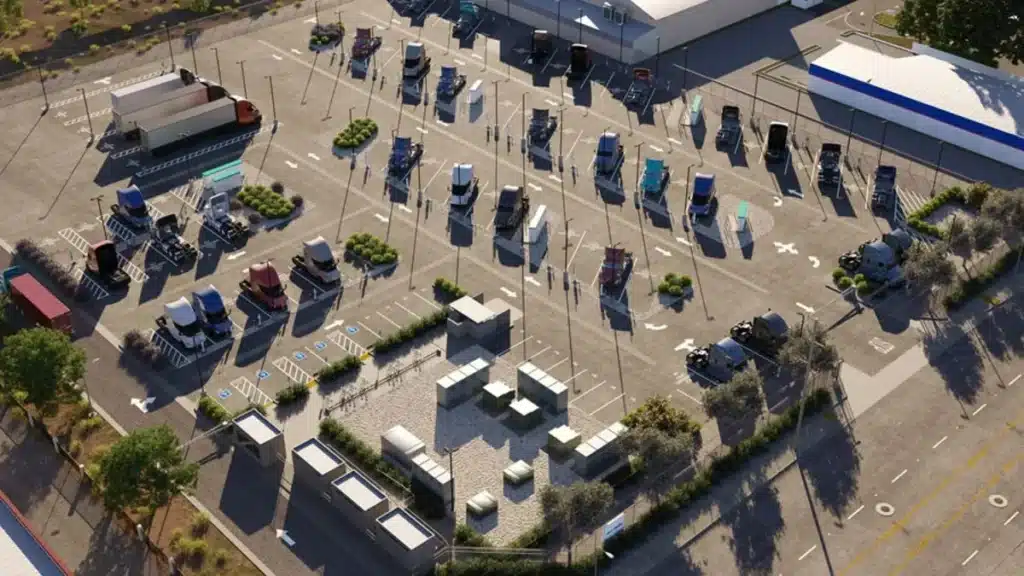
The new hub is strategically located next to the San Bernardino Intermodal Facility, surrounded by more than 60 million square feet of warehouse space, and within immediate reach of Interstates 10 and 215, one of the busiest freight corridors connecting the Ports of Los Angeles and Long Beach to inland distribution centers.

Once complete, the site will feature 9.9 megawatts of grid capacity and 76 DC fast charging ports provided by Kempower, including megawatt-capable pull-through stalls designed to accommodate heavy-duty Class 8 trucks. The facility will primarily serve regional and short-haul fleet operators in the Inland Empire, a logistics hotspot that is home to nearly 17,000 medium- and heavy-duty trucks.
The San Bernardino hub is backed by the South Coast Air Quality Management District and has received a conditional award from California’s EnergIIZE Commercial Vehicles Project, funded by the California Energy Commission. Construction is underway and the hub is expected to open before the end of the year.
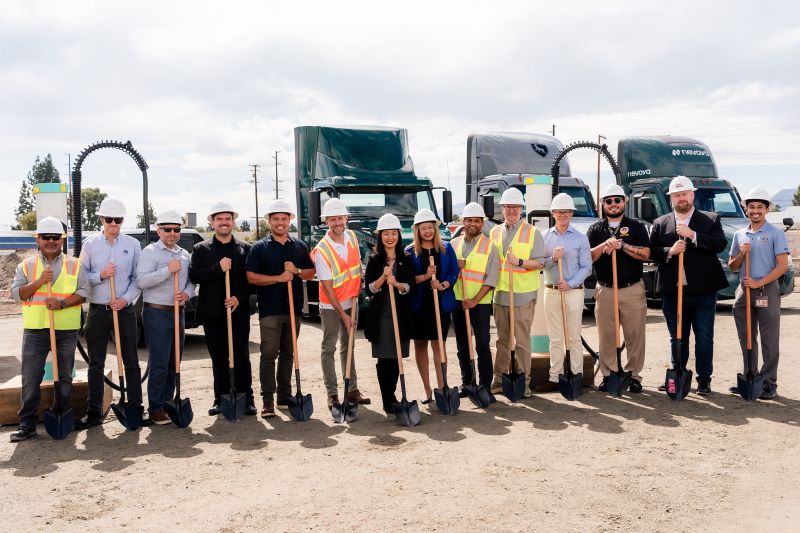
To accelerate this buildout, EV Realty also announced it has secured $75 million in growth equity from private equity firm NGP, with additional contributions from the company’s management team. The funding will expand the company’s Powered Properties portfolio, with San Bernardino as its flagship project.
Founded in 2022, EV Realty is rapidly scaling to meet the charging needs of commercial fleets. Earlier this year, it acquired a portfolio of assets from charging provider Gage Zero and signed a partnership with Prologis to provide truck drivers access to both companies’ charging networks.
With this new hub, EV Realty is positioning itself as a key player in California’s clean freight transition, helping decarbonize one of the nation’s busiest logistics regions.
Heavy-Duty EV Trucks Are Gaining Ground in the U.S., With California Leading the Way
The shift to electric trucks is accelerating across the United States, and heavy-duty vehicles are now beginning to make the transition once thought nearly impossible. These trucks, which account for a small share of vehicles on the road but a disproportionately large share of greenhouse gas emissions and harmful air pollution, are central to any strategy for cleaning up freight. Their electrification is no longer just a pilot project or proof of concept. It is becoming a commercial reality, especially in California.
Nationwide, the number of zero-emission trucks has been climbing steadily, and the past two years have marked a turning point. More than 52,000 medium- and heavy-duty zero-emission trucks are already deployed across the country, with orders and fleet commitments growing at record pace. California is at the center of this momentum. In 2023, one out of every six new trucks, buses, and vans sold in the state was fully electric, a milestone that exceeded early projections and signaled that the market is maturing faster than many expected.
Logistics companies, drayage operators at the Ports of Los Angeles and Long Beach, and regional delivery fleets across the Inland Empire are all adding electric trucks to their operations, supported by investments in charging infrastructure.
California is also home to several firsts that underscore the speed of change. The nation’s first solar-powered electric truck stop opened here, and Amazon has launched its largest electric heavy-duty fleet in the state. Companies like WattEV are rapidly expanding their Class 8 battery-electric fleets and building out charging depots to support them, showing that the economics of clean freight are beginning to take shape.
Terawatt Infrastructure, a company powering electrified fleets with the most reliable network of charging centers, designs, operates and owns electric vehicle charging centers for fleet operations combining property assets with energy and charging expertise. As of September 2025, Terawatt reported 14 sites under development, 20MW of power brought to customers in 2024 alone, and 1,656 vehicles charging per day.
Challenges remain, particularly in the buildout of high-power charging hubs and the need for massive grid upgrades to support megawatt-scale charging. Vehicle costs are still higher than diesel, and for certain long-haul duty cycles battery range remains a limitation. But the benefits—reduced emissions, cleaner air in communities long burdened by freight pollution, and the promise of long-term cost savings on fuel and maintenance, are pushing adoption forward.
As the U.S. works to decarbonize freight, California offers a glimpse of what the future looks like. Heavy-duty EV trucks are no longer a distant ambition. They are already operating on highways and in distribution hubs, signaling that the road to cleaner logistics is not only possible but already underway.

Electric Vehicle Marketing Consultant, Writer and Editor. Publisher EVinfo.net.
Services