MotorTrend Test Drives Telo’s Tiny 500-HP Electric Truck
MotorTrend’s first drive of the Telo MT1 mini electric pickup prototype portrays it as an ambitious and surprisingly capable newcomer in the EV truck space, a blend of clever design, compact proportions, and lifestyle appeal. The startup Telo, which recently secured $20 million in Series A funding, aims to redefine what a small truck can be by offering the utility of a mid-size pickup in the footprint of a compact car.
Measuring about 152 inches long, 73 inches wide, and 67 inches tall, with a 111-inch wheelbase, the MT1 is roughly the size of a Mini Countryman but manages to fit a truck bed comparable in length to that of a Toyota Tacoma. It’s a remarkable packaging achievement that immediately sets the tone for the rest of the vehicle.
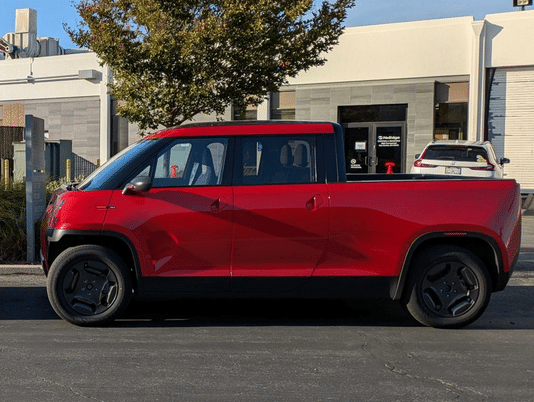
Performance figures are equally bold. Telo estimates between 300 and 500 horsepower depending on configuration, with 0–60 mph acceleration in around four seconds and an estimated driving range of 260 to 350 miles. Pricing is expected to start around $41,250.
During MotorTrend’s early test drive of the hand-built prototype, the publication noted that the MT1 already feels engaging to drive, with playful acceleration and a promising chassis balance that avoids glaring flaws in any major area. Ride quality, steering feel, and throttle response will require refinement before production, but the underlying dynamics suggest a solid foundation for a nimble urban truck.
Interior impressions were largely positive, though the prototype’s minimalist approach revealed areas for improvement. The reviewer, who stands 6’10,” was impressed that the small truck offered enough legroom and comfort, a testament to thoughtful spatial engineering.
However, the steering wheel felt awkwardly low and far away, with limited adjustment range, underscoring the need for more ergonomic flexibility. The dashboard’s reliance on touchscreen controls for basic functions such as climate, audio, and driver assists drew criticism; MotorTrend urged Telo to include physical controls to make the vehicle more intuitive and safer to operate while driving.
The MT1’s cabin design leans toward lifestyle rather than heavy-duty work, featuring soft fabrics, cork accents, and aluminum trim that deliver a premium, Scandinavian-inspired feel. Yet reviewers questioned whether these upscale materials would endure the rigors of daily utility or commercial use. They suggested offering a tougher “work trim” interior to broaden the truck’s market appeal.
Sound insulation was another concern, with noticeable wind and road noise above 30 mph, not unusual for an early prototype but something that will need to be addressed before production. Similarly, the expansive glass roof, while visually appealing, was said to let in excessive light and heat; a solid roof might be a more practical option for real-world use.
Beyond refinement issues, MotorTrend raised questions about occupant safety. The MT1’s unconventional layout pushes passengers forward within the short chassis, leaving less visible crumple space in front. The publication emphasized that Telo will need to thoroughly validate its crash protection and communicate those results convincingly to gain consumer trust.
Despite these challenges, the review concludes on a positive and even enthusiastic note. The Telo MT1 is seen not as a gimmick but as a serious effort to rethink how electric trucks can serve city dwellers, adventurers, and tradespeople alike. Its combination of small size, long bed, strong performance, and smart design could fill a niche that no current EV truck occupies.
MotorTrend’s verdict is that while the MT1 is far from finished, its shortcomings are developmental rather than conceptual — fixable issues rather than fundamental flaws. If Telo can refine the ergonomics, reduce cabin noise, toughen materials, and prove safety performance, the MT1 could become a standout entry in the growing world of electric pickups.
What They’re Building: The Telo Trucks MT1
Telo Trucks is a California-based electric vehicle startup founded in 2022 in San Carlos by Jason Marks, Forrest North, and designer Yves Béhar. The company’s mission is to reinvent the pickup truck for modern, urban life, compact, efficient, and electric, yet practical enough for both work and adventure. Marks, a former Tesla and Rivian engineer, and North, who worked at Mission Motors, bring deep EV and manufacturing experience, while Béhar shapes the brand’s design and lifestyle identity.
In 2025, Telo raised $20 million in Series A funding led by several notable investors including Marc Tarpenning, Salesforce founder Marc Benioff, and design entrepreneur Yves Béhar himself, signaling growing confidence in the company’s vision.
The centerpiece of Telo’s work is the MT1, short for Mini Truck One. Roughly the length of a two-door Mini Cooper at 152 inches, the MT1 manages to pack the utility of a midsize pickup into an urban-friendly footprint. Its design prioritizes efficiency and versatility, combining a five-passenger cabin with a bed nearly as long as that of a Toyota Tacoma.
The bed can be extended via a midgate opening into the rear cabin, allowing longer cargo to fit when needed. The MT1 will come in several configurations, starting with a single-motor, rear-wheel-drive version producing around 300 horsepower and an estimated range of 260 miles. A dual-motor, all-wheel-drive option is expected to deliver roughly 500 horsepower and up to 350 miles of range. Telo plans a base price of about $41,250, aiming to balance affordability and capability while keeping the vehicle aspirational rather than utilitarian.
The MT1’s design language reflects Béhar’s influence, with smooth, approachable lines and a modern aesthetic that feels equally at home on city streets or weekend getaways. The interior materials favor soft textiles, cork, and aluminum accents, giving it a premium but sustainable character. Telo is also developing solar-powered accessories in collaboration with Aptera, offering optional solar panels for the roof, bed cover, or camper shell to extend range and power outdoor activities.
The company has already partnered with Aria Group, a California-based specialty vehicle manufacturer, to build early prototypes and prepare for low-volume production. As of late 2025, Telo claims more than 12,000 preorders, reflecting significant consumer interest for a vehicle that blends compact practicality with truck utility.
Telo’s ambitions are high but measured. The team aims to start customer deliveries by the end of 2026, focusing first on small-batch production to validate quality and reliability before scaling up. Their lean approach is milestone-driven, capital-efficient, and built around iterative improvement. Still, the road ahead carries serious challenges.
Because of its unusually short front overhang and flat nose, the MT1 must meet rigorous crash standards, and ensuring strong frontal impact protection will be critical. The company will also face the familiar startup hurdles of scaling manufacturing, maintaining quality, and securing supplier relationships at volume.
Another question is market positioning. With a starting price over $40,000, the MT1 sits above compact gasoline pickups like the Ford Maverick or Hyundai Santa Cruz, while competing with larger EV trucks that boast longer range and towing capacity.
Telo is betting that buyers in dense cities, who value compactness, maneuverability, and sustainability over size and brute strength, will embrace its rethinking of what a pickup can be. Its focus on design, efficiency, and multifunctionality may appeal to drivers who want a truck that fits into daily urban life without the compromises of traditional pickups.
Overall, Telo represents a bold attempt to carve out a new category in the EV landscape: the compact electric lifestyle truck. Its founders’ backgrounds and investor support give it strong credibility, while its design and packaging ingenuity have drawn early enthusiasm from reviewers. Whether the company can deliver on safety, quality, and production promises will determine whether the MT1 becomes a niche curiosity or a genuine disruptor in the evolving electric vehicle market.