Renewables Overtook Coal for the First Time in Modern Era, Global EV Sales Increased Over 20% in 2025
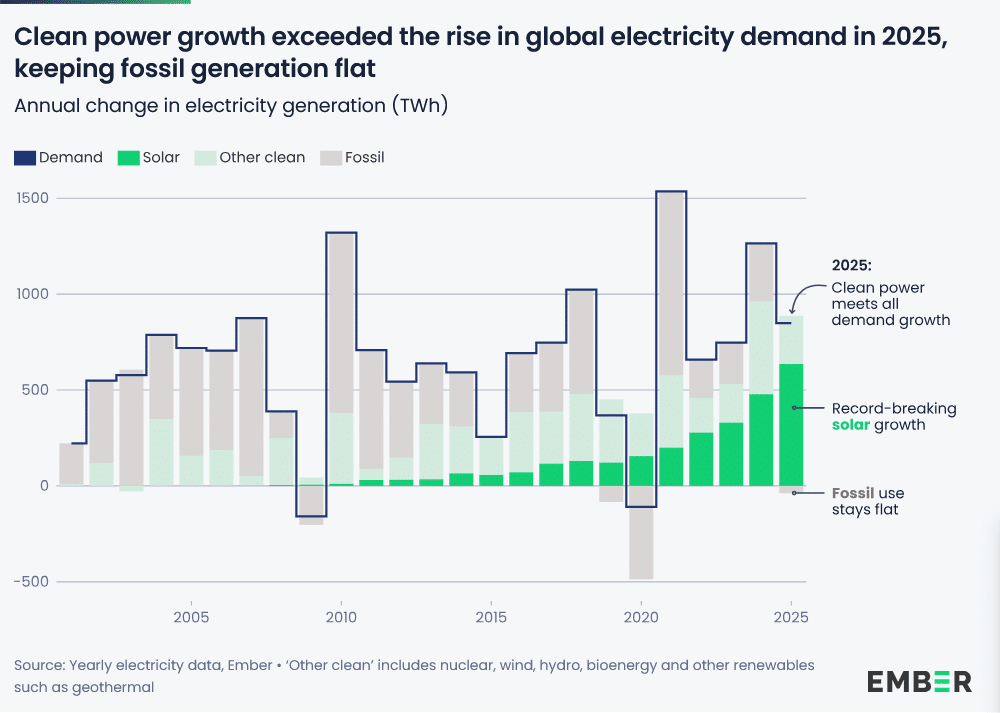
On April 21, 2026, Ember reported clean electricity reached a pivotal milestone in 2025, as low-carbon sources supplied the entirety of growth in global power demand, effectively halting any increase in fossil-fueled generation, according to a new Ember analysis.
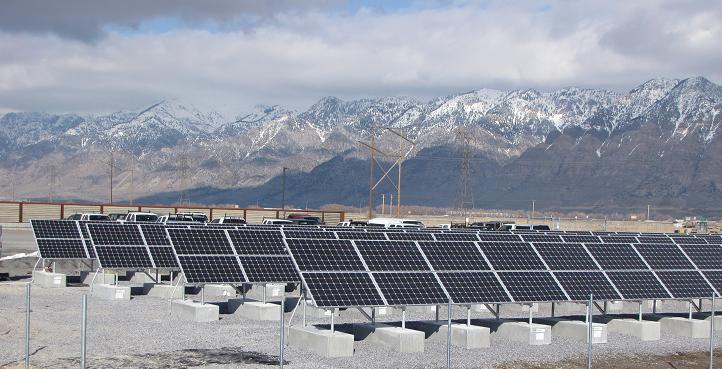
Solar was the primary force behind this shift. Global solar output climbed by 636 TWh in 2025, marking a 30% year-over-year increase and the fastest growth rate in eight years despite much larger absolute gains. Since 2015, solar generation has expanded more than tenfold, doubling roughly every three years. Its total output now matches the entire electricity demand of the EU-27.
China dominated this expansion, contributing over half of the global increase in both solar capacity and generation. Combined with gains in other clean energy sources, solar alone accounted for 75% of demand growth, while solar and wind together covered 99%. Overall, clean generation rose by 887 TWh, surpassing demand growth of 849 TWh. As a result, fossil generation edged down by 0.2%, making 2025 just the fifth year this century without fossil power growth.
Ember’s seventh Global Electricity Review delivers a comprehensive snapshot of the 2025 power system using country-level data, alongside a new open dataset covering 215 countries, including 2025 figures for 91 nations representing 93% of global demand.
A major driver of this transition was the shift underway in China and India, historically the largest contributors to fossil power growth. In both countries, record additions of clean energy exceeded demand increases, leading to declines in fossil generation. China reduced fossil output by 56 TWh, while India saw a 52 TWh drop, supported by strong solar and wind expansion, robust hydropower, and slower demand growth. This marks the first time this century that both nations simultaneously cut fossil generation, tipping the global balance.
Renewables reached a 34% share of global electricity in 2025, surpassing coal’s 33% for the first time in a century. Coal generation declined by 63 TWh globally, its first drop since 2020 and its first time below one-third of total generation.
At the same time, battery storage is emerging as a critical enabler of solar’s next phase. Installations in 2025 were sufficient to shift 14% of newly added solar generation from midday peaks to other times of day. Countries like Chile and Australia are already deploying grid-scale storage at levels that allow significant portions of solar output to be used beyond daylight hours, improving system flexibility and reliability.
As solar continues to scale, paired with storage, it is enabling a transition toward continuous clean power. The growing availability of low-cost, abundant electricity is also accelerating electrification across sectors such as transportation, reducing dependence on imported fossil fuels and strengthening energy security.
The next phase of this transition will depend on modernizing grid infrastructure and regulatory frameworks to accommodate higher shares of clean energy and ensure systems can efficiently manage this rapidly evolving energy landscape.

Electric Car Sales Increased by More Than 20% Year-On-Year in 2025, Rising to 21 Million Units Globally
The IEA’s Global Energy Review 2026 reported that global electric vehicle adoption accelerated sharply in 2025, with sales surpassing 21 million units, a year-over-year increase of more than 20%. As a result, one out of every four cars sold worldwide was electric, aligning with projections outlined in the IEA’s Global EV Outlook.
China remained the dominant force behind this growth. Strong domestic competition, competitive pricing, and a broader range of available models pushed EV adoption to new heights, with electric cars accounting for over half of all vehicle sales in the country for the first time. Growth was driven by battery electric vehicles, while plug-in hybrids saw only modest gains of about 4%. Meanwhile, electric heavy-duty truck sales in China tripled, exceeding 200,000 units.
Across the European Union, EV sales rose by 30% in 2025. Germany, the region’s largest auto market, recorded strong gains, alongside Spain and Italy, where the reintroduction of purchase incentives helped stimulate demand. Other markets also posted notable increases, including Poland with a 140% surge and the Netherlands with a 25% rise, while France remained flat compared to 2024.
Europe overall emerged as the fastest-growing major EV market, overtaking China. The United Kingdom saw sales climb by more than 25%, and Norway continued to lead globally, with battery electric vehicles reaching a record 96% share of total car sales. Electric truck adoption also gained traction across Europe, with medium- and heavy-duty segments expanding by roughly 40% to capture a 3% market share.
In contrast, the United States experienced a slight decline in EV sales, down 2% for the year. This was largely attributed to the removal of federal tax incentives after September and the elimination of penalties tied to fuel economy compliance. Prior to these policy changes, EV sales had reached a record high in the third quarter.
Outside of China, emerging and developing markets delivered some of the fastest growth rates globally, with EV sales increasing by around 80%. Total volumes in these regions matched the scale of Australia’s annual car market, supported in part by rising exports from Chinese manufacturers seeking new outlets amid intense competition at home.
India recorded a milestone year, with total EV sales reaching 2.3 million units and electric car sales jumping more than 75%. Southeast Asia also saw rapid expansion, with EV sales more than doubling, led by Thailand and Vietnam, while Indonesia posted a 125% increase.
In Latin America and the Caribbean, EV sales climbed approximately 70% to nearly 350,000 units. Mexico saw sales more than triple, and Brazil grew by 40% on top of strong gains the previous year. Smaller markets also delivered standout growth, particularly Ecuador and Uruguay, where sales rose by about 240% and 140%, respectively.

Electric Vehicle Marketing Consultant, Writer and Editor. Publisher EVinfo.net.
Services