Niron Magnetics Breaks Ground on Rare-Earth-Free Magnet Facility, Partners With Stellantis
Recently, China has expanded restrictions on rare earth minerals, causing great controversy. The new rules, which will take effect in phases starting Nov 8 and Dec 1, apply globally. This move is viewed as economic coercion, giving China significant control over global manufacturing and technology supply chains.
The rare earth restrictions are significant because these minerals are critical for producing electric, hybrid, and gas vehicles, computer chips, magnets for drones, robots, and defense technologies such as F-35 fighter jets and Tomahawk missiles. Foreign firms will now need Chinese government approval to export products containing even trace amounts of Chinese-origin rare earths. The US, heavily reliant on Chinese dominance in this sector, faces national security concerns. Stellantis and Niron Magnetics announced a new partnership as an answer to the problem.
On October 16, 2025, Niron Magnetics and Stellantis announced the two companies are collaborating to develop new electric motor designs using magnets free of rare-earth elements. Niron’s Iron Nitride magnets provide an alternative to traditional rare-earth-based magnets, helping reduce reliance on foreign supply chains.
“This collaboration is another critical notch of success in our strategy to scale our technology to meet the demands for permanent magnets and securing our domestic supply chains for leading manufacturers like our partners at Stellantis,” said Jonathan Rowntree, CEO of Niron Magnetics. “By switching to rare-earth-free Iron Nitride, we’re not only working together to build a more resilient foundation for industry but expanding the boundaries of what’s possible for motor performance.”
Traditional magnets rely on rare earth elements, mainly sourced from China. Niron’s magnets are made from iron and nitrogen, which are abundant and readily available in the U.S. and globally. Stellantis Ventures invested in Niron Magnetics in 2023, and the U.S. Department of Energy’s AMMTO has provided $2.7 million in support for the project. Permanent magnets are vital in vehicle systems such as powertrains, steering, and audio.
“Collaborating with the Niron Magnetics team allows us to explore the possibilities of this innovative magnet technology,” said Micky Bly, senior vice president, head of propulsion systems engineering for Stellantis. “As part of our broader research into advanced propulsion solutions, we’re continually evaluating emerging technologies that could support future mobility options and enhance customer choice.”
The collaboration aims to improve motor efficiency and performance across all vehicle types by leveraging the properties of Iron Nitride magnets. This effort is part of Stellantis’ ongoing research into advanced propulsion systems and the scaling of Niron’s technology for domestic manufacturing.
Titled “Variable Flux Field Intensifying Motors Using Iron Nitride Permanent Magnets,” the joint project builds on Stellantis’ investment and ongoing collaboration with Niron Magnetics. The colloboration focuses on areas such as traction motors, automotive audio, and other magnet-driven systems.
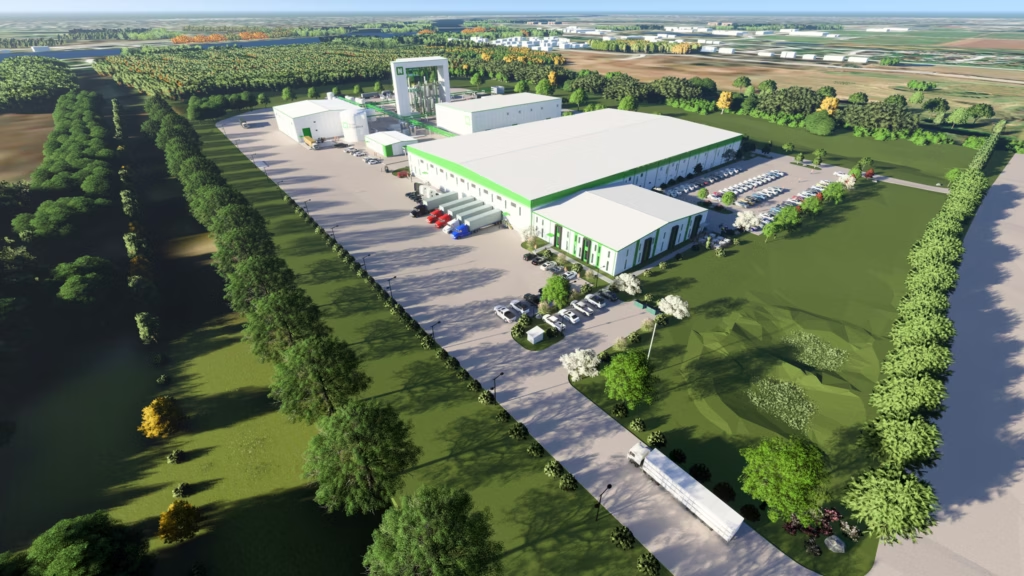
Niron Magnetics Breaks Ground on New Manufacturing Facility in Sartell, MN
Niron Magnetics has begun construction in September on a new 190,000-square-foot permanent magnet manufacturing facility in Sartell, Minnesota, which is expected to be operational by early 2027. The plant will have a production capacity of 1,500 tons of permanent magnets per year and will create 175 full-time jobs across manufacturing, engineering, and operations.
The new facility will utilize Iron Nitride, a breakthrough material that eliminates the need for rare-earth elements, offering magnets with high magnetization. This technology has been developed in collaboration with the U.S. Department of Energy and the University of Minnesota. The Iron Nitride magnets are positioned as a superior and more sustainable alternative to traditional rare-earth magnets, addressing both supply chain concerns and rising demand in industries like data center cooling, automotive motors, robotics, consumer electronics, and defense.
The Sartell plant builds on the success of Niron’s pilot plant in Minneapolis, and the company has already attracted major partners such as Stellantis, Samsung, and Allison Transmission, among others. This new facility is strategically important in light of growing geopolitical tensions and supply chain pressures on rare-earth materials, and it aims to support a more resilient domestic supply chain.
Niron Magnetics CEO, Jonathan Rowntree, emphasized that the project is a significant step forward for American innovation and manufacturing. The plant’s development will bring economic benefits to Sartell and bolster U.S. industries that rely on permanent magnets.
EVinfo.net’s Take
China’s controversial rare earth restrictions are even more evidence of the dire need for America to bolster its domestic EV and EV battery production. Cutbacks in federal support such as cutting the federal EV credit were huge mistakes. Those mistakes, combined with economically damaging tariffs, are weighing down and holding back our automakers. EVinfo.net suggests that our government IMMEDIATELY reverse course on its anti-EV policy and switch to fully supporting EVs in the US. If we don’t, China could continue to make moves like these, further disrupting our economy.

Electric Vehicle Marketing Consultant, Writer and Editor. Publisher EVinfo.net.
Services