A Delaware-Based Startup Is Redefining How EV Charging Gets Deployed
OmniPotential Energy Partners is a Delaware-based startup changing how EV charging gets deployed, using faster and less costly methods. Its patented Curbstar platform is a utility-side Level 2 charger that draws power directly from a distribution transformer, bypassing a building’s electrical system entirely. That single architectural difference eliminates the panel upgrades, hardscape disruption, and capacity constraints that make traditional EV charging costly and slow to scale.
Because Curbstar connects on the utility side of the meter, it isn’t limited by what any building can supply. It can be deployed wherever the distribution grid exists, across commercial properties, multifamily housing, and curbside residential streets, and most installations go from signed agreement to operational charger in about 12 weeks.
“Most EV charging infrastructure is built around the electrical limitations of buildings. Curbstar flips that model by connecting directly to the utility distribution system, making it particularly well suited for distributed applications, properties with constrained electrical capacity, and municipal pilot programs,” said Cora Castle, President & Founder.
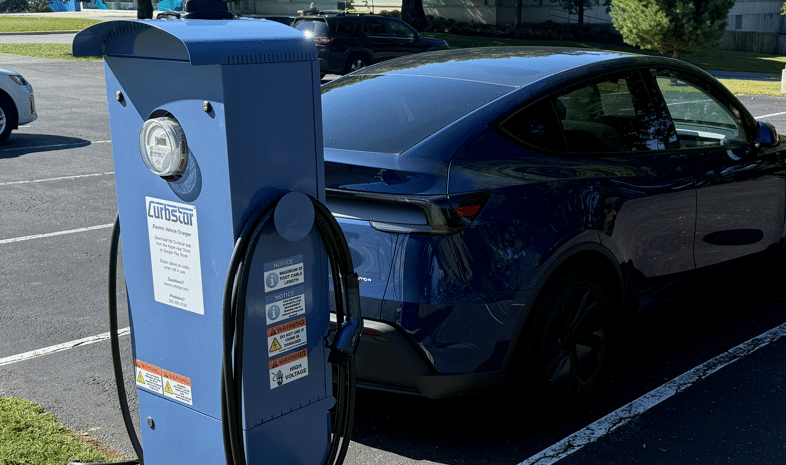
Core Features: All Configurations
Curbstar connects directly to the grid rather than drawing from any building, so no electrical upgrades are required regardless of where it’s installed. Each unit offers dual 9.6 kW ports that charge two EVs simultaneously in approximately four hours. The design is intentionally low-maintenance: no moving parts and no exposed payment terminal means less downtime and fewer security vulnerabilities. Units are available in ground-mount or wall-mount configurations, carry a distinctive pedestal form factor that’s easy for drivers to spot, and are designed and built in Delaware to meet national safety standards.
For Municipalities
EV ownership is rising, and so are the hazards that come with it. Extension cords running from homes to the curb create electrical, fire, and tripping risks that grow more common as adoption increases. Traditional curbside charging is expensive to install and difficult to power from existing residential electrical infrastructure. Curbstar solves both problems by sourcing power from a nearby distribution transformer rather than any residence.
Deployed at the neighborhood level, Curbstar gives residents overnight charging where they live, reducing dependence on distant public hubs and eliminating dangerous workarounds. Community-use stations also reduce pressure on reserved parking, keeping curb space flexible for all users. Each Curbstar transaction generates tax flow, and public-private models allow direct revenue sharing for municipalities that want it. Owner-operator programs are also available for cities that prefer a no-capital-investment approach. We provide policy guidance informed by real municipal deployments.
For Multifamily Properties
Tenants with EVs increasingly factor charging access into leasing decisions, and code mandates are expanding to match. Meeting those requirements with traditional chargers typically means a five- or six-figure electrical upgrade. Extension cords fill the gap in the meantime, and bring real hazards with them. Curbstar offers a better path.
Because Curbstar draws from the grid rather than the building, it can be added without touching the electrical panel, preserving capacity for other operations and eliminating the cost of a premature service upgrade. Units can be positioned near individual buildings rather than consolidated in a single centralized bank, giving all tenants convenient access rather than forcing them to compete for a few distant ports. Property owners can collect usage fees from EV drivers or offer charging as a no-cost amenity. Installation is turnkey: we need two square feet near your parking area and a nearby utility transformer, and we can manage the utility account on your behalf.
For Commercial Properties
Connecting EV chargers to a building’s electrical system can trigger a service upgrade years ahead of schedule, a capital expense that frequently reaches five or six figures and competes directly with other business priorities. Curbstar offloads EV charging from the building entirely by drawing power from a nearby distribution transformer instead.
That means your electrical infrastructure stays available for operations and future growth rather than being consumed by charging demand. Most installations break even in under three years, and the turnkey deployment model keeps the process simple: we handle installation, manage the utility account if needed, and require nothing more than two square feet near your parking area and a nearby transformer. Dual-port charging with approximately four hours to a full charge makes Curbstar well suited to any location where employees or visitors spend several hours at a time.
Request a Free Site Assessment, contact the OmniPotential Energy Partners team today: info@omnipotential.com