HV-MELA-BAT Project Enables Charging of Over One Megawatt With a Limited Grid Connection Capacity of 500 kW
Charging infrastructure for battery-powered heavy-duty and passenger transport is crucial for a successful transportation transition. The trend is toward higher charging power and, consequently, higher charging currents and voltages. The collaborative HV-MELA-BAT project developed the power electronic converters required for what researchers are calling XXL charging., as well as a contact system for high currents and voltages. Fraunhofer ISE announced the news on March 20, 2026.
Thanks to a high switching frequency, the isolated DC/DC converter achieves a volumetric power density of 9 kW/l while maintaining a record-breaking efficiency of 99.26 percent. A buffer storage unit was integrated to ensure full charging power even at power-limited grid connection points.
The project focused on upgrading existing fast-charging infrastructure based on the international Combined Charging System (CCS) standard to the new Megawatt Charging System (MCS). “The higher charging power poses new challenges for power electronics, the contact system, and the available grid connection capacity,” said project coordinator Stefan Reichert of the Fraunhofer Institute for Solar Energy Systems ISE. Other project partners included Motion Control & Power Electronics GmbH, STS Spezial-Transformatoren Stockach GmbH, Mercedes-Benz Energy GmbH, and Fraunhofer IVI.
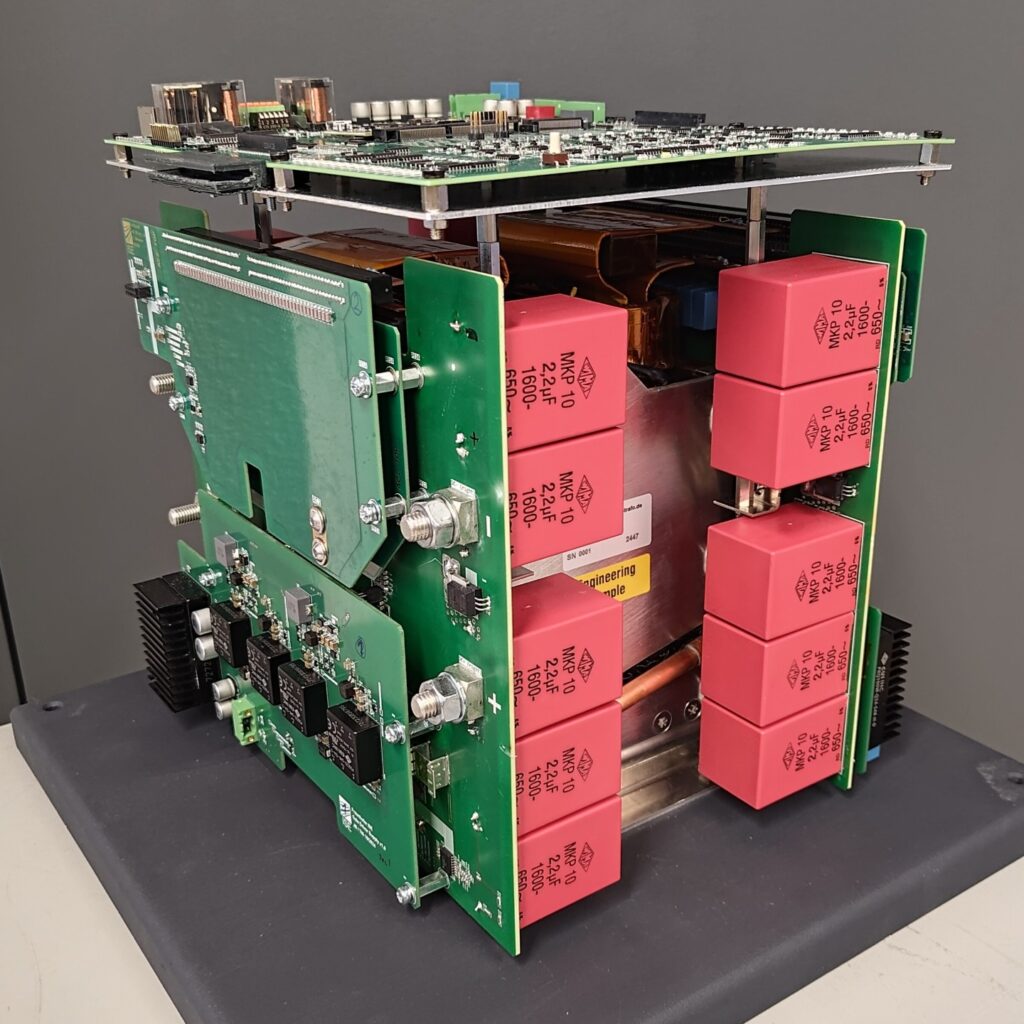
Charging System for a Wide Range of Vehicles and Grid Connections
The project team developed the core components required for XXL charging: power electronic converters including the grid-side rectifier, a modular interconnection of DC/DC converters for galvanic isolation, and DC/DC converters for adjusting charging voltages, as well as the contact system for high voltages and currents. The charging system was supplemented by a buffer storage system made from second-life passenger car batteries. The storage system reduced the required grid connection capacity of the charging station to 500 kW while buffering high load peaks, thereby reducing strain on the grid.
The MCS system was designed to be flexible in order to cover the widest possible range of charging voltages and vehicle types, and is downward compatible with the existing CCS charging standard. The project team also investigated the modular configuration of up to four 250-kW charging points and the integration of renewable energy sources such as photovoltaic systems and loads within the system. Solar power can be used directly for the charging station or fed into the buffer storage.
The complete MCS charging system and buffer storage were set up, commissioned, and tested at the Fraunhofer ISE Center for Power Electronics and Sustainable Networks in Freiburg. Using the modular and flexibly configurable DC/DC converters from Motion Control & Power Electronics, the battery, AC grid, and charging output were connected via a common DC bus. This enabled a charging power of more than one megawatt to be demonstrated with a limited grid connection capacity of 500 kW, with the remaining 500 kW supplied by the buffer storage system. The system was tested with charging processes of varying durations, and the size of the buffer storage system was also varied, achieving above-average overall transmission efficiencies from the AC grid to the vehicle battery.
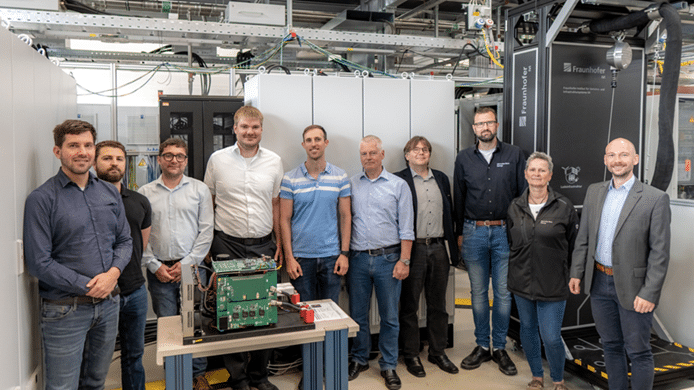
Innovative Circuit Topologies and High Switching Frequencies for Record-Breaking Efficiency
A key innovation of the project is a new ultra-compact, galvanically isolated DC/DC converter with a power transfer capacity of 250 kW. To provide a charging power of 1 MW, four of these modular converters are connected in parallel. The converter is based on the fundamental topology of a series resonant converter and operates at a very high switching frequency of up to 200 kHz, allowing inductive components such as the high-frequency transformer and resonant circuit to be designed smaller. This reduces material usage and the overall size of the converter. The converter achieves a volumetric power density of 9 kW/l with a maximum efficiency of 99.26 percent, representing a world first in this power range.
The project was supported by the Federal Ministry for Economic Affairs and Energy.
Electric Vehicle Marketing Consultant, Writer and Editor. Publisher EVinfo.net.
Services