Einride Approved to Expand Autonomous Electric Truck Operations in TX, its Fifth Approved U.S. State
Swedish autonomous electric freight company Einride has secured National Highway Traffic Safety Administration approval to deploy its driverless electric trucks in Austin, Texas, making it the fifth U.S. state where the company operates alongside Arizona, Colorado, South Carolina, and Tennessee.
The announcement came alongside a live demonstration of Einride’s cab-less autonomous electric truck in Austin, held at the company’s Analyst and Investor Day on March 24, 2026, ahead of its planned public listing through a proposed merger with Legato Merger Corp. III.
“Receiving government approval to operate in a fifth U.S. state is a testament to the safety and maturity of our autonomous technology,” said CEO Roozbeh Charli. “We view Texas as a core hub for our American autonomous freight operations.”
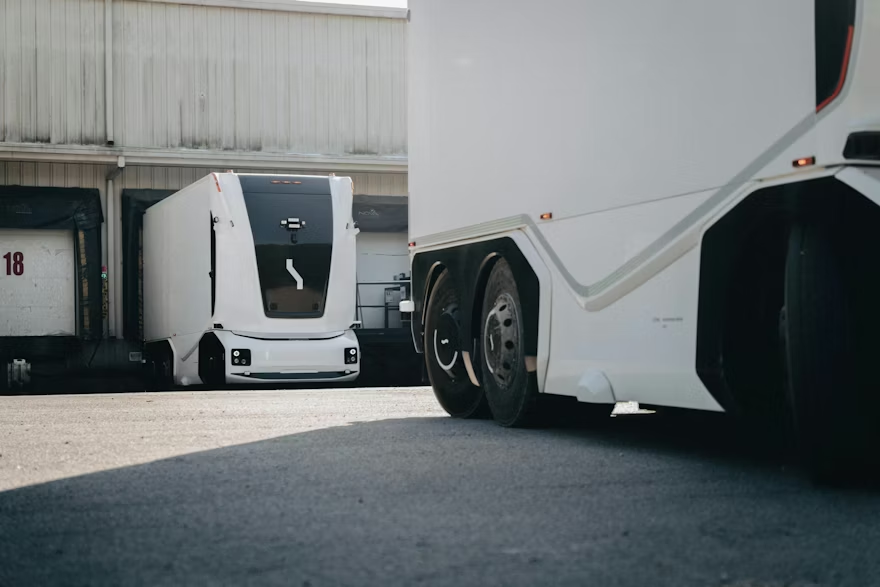
Einride operates one of the largest electric heavy-duty fleets globally, supporting shippers across the U.S. and Europe with both electric and autonomous operations, while expanding electric-only deployments in the Middle East. Its safety architecture has been independently audited against internationally recognized benchmarks for operational safety and cybersecurity.
The planned SPAC merger is projected to generate roughly $219 million in gross proceeds, with an additional $100 million PIPE raise in progress. The deal builds on $100 million in crossover financing secured earlier this year from investors including EQT Ventures and NordicNinja. Einride is targeting a share of the $4.6 trillion global road transport market.
Autonomous Electric Trucks Are the Answer to Problems the Industry Has Accepted for Too Long
The freight industry runs the world. Everything in a store, warehouse, or home got there on a truck at some point. And for decades, that system has operated with a set of compounding problems that have been treated as simply the cost of doing business: diesel fuel, driver shortages, fatigue-related accidents, high maintenance costs, and a direct exposure to whatever is happening geopolitically on any given week.
None of those problems are inevitable. Autonomous electric trucks solve most of them at once.
Start with fuel. Diesel prices do not move in isolation. They move with wars, with sanctions, with chokepoints, with the decisions of producers who have their own interests. The current conflict involving Iran is a reminder, again, that any logistics operation running on petroleum is running on borrowed stability. Electric trucks charged from a domestic grid eliminate that exposure entirely. The fuel source becomes local, predictable, and increasingly cheap as renewable energy expands.
Then there is maintenance. Internal combustion engines are mechanically complex, with hundreds of moving parts that wear, break, and require skilled labor to fix. Electric drivetrains are fundamentally simpler. Fewer components, less wear, longer service intervals, lower lifetime operating costs. For fleet operators running hundreds of trucks, that difference compounds quickly.
The driver shortage is a structural problem that has been getting worse for years. It is not going to self-correct. Trucking is physically demanding, isolating, and increasingly difficult to staff at the scale freight volumes require. Driver fatigue is also a genuine safety issue, responsible for thousands of accidents annually. Autonomous trucks do not get tired, do not need rest stops, and can run routes that human drivers cannot sustain.
None of this means the transition happens overnight. Regulation, infrastructure, and public trust all take time to build. Einride’s NHTSA approval to operate in five U.S. states is progress, but it is early-stage progress in a very large industry. The technology will need to prove itself at scale, in varied conditions, over time.
But the direction is clear. The freight industry’s legacy cost structure, its fuel volatility, its driver dependency, its emissions footprint, is not a fixed feature of how goods move. It is a starting point that autonomous electric trucks are beginning to dismantle. The companies building that future now will be the ones defining how freight works for the next fifty years.
Autonomous Vehicles Will Accelerate the EV Revolution
The electric vehicle transition and the autonomous vehicle revolution are usually discussed as separate stories. They should not be. They are deeply intertwined, and the growth of one is going to drive the growth of the other in ways that will compound faster than most people expect.
Here is the core dynamic. Autonomous vehicles are, almost without exception, being built as electric vehicles. The sensor arrays, compute hardware, and software architectures that enable self-driving capability integrate far more cleanly with electric drivetrains than combustion ones. The companies building autonomous systems, whether for passenger vehicles, robotaxis, or freight trucks, are building on electric platforms. Every autonomous vehicle that reaches the road is also an EV.
That matters because autonomous vehicles have a powerful economic argument that accelerates adoption in ways that environmental motivation alone has not. Fleet operators do not buy trucks because they care about emissions. They buy trucks that lower their operating costs, reduce their labor exposure, and improve their reliability. Autonomous electric trucks deliver on all three. The business case drives the purchase, and the purchase adds another electric vehicle to the road.
The same logic applies to robotaxis and autonomous ride-hail fleets. These vehicles run far higher mileage than personally owned cars. A single robotaxi operating 20 hours a day represents the emissions and fuel displacement of many privately owned combustion vehicles. As autonomous ride-hail scales, its impact on overall EV adoption numbers will be disproportionate to the vehicle count.
There is also an infrastructure feedback loop at work. More EVs on the road justify more charging infrastructure investment. More charging infrastructure makes EVs more practical for the next buyer. Autonomous fleets, which will charge predictably, at scale, on known schedules, are ideal anchor customers for charging infrastructure operators. They de-risk the investment and pull the buildout forward.
Then there is the public trust dimension. One of the quiet barriers to EV adoption has been uncertainty, range anxiety, unfamiliarity, a general hesitation about changing something as familiar as how a car works. Autonomous vehicles, particularly in commercial settings where performance is tracked and published, will generate enormous amounts of real-world data demonstrating EV reliability at scale. That data builds the case for the broader transition in a way that marketing never could.
The EV revolution needed a second engine. Autonomous vehicles may be exactly that.

Electric Vehicle Marketing Consultant, Writer and Editor. Publisher EVinfo.net.
Services