Rivian Spinout ALSO Announces Strategic Partnership With Doordash
ALSO, the Palo Alto-based electric micromobility company building small EVs for people and goods, has announced a strategic partnership with DoorDash that includes a direct investment and a multi-year commercial agreement focused on developing and scaling autonomous delivery. DoorDash Co-Founder and Head of DoorDash Labs Stanley Tang will join ALSO’s board as an observer. The partnership was announced alongside news that Prysm Capital has joined ALSO’s $200 million Series C financing round, which is led by Greenoaks.
“I couldn’t be more excited to partner with the team at DoorDash to deploy autonomy in areas not yet fully solved for, at the intersection of roadways, bike lanes, and road-adjacent spaces,” said Chris Yu, co-founder and president of ALSO. “Small autonomous EVs are optimal in these environments and that is what ALSO is building from the ground up.”
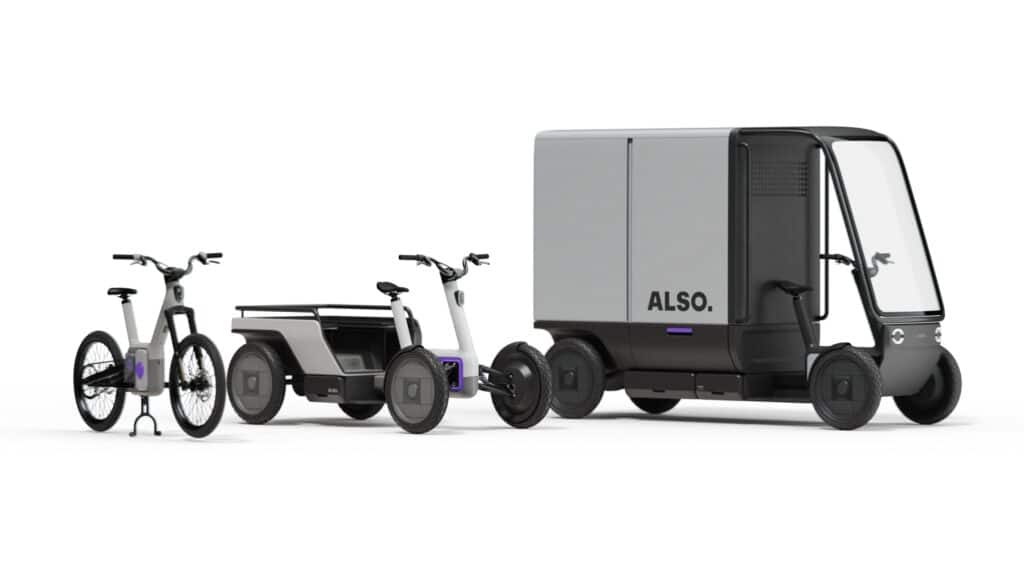
The fresh capital will fuel continued investment in product development, manufacturing, and international expansion. ALSO builds vertically integrated electric vehicles purpose-built for short-distance travel and last-mile delivery, developing everything in-house from motors and batteries to software and electrical architecture.
The company publicly debuted its first lineup in October 2025, introducing the TM-B electric bike, a consumer TM-Q electric quad, and a commercial TM-Q delivery quad alongside a next-generation connected helmet. The TM-B centers on DreamRide, ALSO’s proprietary drive system that replaces a traditional mechanical connection with software-defined motor control and energy regeneration.
The commercial TM-Q targets logistics operators and delivery fleets navigating dense urban environments, while the consumer version is aimed at families looking for a car alternative capable of handling daily errands and weekend use. Retail and online purchasing through Rivian stores is planned for later this year, with financing available through Chase Slate.
The DoorDash partnership positions ALSO directly in the autonomous delivery space, an area that has remained largely unsolved at the specific intersection of public roadways, protected bike infrastructure, and road-adjacent zones where traditional autonomous vehicle platforms struggle to operate. Small, nimble EVs purpose-built for those environments represent a different path forward.
“Last-mile delivery is a physical-world challenge and the details matter, from curb access to making sure an order arrives on time and intact,” said Stanley Tang. “ALSO is building purpose-built EVs that are designed to unlock new ways to meet customers and merchants where they are. We’re excited to invest and partner with them as we look to scale autonomous delivery.”
“ALSO represents exactly the type of company we seek to partner with—one operating at a key inflection point with the potential to reshape a large and evolving market,” said Jay Park, Co-Founder and Managing Partner at Prysm Capital. “We believe the team, product vision, and timing position ALSO to lead the next wave of innovation in global electric transportation.”
The urgency behind that mission is backed by hard numbers. Nearly seven billion people are expected to populate cities by 2050, placing pressure on road networks that were never designed for that volume. Road transportation already accounts for the largest share of CO2 emissions globally, yet 80% of car trips cover less than 15 miles and half fall under six miles. ALSO’s argument is that a significant portion of those trips should never require a car at all, and that the vehicles and infrastructure to serve them need to be built from scratch rather than adapted from existing platforms.
DoorDash’s Autonomous Delivery Robot Dot Makes Its Fremont Debut
Fremont, California found a fitting way to open its 4th Annual Restaurant Week on March 6, 2026. DoorDash’s compact autonomous delivery robot, Dot, navigated city streets to Fremont Bank and presented Mayor Raj Salwan with the event’s opening order, kicking off a celebration that grew to a record 70 participating restaurants before wrapping on March 15. EVinfo.net reported the news.
The moment carried weight beyond the photo opportunity. Dot is assembled locally at Sonic Manufacturing Technologies in Fremont, giving the city a direct stake in the technology operating on its streets. That connection helped lay the groundwork for a formal agreement between DoorDash and the city, built around a deliberate, community-first deployment rather than an aggressive expansion push. An encroachment permit structures the rollout, establishing speed caps and a clear incident response framework. The current permit runs through March 2027.
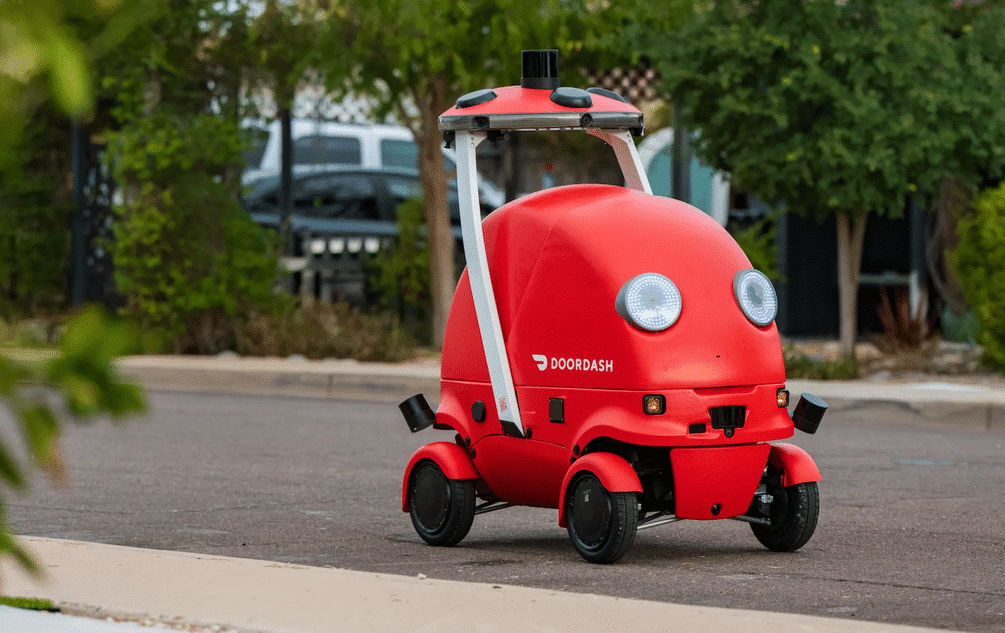
Dot is fully electric and compact enough to share sidewalks and bike infrastructure with pedestrians and cyclists. It navigates to a delivery address and completes the handoff at the door without a human driver in the loop. For DoorDash, the robot represents a way to add an autonomous layer on top of its existing courier network rather than swap one out for the other, building toward a delivery ecosystem that is both more efficient and less dependent on combustion vehicles for short-distance trips.
Honda’s Fastport Brings eQuad and Fleet Platform to New York Auto Show
Fastport, Honda’s B2B micromobility venture focused on last-mile delivery, made its New York International Auto Show debut with the Fastport eQuad and its Fleet-as-a-Service platform.
The all-electric eQuad took center stage during Media Days, with Chief of Operations Jamie Davies leading a live walkthrough and demonstration at the EV Hybrid Test Track on April 1. Established by Honda in 2023, Fastport is built around a straightforward premise: commercial operators should be able to replace traditional delivery vans one-for-one with a purpose-built electric alternative that keeps packages moving through dense urban environments without the emissions or bulk.
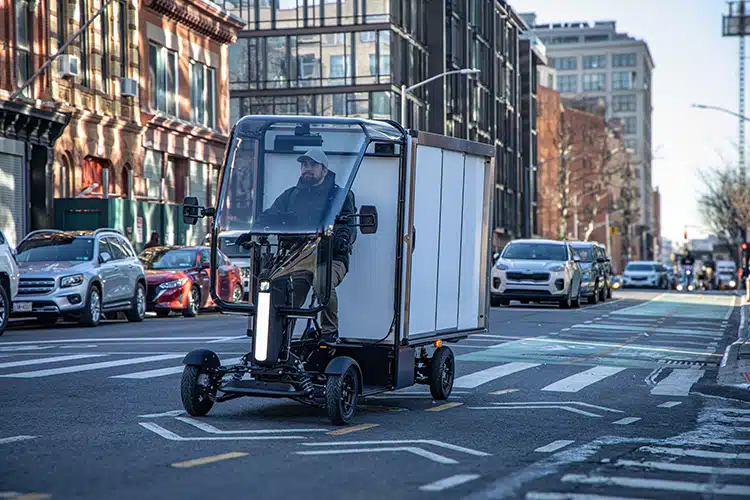
The eQuad is engineered specifically for bike-lane use and combines a pedal-by-wire assist system with Honda’s swappable Mobile Power Pack batteries and software-defined vehicle technology. Regenerative braking, modular cargo configurations, and an enclosed rider cabin round out a platform designed to be both efficient and adaptable across different delivery use cases.
The Fleet-as-a-Service model wraps the hardware into a managed solution for commercial customers, lowering the operational barrier for fleets looking to transition away from combustion vehicles on short urban routes.
More information is available at fastport.honda.com.
EVinfo.net’s Take: Why ALSO and DoorDash’s Autonomous Electric Delivery Partnership Makes Perfect Sense
Last-mile delivery has always been the hardest part of the logistics chain to get right. It is expensive, inefficient, and heavily dependent on human drivers navigating congested urban streets in vehicles that are far larger than the packages they are carrying. The partnership between ALSO and DoorDash, as well as Honda’s Fastport, take direct aim at that problem, and the timing could not be better.
The numbers behind last-mile delivery tell a familiar story. A significant share of delivery trips cover just a few miles, yet they are completed in full-size cars or vans burning fuel the entire way. The cost per delivery stays stubbornly high because labor, fuel, and vehicle wear stack up quickly on short routes run dozens of times a day. For operators like DoorDash, shaving meaningful cost out of that equation has been a long-standing challenge.
ALSO’s electric quads change the math. Built from the ground up for exactly these short, dense, urban routes, they are smaller, lighter, and cheaper to operate than anything with a combustion engine. Charging costs a fraction of what fuel does. Maintenance on a purpose-built electric platform with far fewer moving parts than a traditional vehicle stays low. And because ALSO develops its motors, batteries, software, and electrical architecture in-house, the platform can be tuned specifically for the demands of commercial delivery rather than adapted from something designed for a different purpose.
Add autonomy to that foundation and the economics shift again. A robot that can complete a delivery without a driver does not clock out, call in sick, or require insurance in the traditional sense. It runs the same route with the same consistency at two in the afternoon or two in the morning. For high-volume urban delivery, that reliability has real value. Fastport’s human drivers handle the delivery case for areas not yet ready for fully autonomous delivery.
The environmental case is just as clear. Road transportation is the largest single source of CO2 emissions, and short trips in oversized vehicles are a particularly wasteful slice of that total. Replacing even a fraction of those trips with small, fully electric autonomous vehicles moves the needle in a measurable way. Cities are taking notice. Fremont’s structured partnership with DoorDash, complete with speed limits and a formal incident response plan, reflects a growing willingness among municipalities to welcome this kind of deployment when it is done thoughtfully.
What Honda, ALSO and DoorDash are building together is not a novelty. It is a practical response to a delivery infrastructure that has needed rethinking for years. The vehicles are purpose-built, and the incentives, financial and environmental, all point in the same direction. That kind of alignment does not come along often.
Clean Air, Major Stakes: What Zero-Emission Transportation Could Mean by 2050
Last-mile delivery is a small part of overall transportation, but every little bit in the efforts for clean air helps.
A new national assessment from the American Lung Association makes the case that moving decisively away from combustion engines and fossil-fuel electricity delivers measurable benefits to public health and the climate. The findings are hard to ignore.
By 2050, a full transition to zero-emission transportation and electricity could save 110,000 lives, prevent 2.7 million asthma attacks, and generate $1.2 trillion in public health benefits. Greenhouse gas reductions would compound those gains by easing the climate-driven pressures that worsen air quality over time.
The report is clear that these outcomes are not automatic. Realizing them requires sustained leadership and investment from federal, state, and local governments, alongside public education efforts designed to ensure the clean energy transition reaches every community, not just the ones already well-positioned to benefit.

Electric Vehicle Marketing Consultant, Writer and Editor. Publisher EVinfo.net.
Services