Altilium Secures £18.5 Million to Build UK’s First Commercial Facility for Scaling EV Battery Recycling
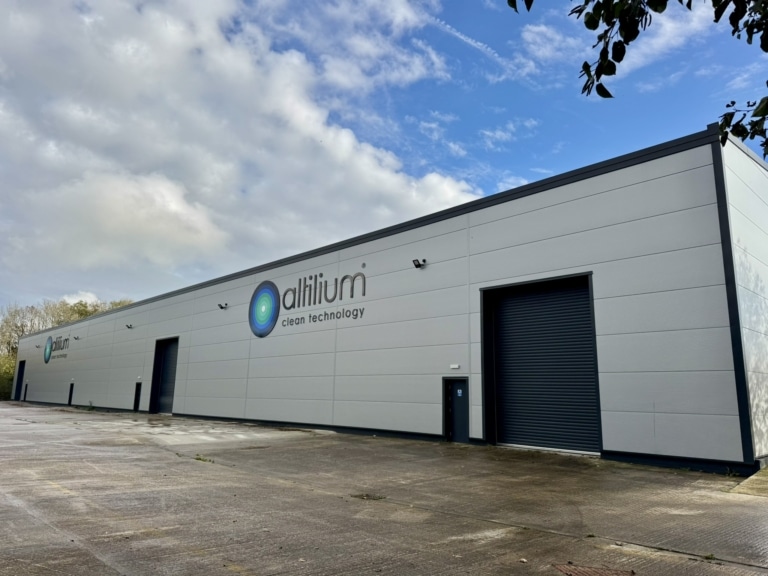
Altilium, a UK clean technology company, has secured £18.5 million in government grant funding to build the country’s first commercial refinery for recovering critical materials from end-of-life EV batteries. The facility, called ACT3, will be located in Plymouth, where Altilium already operates the UK’s only hydrometallurgical pilot plant for EV battery recycling. Construction begins in summer 2026, with commissioning planned for late 2027.
The plant will process 24,000 EV batteries per year, producing nickel mixed hydroxide precipitate, lithium sulphate, and graphite. Altilium’s proprietary EcoCathode process recovers more than 95% of cathode and anode materials from battery waste. An independent lifecycle assessment found those recycled materials carry up to 74% lower emissions than mined alternatives. The technology has already been validated through pilot projects with JLR and Nissan.
The UK currently exports all of its battery waste to Asia for processing, losing the jobs, materials, and revenues that come with refining. China dominates global lithium and graphite refining. Indonesia supplies the majority of the world’s nickel intermediates. UK lithium demand is projected to grow 1,100% by 2035. ACT3 is the first step toward a domestic supply chain that reduces that dependency.
The Plymouth facility will create 70 high-value jobs and lay the groundwork for Altilium’s larger ACT4 plant in Teesside, designed to process 150,000 EV batteries per year and produce 30,000 tonnes of cathode active materials annually, enough to meet roughly 20% of UK demand by 2030.
The grant is expected to unlock further private investment, building on the more than £17 million Altilium has already raised from SQM, Marubeni Corporation, and Mizuho Bank.
Christian Marston, Altilium COO, commented: “This funding marks a pivotal moment for Altilium and for the UK’s battery ecosystem. By scaling our recycling technology and building the UK’s first commercial facility of its kind, we are closing the loop on battery materials and enhancing the growth, productivity and competitiveness of the UK automotive supply chain. We are grateful to the APC and the UK Government for this strong vote of confidence in our technology, our team and our role in building a domestic, circular battery supply chain.”
Why EV Battery Recycling Is One of the Most Important Industrial Problems of the Next Decade
Electric vehicles are winning. Sales are climbing globally, automakers are committing hundreds of billions to electrification, and governments on both sides of the Atlantic are treating the transition as a matter of economic and national security. But underneath the optimism sits a problem that does not get enough attention: the materials inside those batteries, and what happens to them when the batteries die.
This is not a distant problem. The first wave of mass-market EVs is already aging. Batteries from early Nissan Leafs, early Teslas, and first-generation Chevy Bolts are reaching end-of-life. The wave behind them is vastly larger. By 2035, the UK alone expects 110,000 tonnes of battery scrap annually. Scale that across Europe and the United States and the numbers become staggering.
What happens to all of it matters enormously, for reasons that go well beyond environmental responsibility.
Many EV batteries reaching the end of their vehicle life still retain considerable functionality. In many cases, these batteries have more than 80 percent of their original capacity and can be repurposed for stationary applications such as home or commercial energy storage, solar integration, or backup power. Extending battery use through repurposing increases overall value and preserves much of the energy and investment embedded in their production.
A growing repurposing industry has emerged to capture this opportunity. Companies are recovering high-quality batteries from retired EVs and converting them into stationary storage systems. After repurposing, EV batteries are recycled to recover materials.
The Supply Chain Problem
EV batteries depend on a short list of critical materials: lithium, nickel, cobalt, graphite, and manganese. These are not evenly distributed around the world, and the refining capacity for most of them is even less evenly distributed than the raw ore. Battery recycling is one of the most direct ways to reduce that exposure.
China dominates the refining and processing of lithium and graphite. Indonesia is by far the largest global supplier of nickel intermediates. Congo produces the majority of the world’s cobalt. For Europe and the United States, building an EV industry on top of that supply chain is a strategic vulnerability. It means that the clean energy transition, designed in part to reduce dependence on foreign oil, risks creating a new and potentially more concentrated dependence on foreign materials and the countries that process them.
The Environmental Case
Mining is not clean. Lithium extraction consumes enormous quantities of water in some of the most arid regions on earth. Nickel and cobalt mining carry serious environmental and human rights concerns. Graphite processing generates significant air pollution. Recycled battery materials sidestep much of that.
However, even considering environmental damage from mining and battery production, EVs are still by far the cleanest of all vehicles. A comprehensive new life-cycle analysis out of many similar studies finds that electrifying light-duty vehicles (LDVs) in the United States delivers substantial greenhouse-gas reductions across every vehicle type and powertrain, even under unfavorable conditions.
For Europe, which has set binding carbon reduction targets and is building out a regulatory framework for battery sustainability, environmental issues matter both as policy and as market reality. The EU Battery Regulation, which took effect in stages from 2023, requires manufacturers to meet minimum recycled content thresholds and provide battery passports documenting the materials and carbon footprint of every battery placed on the market. Companies that cannot source recycled materials domestically will face compliance pressure. Those that can will have a structural advantage.
The Economic Case
The materials inside a used EV battery are not waste. They are inventory. A single EV battery pack contains thousands of dollars worth of recoverable nickel, lithium, and cobalt at current market prices. At scale, a commercial recycling operation is not just an environmental service. It is a materials business.
Europe and the United States are both at an early stage of building that industry. Facilities at various stages of development are coming online across Germany, France, and the United States. But capacity is still far behind what will be needed.
The companies that build the processing infrastructure now will be sitting on an increasingly valuable asset as the volume of end-of-life batteries grows through the late 2020s and into the 2030s. First movers in battery recycling are positioning themselves the way early movers in EV manufacturing did, ahead of a demand curve that only goes one direction.
The Infrastructure Gap
One of the underappreciated challenges is that battery recycling is not simple. It requires sophisticated chemistry, significant capital investment, and the ability to handle materials that are hazardous if mismanaged. Hydrometallurgical processes, which dissolve battery materials in solution and selectively recover them through chemical separation, can achieve recovery rates above 95% for key materials, but they require genuine technical expertise and industrial-scale facilities to work at acceptable cost.
Right now, the gap between the volume of batteries reaching end-of-life and the capacity to process them responsibly is being filled by exports to Asia, primarily China and South Korea. That means the materials, the jobs, and the economic value all leave. It also means that European and American recycling standards, which tend to be more stringent on environmental and labor grounds, are not being applied.
Europe and the United States both have strong reasons to build this industry at home. The materials are coming. The question is whether the infrastructure will be ready to catch them.

Electric Vehicle Marketing Consultant, Writer and Editor. Publisher EVinfo.net.
Services