Honda’s Fastport Announced a New Customer Relationship With Bird and Spin to Support Urban Fleet Operations
Honda, through its micromobility business Fastport, announced a new customer relationship with Bird and Spin to support urban fleet operations, expanding the real-world deployment of its all-electric last-mile mobility solutions. Honda announced the news on April 16, 2026.
The partnership will integrate Fastport’s eQuad vehicle and its Fleet-as-a-Service (FaaS) platform into Bird and Spin’s day-to-day operations. Initial deployments are planned across select university campuses and dense urban markets in the United States, where micromobility fleets require constant servicing, repositioning, and maintenance. These environments demand vehicles that are compact, maneuverable, and efficient under high-frequency stop-and-go conditions.
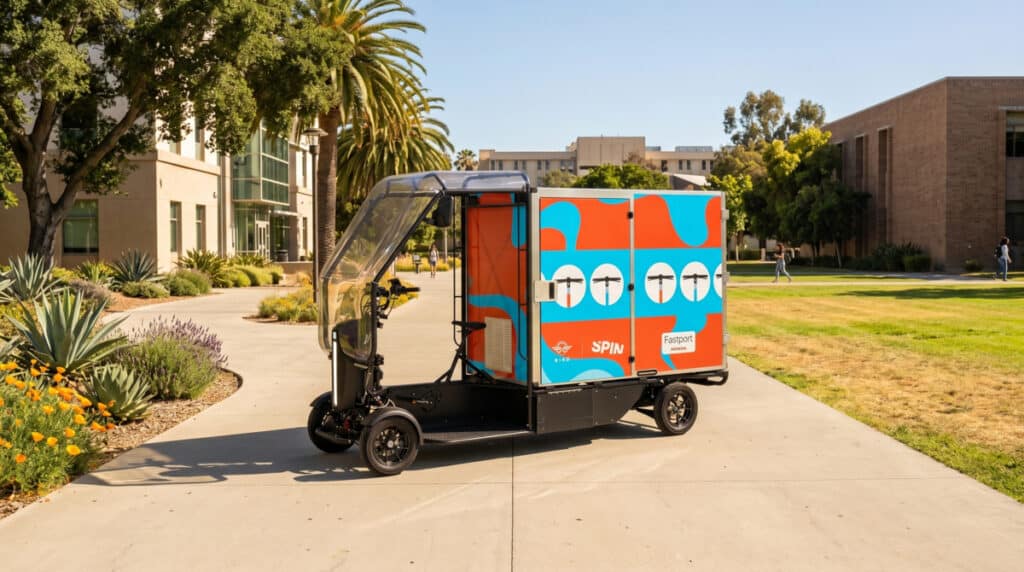
The Fastport eQuad is a purpose-built, four-wheeled, single-operator electric vehicle designed specifically for urban logistics and service applications. It is engineered to replace traditional internal combustion engine vans used in fleet support roles. The vehicle features pedal-assist functionality, a swappable battery system for continuous operation, regenerative braking, and a cargo-focused design optimized for tools, batteries, and equipment used in field service work.
Bird and Spin will deploy the eQuad to carry out core operational tasks including battery swapping for scooters and e-bikes, fleet rebalancing to ensure vehicle availability across service areas, and routine maintenance and repair activities. These tasks typically require navigating congested city streets, making frequent stops, and accessing areas that are inefficient for larger vehicles. The eQuad’s smaller footprint and electric drivetrain improve operational efficiency while reducing emissions and noise.
Fastport’s Fleet-as-a-Service platform underpins the deployment by combining vehicles with software and operational tools. The system enables real-time fleet monitoring, route optimization, vehicle diagnostics, and over-the-air updates, allowing operators to manage assets more efficiently and maintain high uptime. The integrated approach is designed to reduce total cost of ownership while simplifying fleet management complexity.
The collaboration reflects a broader industry shift toward “right-sizing” urban fleets. Instead of relying on oversized, fuel-powered service vehicles, operators are increasingly adopting smaller, task-specific electric vehicles that align with the realities of urban logistics. This transition improves efficiency, lowers operating costs, and supports sustainability goals by reducing greenhouse gas emissions.
By working with Bird and Spin, Fastport is positioning its platform within one of the most demanding use cases in urban mobility. The partnership demonstrates how purpose-built electric vehicles, combined with software-driven fleet management, can transform last-mile service operations and support the continued growth of shared micromobility systems in cities.
Bird is a U.S.-based micromobility company that operates fleets of shared electric scooters and bikes across cities globally. Its core model is simple: users locate, unlock, and ride vehicles through a mobile app for short trips, typically under a few miles. The company positions itself as a solution to urban congestion, offering a cleaner and more flexible alternative to cars. Bird has continued expanding its vehicle lineup with improved safety, performance, and accessibility features, reinforcing its role in modern urban transportation systems.
Spin, originally launched as an independent scooter and bike-share company, follows a similar operational model, deploying shared electric vehicles in cities and on campuses. It has historically emphasized partnerships with municipalities and controlled deployments to align with local transportation goals.
In 2023, Bird acquired Spin, making Spin a wholly owned subsidiary and significantly expanding Bird’s scale. The combined entity now operates across hundreds of markets with a large, diversified fleet of vehicles, strengthening its position as the largest micromobility operator in North America by market share.

Electric Vehicle Marketing Consultant, Writer and Editor. Publisher EVinfo.net.
Services