Children’s Climate Series “Steve and Eve” Debuts Worldwide on Earth Day
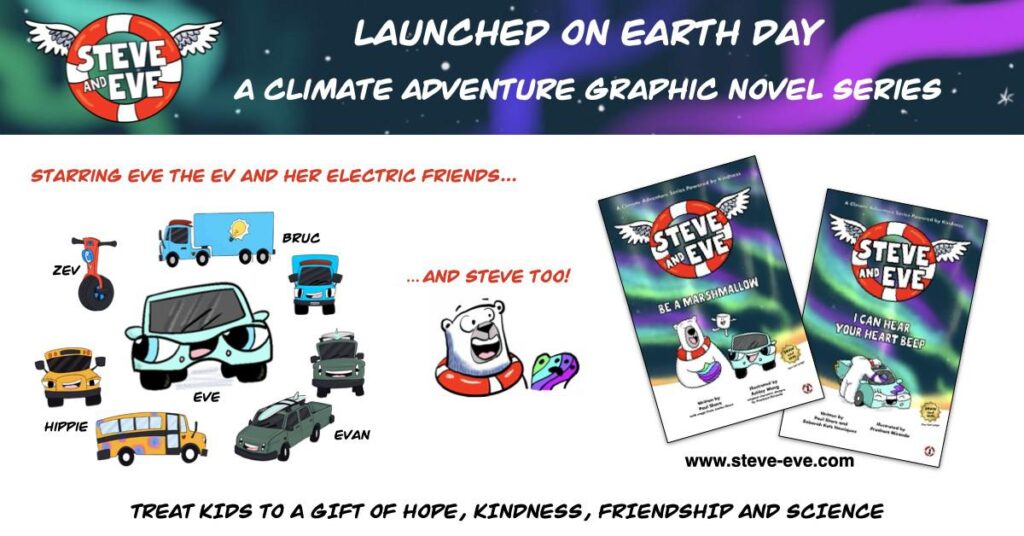
Canadian writer Paul Shore is bringing his celebrated Steve and Eve graphic novel series to a worldwide audience on Earth Day, with the release of Be a Marshmallow, the second installment in this beloved children’s climate adventure franchise. Hitting shelves simultaneously in English, French, and Spanish, the series arms young readers with optimism, laughter, and a grounded understanding of the environment.
Taking place across the fjords of Norway and the sun-scorched landscapes of California, Be a Marshmallow reunites Steve, a compassionate polar bear with extraordinary powers, and Eve, his trusty flying electric vehicle, as the duo rallies to support wildlife threatened by drought and rising temperatures. Through inventive storytelling, children encounter meaningful concepts ranging from clean energy to ecological restoration.
“Our characters face the hard realities of a warming planet with warmth, wonder, and determination,” Shore explained. “Book two teaches kids to stay centered and resilient when things get difficult — to be a marshmallow.”
The launch coincides with the opening session of the inaugural conference hosted by the Fossil Fuel Non-Proliferation Treaty initiative, connecting grassroots children’s storytelling with high-level global climate negotiations. Treaty founder Tzeporah Berman praised the book as a rare work that confronts environmental challenges honestly while leaving children feeling uplifted and capable.
This marks the first multilingual rollout for the Steve and Eve universe, opening doors for classrooms and households across the globe. The debut title, I Can Hear Your Heart Beep, has earned widespread recognition for weaving ecological awareness with wit and emotional resonance. Its French counterpart, Mon Cœur Fait Bip-Bip, had its European debut in Saint-Paul de Vence, France earlier this year.
Shore is a decorated author, seasoned engineer, and business leader headquartered in Whistler, Canada, whose career has spanned technology, athletics, and healthcare across multiple continents.
Steve and Eve: Be a Marshmallow and all titles in the series are available on Amazon.
Press Inquiries:
Paul Shore
pshore26@telus.net
www.steve-eve.com
EVinfo.net’s Take: Educating Children About Global Human Caused Climate Change and the Many Benefits of EVs is Important
EVinfo.net is proud to support Paul Shore in this important effort.
Educating children about electric vehicles (EVs) is not just about explaining a new type of car. It is about building foundational literacy in energy, technology, and environmental responsibility at a time when the world is actively confronting Climate Change driven by human activity.
At a basic level, EV education introduces kids to how energy systems work. They begin to understand the difference between fossil fuels and electricity, how emissions are created, and why reducing them matters. This naturally leads into broader concepts like renewable energy, grid infrastructure, and efficiency. When students grasp that transportation is one of the largest contributors to greenhouse gas emissions, EVs become a tangible example of how innovation can directly reduce environmental impact.
There is also a long-term behavioral component. Children who understand the benefits of EVs, such as zero tailpipe emissions, lower operating costs, and quieter urban environments, are more likely to carry those preferences into adulthood. Early exposure shapes consumer behavior, voting priorities, and career interests. It normalizes sustainability not as a niche concern, but as a baseline expectation.
Importantly, EVs serve as an accessible entry point into climate solutions. Topics like atmospheric chemistry or global carbon cycles can feel abstract, but a vehicle that plugs in instead of filling up is easy to visualize and relate to everyday life. From there, educators can expand into adjacent solutions like public transit, energy storage, and clean electricity generation, helping students see that addressing climate change requires a systems-level approach.
Education also fosters critical thinking. Not all EV discussions are simplistic or universally positive. Kids can explore questions around battery production, resource extraction, and grid demand. This balanced perspective is essential. The goal is not advocacy without nuance, but informed understanding that equips future decision-makers to improve upon current technologies.
Finally, there is an economic and workforce dimension. The transition to electrification is reshaping industries, from automotive manufacturing to energy and software. Students who are introduced early to EV technology are better positioned to participate in this shift, whether as engineers, policymakers, entrepreneurs, or informed citizens.
In practical terms, teaching children about EVs is about more than cars. It is about connecting daily life to global challenges, showing that human innovation can both contribute to and help solve problems. When done effectively, it empowers the next generation to engage with climate issues not with abstraction or fear, but with knowledge, agency, and a clearer sense of what progress looks like.

Electric Vehicle Marketing Consultant, Writer and Editor. Publisher EVinfo.net.
Services