The Ford Racing Mustang Cobra Jet 2200 Sets New Electric Drag Race Record
On April 28, 2026, Ford announced that the Ford Racing Mustang Cobra Jet 2200 achieved a low ET of 6.76 and top speed of 222 mph in the quarter mile, making it the quickest and fastest electric car in drag racing.
The outing at the NHRA 4-Wide Nationals in Charlotte carried real significance for Ford Motor Company. It was an opportunity to put the car in front of fans, racers, and media, and validate the program in the environment that matters most. The result was a 6.76-second quarter mile at 222 mph, establishing it as the quickest and fastest electric car over that distance.
Beyond the numbers, the program delivered what it was built to achieve. It provided proof of concept, generated real-world data, and sharpened understanding of how electric performance behaves under extreme conditions. The event marked both a milestone and a starting point, bringing years of development into focus while opening the door for further gains.
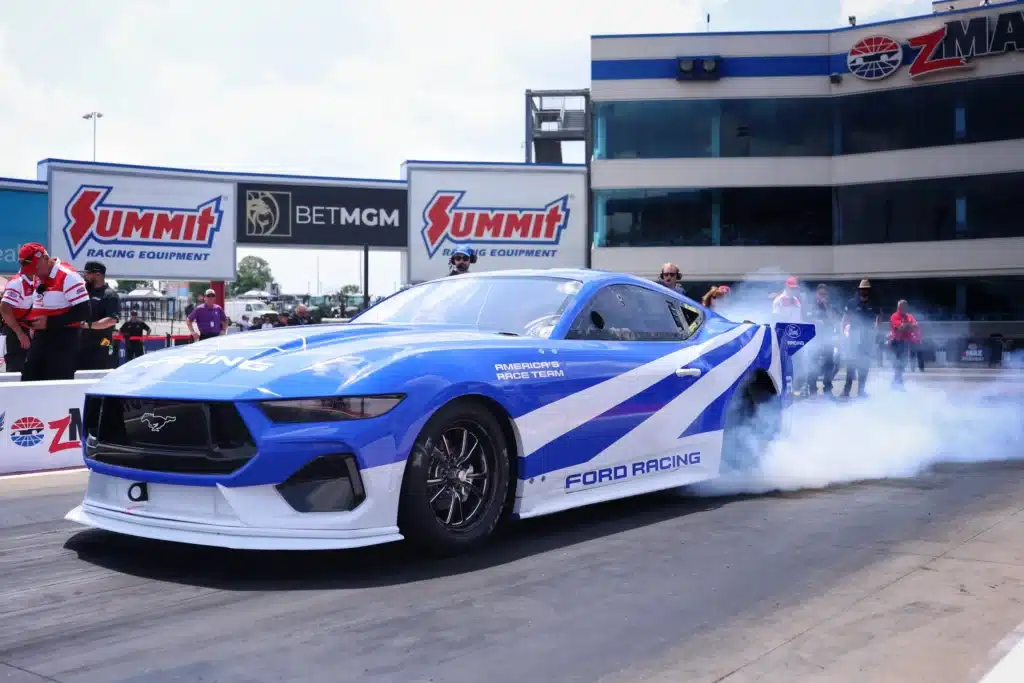
The Cobra Jet 2200 is part of a broader progression that includes the Cobra Jet 1400 and the Super Cobra Jet 1800. Each iteration expanded knowledge around power delivery, battery performance, calibration, traction, and packaging. This latest version builds on that foundation with a more refined and purpose-built approach.
The vehicle is designed to answer specific engineering questions at a high level. What happens when maximum performance is pursued within an electric platform built specifically for drag racing? How can power, traction, serviceability, and safety be managed in a system that must perform repeatedly under extreme load? The Cobra Jet 2200 addresses these questions through a tightly integrated system.
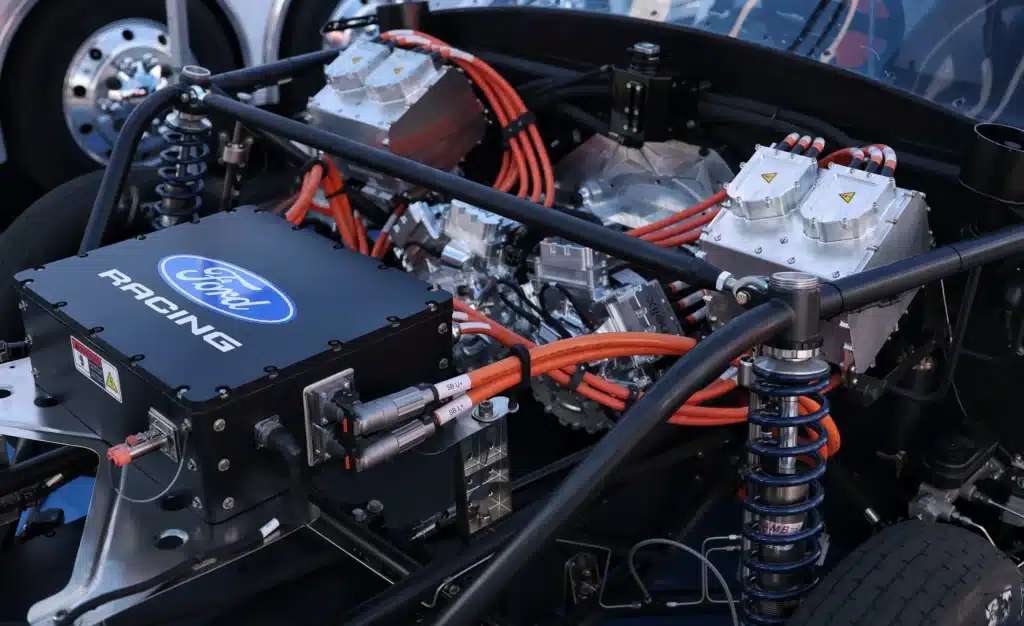
The first priority was weight reduction. Every component was evaluated with mass in mind. The car features dual 1,200 horsepower electric motors, a custom tube-frame chassis, and a carbon-fiber body. Even smaller details, such as a lightweight NASCAR-style vinyl wrap, contribute to overall reduction. The result is a platform more than 1,000 pounds lighter than the Super Cobra Jet 1800, which itself was 1,000 pounds lighter than the Cobra Jet 1400. This progression reflects a sustained focus on increasing output while reducing mass and improving efficiency.
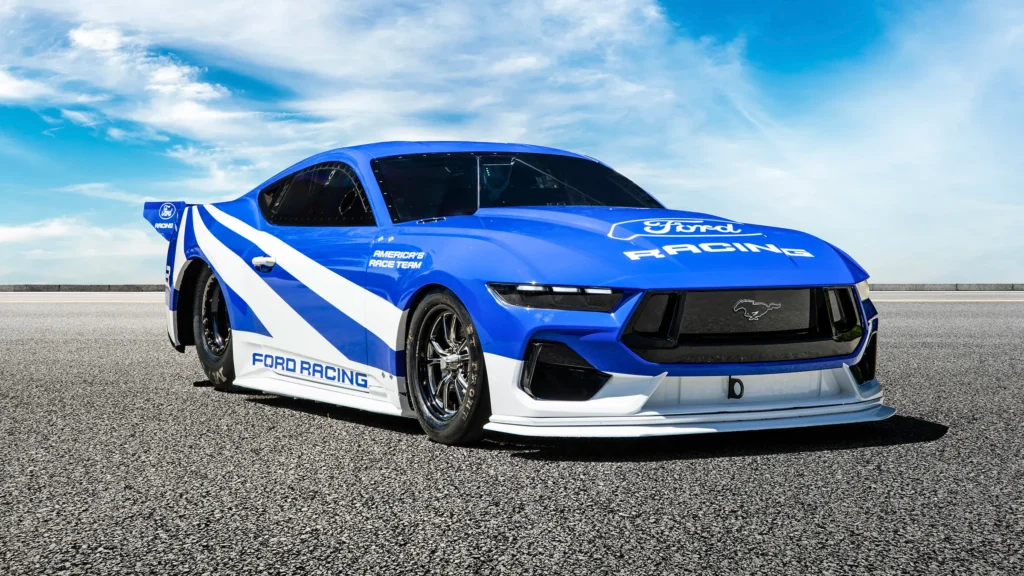
The second focus is driveline control. Delivering 2,200 horsepower and 1,340 lb-ft of torque requires more than raw output. It requires precise management. The reverse-acting centrifugal clutch, paired with a five-speed clutchless transmission, allows the car to launch in direct drive and modulate torque through shifts. This approach helps prevent tire slip and maintains stability as the run develops. While many electric vehicles rely on one or two gears, this system uses five to ensure optimal torque delivery at every moment.
The third element is safety. High-voltage systems operating at this level require integrated protection. A pyrotechnic circuit breaker isolates the system when necessary by physically interrupting the circuit. Developed in collaboration with the National Hot Rod Association, the setup includes an external cut loop that allows safety crews to activate the system if needed. This ensures that safety, control, and performance operate as a unified system.
The Cobra Jet 2200 reflects a deeper evolution in electric performance engineering. It is not only about peak output or speed, but about solving a complex set of challenges in a compressed timeframe. Every run places immediate pressure on the system, exposing results without delay.
This is why motorsports remains central to development. It forces clarity, reveals limitations, and accelerates progress. The Cobra Jet 2200 demonstrates how those principles continue to shape the future of performance, with each pass generating data and informing what comes next.
EVinfo.net’s Take: How This Applies to Everyday EV Adoption
Congrats to Ford Racing!
EVinfo.net reports news like this for several reasons.
It’s true it doesn’t have much to do with how EVs can help middle-class people like me save money and the environment at the same time through EV adoption, which is EVinfo.net‘s main focus.
However, EVs are beginning to dominate racing and sportcars. In addition to being the most eco friendly and cost effective vehicle, they are the fastest.
Last year, BYD’s U9 Extreme EV took the crown of world’s fastest production car.
Benefits of wins like Ford’s and BYD’s are several.
One, these news items bring attention to how EVs are rapidly advancing and breaking records through every part of automotive. This gets more buyers interested in driving electric.
Two, that some tech advancements like Ford and BYD’s in setting these records gradually make their way down to everyday EVs that people like me drive. And that means EVs keep getting better, their advantages over gas keep getting more obvious.

Electric Vehicle Marketing Consultant, Writer and Editor. Publisher EVinfo.net.
Services